Results by title
193 books match the query '1945-' and 6 start with o
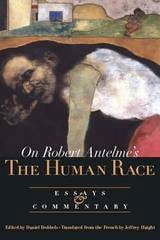
On Robert Antelme's The Human Race
Essays and CommentaryRobert Antelme
Northwestern University Press, 2003
Rescued in 1945 from Dachau—where François Mitterand, his onetime comrade in the resistance, recognized him among the thousands of quarantined prisoners—Robert Antelme set out to do what seemed "unimaginable," to describe not only his experience but the humanity of his captors. The result, The Human Race, was called by George Perec "the finest example in contemporary French writing of what literature can be."
In this volume, the extraordinary nature and extent of Robert Antelme's accomplishment, and of the reverberations he set in motion in French life and literature, finds eloquent expression. The pieces Antelme wrote for journals—including essays on "principles put to the test," man as the "basis of right," and the question of revenge—appear here alongside appreciations of The Human Race by authors from Perec to Maurice Blanchot to Sarah Kofman. Also included are Antelme's personal recollections and interviews with, among others, Dionys Mascolo (who brought Antelme back from Dachau), Marguerite Duras (Antelme's wife, who tells of his return from Germany), and Mitterand.
In this volume, the extraordinary nature and extent of Robert Antelme's accomplishment, and of the reverberations he set in motion in French life and literature, finds eloquent expression. The pieces Antelme wrote for journals—including essays on "principles put to the test," man as the "basis of right," and the question of revenge—appear here alongside appreciations of The Human Race by authors from Perec to Maurice Blanchot to Sarah Kofman. Also included are Antelme's personal recollections and interviews with, among others, Dionys Mascolo (who brought Antelme back from Dachau), Marguerite Duras (Antelme's wife, who tells of his return from Germany), and Mitterand.
Also available: Antelme's The Human Race
[more]
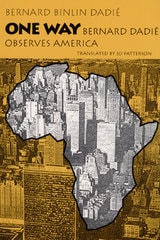
One Way
BERNARD DADIE OBSERVES AMERICABernard Binlin Dadié
University of Illinois Press, 1994
In 1959, when Un Negre a Paris first appeared, the French still held West Africa under colonial rule. Dadie's observations and subtle parodies of Parisian manners and morals are entertaining and poignant, charming yet profound.
[more]
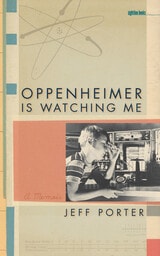
Oppenheimer Is Watching Me
A MemoirJeff Porter
University of Iowa Press, 2007
When he discovers that his father worked on missiles for a defense contractor, Jeff Porter is inspired to revisit America’s atomic past and our fallen heroes, in particular J. Robert Oppenheimer, the father of the atomic bomb. The result, Oppenheimer Is Watching Me, takes readers back to the cold war, when men in lab coats toyed with the properties of matter and fears of national security troubled our sleep. With an eye for strange symmetries, Porter traces how one panicky moment shaped the lives of a generation.
[more]
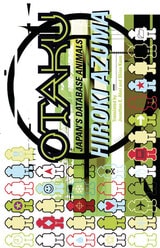
Otaku
Japan's Database AnimalsHiroki Azuma
University of Minnesota Press, 2009
In Japan, obsessive adult fans and collectors of manga and anime are known as otaku. When the underground otaku subculture first emerged in the 1970s, participants were looked down on within mainstream Japanese society as strange, antisocial loners. Today otaku have had a huge impact on popular culture not only in Japan but also throughout Asia, Europe, and the United States.
Hiroki Azuma’s Otaku offers a critical, philosophical, and historical inquiry into the characteristics and consequences of this consumer subculture. For Azuma, one of Japan’s leading public intellectuals, otaku culture mirrors the transformations of postwar Japanese society and the nature of human behavior in the postmodern era. He traces otaku’s ascendancy to the distorted conditions created in Japan by the country’s phenomenal postwar modernization, its inability to come to terms with its defeat in the Second World War, and America’s subsequent cultural invasion. More broadly, Azuma argues that the consumption behavior of otaku is representative of the postmodern consumption of culture in general, which sacrifices the search for greater significance to almost animalistic instant gratification. In this context, culture becomes simply a database of plots and characters and its consumers mere “database animals.”
A vital non-Western intervention in postmodern culture and theory, Otaku is also an appealing and perceptive account of Japanese popular culture.
[more]
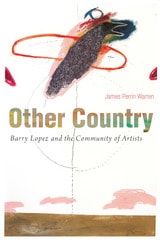
Other Country
Barry Lopez and the Community of ArtistsJames Perrin Warren
University of Arizona Press, 2015
The award-winning American environmental writer Barry Lopez has traveled extensively in remote and populated parts of the world. Lopez’s fiction and nonfiction focus on the relationship between the physical landscape and human culture, posing abiding questions about ethics, intimacy, and place.
Other Country presents a full-scale treatment of Lopez’s work. James Perrin Warren examines the relationship between Lopez’s writing and the work of several contemporary artists, composers, and musicians, whose works range from landscape photography, painting, and graphic arts to earth art, ceramics, and avant-garde music. The author demonstrates Lopez’s role in creating this community of artists who have led cultural change, and shows that Lopez’s writing—and his engagement with the natural world—creates an “other country” by redefining boundaries, rediscovering a place, and renewing our perceptions of landscapes.
Warren’s critique examines manuscripts and typescripts from the 1960s to the present, interviews with Lopez conducted from 2008 to 2013, and interviews with artists. Part 1 focuses on the relationship between Lopez’s storytelling, which he calls “a conversation with the land,” and Robert Adams’s landscape photography. For both Lopez and Adams, a worthy artistic expression serves the cultural memory of a community, reminding us how to behave properly toward other people and the land. Part 2 looks at the collaborative friendship of Lopez and visual artist Alan Magee, tracking the development of Lopez’s short stories through a consideration of Magee’s career. Part 3 moves farther afield, discussing Lopez’s relationship to Richard Long’s earth art, Richard Rowland’s ceramics, and John Luther Adams’s soundscapes.
Other Country reveals the dynamic relationships between Lopez, considered by many the most important environmental writer working in America, and the artistic community, who seek to explore the spiritual and ethical dimensions of an honorable and attentive relationship to the land and thus offer profound implications for the future of the planet.
[more]
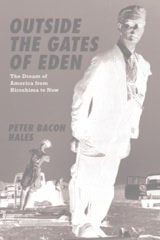
Outside the Gates of Eden
The Dream of America from Hiroshima to NowPeter Bacon Hales
University of Chicago Press, 2014
Exhilaration and anxiety, the yearning for community and the quest for identity: these shared, contradictory feelings course through Outside the Gates of Eden, Peter Bacon Hales’s ambitious and intoxicating new history of America from the atomic age to the virtual age.
Born under the shadow of the bomb, with little security but the cold comfort of duck-and-cover, the postwar generations lived through—and led—some of the most momentous changes in all of American history. Hales explores those decades through perceptive accounts of a succession of resonant moments, spaces, and artifacts of everyday life—drawing unexpected connections and tracing the intertwined undercurrents of promise and peril. From sharp analyses of newsreels of the first atomic bomb tests and the invention of a new ideal American life in Levittown; from the music emerging from the Brill Building and the Beach Boys, and a brilliant account of Bob Dylan’s transformations; from the painful failures of communes and the breathtaking utopian potential of the early days of the digital age, Hales reveals a nation, and a dream, in transition, as a new generation began to make its mark on the world it was inheriting.
Full of richly drawn set-pieces and countless stories of unforgettable moments, Outside the Gates of Eden is the most comprehensive account yet of the baby boomers, their parents, and their children, as seen through the places they built, the music and movies and shows they loved, and the battles they fought to define their nation, their culture, and their place in what remains a fragile and dangerous world.
[more]