Results by title
313 books match the query 'Administration' and 9 start with o

On the Eve of Conquest
The Chevalier de Raymond's Critique of New France in 1754Joseph L. Peyser
Michigan State University Press, 1997
In 1754, Charles de Raymond, chevalier of the Royal and Military Order of Saint Louis and a captain in the Troupes de la Marine wrote a bold, candid, and revealing expose; on the French colonial posts and settlements of New France. On the Eve of the Conquest, more than an annotated translation, includes a discussion on the historical background of the start of the French and Indian War, as well as a concise biography of Raymond and Michel Le Courtois de Surlaville, the army colonel at the French court to whom the report was sent. The events surrounding Raymond's controversial year as commandant of the post (now Fort Wayne, Indiana) in 1749-50, his disputed recall by Governor General Jacques-Pierre de Taffanel de La Jonquier, and the subsequent friction between La Jonquiere's successor, Ange de Menneville Duqesne, and Raymond are presented in detail and illustrated by translations of their correspondence.
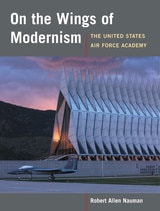
On the Wings of Modernism
The United States Air Force AcademyRobert Allen Nauman
University of Illinois Press, 2003
The United States Air Force Academy stands as one of the most extensive architectural projects of the cold war era. Key to a full understanding of American modernism, the project was also a volatile battleground involving competing ideas about aesthetics and politics. Arguing that the academy's production was squarely grounded in bureaucratic and political processes, Robert Allen Nauman demonstrates that selection of both the site and the design firm was the result of political maneuverings involving U.S. military leadership.
In the academy’s iconic design, myths and metaphors of flight and the American West were interwoven with those of modernism, both to justify the plan and to free it from any lingering socialist or European associations. Skidmore, Owings, and Merrill’s first public exhibition of plans and models for the project was designed by the former Bauhaus master Herbert Bayer, and it incorporated photographs of the Colorado Springs site by Ansel Adams and William Garnett. Using previously unexplored resources of the U.S. Air Force Academy, SOM, and the Air Force Academy Construction Agency, Nauman uncovered materials such as negatives of Adams’s original photographs of the sites. He also conducted extensive interviews with SOM’s project director for the academy, Walter Netsch, in tracing the complete history of the academy's construction, from its earliest conception to eventual completion.
One Semester Away from a Crisis
An Economist's Perspective on Leading Small CollegesWilliam T. Bogart
Rutgers University Press, 2026
Small colleges are a vital component of the United States higher education system. However, their unique characteristics are often overlooked in analyses that incorporate all colleges and universities. Many concepts familiar to economics professors but less familiar to more general audiences are helpful in understanding small colleges. These concepts include sophisticated ideas not typically covered in basic economics courses, such as regulatory capture, decision-making under uncertainty, and the logic of collective action. By combining economic theories with his own experiences leading small colleges, William T. Bogart provides a way for presidents, trustees, and other leaders of small colleges to more effectively help their institutions achieve their full potential.
Opening Ceremony
Inviting Inclusion into University GovernanceKathryn J. Gindlesparger
University of Minnesota Press, 2023
Explores how university governance is restricted by ceremony and what it must do to survive
University shared governance is a microcosm of regulation and thrives particularly on ceremony to communicate its relevance. While many investigations of university governance examine representation, Opening Ceremony offers that, instead, stakeholders’ belief in institutional values can invite revision of stagnant governance practices. Governance tells us what the rules are, but they also tell us how to feel: opening up the ceremonial communication of this system invites new participants to rewrite how universities respond to felt needs.
Kathryn J. Gindlesparger considers how to break the seal of ceremony to invite voices not traditionally heard in governance and, in doing so, protect the ideals of the institution and rebuild trust in higher education.
Organizing Professionals
Academic Employees Negotiating a New AcademyGary Rhoades
Rutgers University Press, 2025
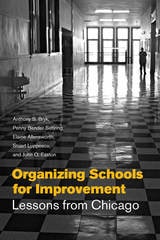
Organizing Schools for Improvement
Lessons from ChicagoAnthony S. Bryk, Penny Bender Sebring, Elaine Allensworth, Stuart Luppescu, and John Q. Easton
University of Chicago Press, 2009
In 1988, the Chicago public school system decentralized, granting parents and communities significant resources and authority to reform their schools in dramatic ways. To track the effects of this bold experiment, the authors of Organizing Schools for Improvement collected a wealth of data on elementary schools in Chicago. Over a seven-year period they identified one hundred elementary schools that had substantially improved—and one hundred that had not. What did the successful schools do to accelerate student learning?
The authors of this illuminating book identify a comprehensive set of practices and conditions that were key factors for improvement, including school leadership, the professional capacity of the faculty and staff, and a student-centered learning climate. In addition, they analyze the impact of social dynamics, including crime, critically examining the inextricable link between schools and their communities. Putting their data onto a more human scale, they also chronicle the stories of two neighboring schools with very different trajectories. The lessons gleaned from this groundbreaking study will be invaluable for anyone involved with urban education.
Our Body of Work
Embodied Administration and Teachingedited by Melissa Nicolas & Anna Sicari
Utah State University Press, 2022
Open exchanges enable complex and nuanced conversations about intersectionality and how racism, sexism, classism, and ableism (among other “isms”) create systems of power. Contributors examine how these conversations are framed around work, practices, policies, and research and identify ways to create inclusive, embodied practices in writing programs and classrooms. The collection is organized to maximize representation in the areas of race, gender, identity, ability, and class by featuring scholarly chapters followed by narratively focused interchapters that respond to and engage with the scholarly work.
The honest and emotionally powerful stories in Our Body of Work expose problematic and normalizing policies, practices, and procedures and offer diverse theories and methodologies that provide multiple paths for individuals to follow to make the academy more inclusive and welcoming for all bodies. It will be an important resource for researchers, as well a valuable addition to graduate and undergraduate syllabi on embodiment, writing instruction/pedagogy, and WPA work.
Contributors: Dena Arendall, Janel Atlas, Hayat Bedaiwi, Elizabeth Boquet, Lauren Brentnell, Triauna Carey, Denise Comer, Joshua Daniel, Michael Faris, Rebecca Gerdes-McClain, Morgan Gross, Nabila Hijazi, Jacquelyn Hoermann-Elliott, Maureen Johnson, Jasmine Kar Tang, Elitza Kotzeva, Michelle LaFrance, Jasmine Lee, Lynn C. Lewis, Mary Lourdes Silva, Rita Malenczyk, Anna Rita Napoleone, Julie Prebel, Rebecca Rodriguez Carey, Ryan Skinnell, Trixie Smith, Stacey Waite, Kelsey Walker, Shannon Walters, Isaac Wang, Jennie Young
Our Charge to Keep
Writing Center and Writing Program Administration at Historically Black Colleges and UniversitiesWonderful Faison
Utah State University Press, 2026
The first book to explore writing center (WC) and writing program (WP) administration in HBCUs, Our Charge to Keep nuances ideas of ethical tutoring, explores Black college students’ beliefs about using Black Language in academic writing, provides new theories about tutoring, and gives insights into infrastructure and challenges facing WC and WP administrators in HBCU settings.
Many writing center directors have taken up the challenge to interrogate the impact of systemic racism on writing center theory, research, pedagogy, praxes, and daily operations, but the focus has largely been on predominantly white institutions (PWIs). As a result, writing center theory and research has unintentionally excluded the practices of everyday HBCU writing centers—their pedagogies, praxes, theories, and research. This edited volume rectifies this marginality by centering the epistemologies, practices, and wisdom of HBCU writing administrators, theorists, and practitioners. Chapters examine antiracist pedagogy, first-year writing challenges, the role of the larger HBCU community, and more.
Our Charge to Keep is a collection of writings that ultimately demystifies the administration of HBCU writing centers and inspires critical curiosity about them. Dr. Wonderful and Kendra Mitchell frame and showcase the resilience of HBCU writing center directors in combating the residual impact of systemic oppression and point the way forward for PWIs to shift toward new HBCU-centered perspectives on how to institute true antiracist policies and initiatives.

Our New Husbands Are Here
Households, Gender, and Politics in a West African State from the Slave Trade to Colonial RuleEmily Lynn Osborn
Ohio University Press, 2011
In Our New Husbands Are Here, Emily Lynn Osborn investigates a central puzzle of power and politics in West African history: Why do women figure frequently in the political narratives of the precolonial period, and then vanish altogether with colonization? Osborn addresses this question by exploring the relationship of the household to the state. By analyzing the history of statecraft in the interior savannas of West Africa (in present-day Guinea-Conakry), Osborn shows that the household, and women within it, played a critical role in the pacifist Islamic state of Kankan-Baté, enabling it to endure the predations of the transatlantic slave trade and become a major trading center in the nineteenth century. But French colonization introduced a radical new method of statecraft to the region, one that separated the household from the state and depoliticized women’s domestic roles. This book will be of interest to scholars of politics, gender, the household, slavery, and Islam in African history.