Results by title
784 books match the query 'American Government' and 10 start with o

Obama's Washington
Political Leadership in a Partisan EraEdited by Clodagh Harrington
University of London Press, 2014
Oligarchy in America
Power, Justice, and the Rule of the FewLuke Winslow
University of Alabama Press, 2024
Roderick P. Hart Outstanding Book Award for the National Communication Association's Political Communication Division
A fascinating survey of the history of political and economic ideas in the US that have led to an increasingly entrenched ultra-rich class of oligarchs.
To an American, oligarchy is something that happens somewhere else. In Oligarchy in America, Luke Winslow reveals oligarchy’s deep intellectual roots and alarming growth in America. The book provides conceptual tools the lack of which have prevented Americans from recognizing oligarchy at home.
Winslow argues that generic labels like “billionaires” for a class of ultra-rich masks the pervasive structures that entrench their power. He introduces instead the concept of democratic oligarchy—an institutional arrangement in which the ultra-rich form a class consciously creating and leveraging state power to accumulate wealth.
Like a master class in political ideas, Winslow traces the intellectual lineage of oligarchy in the US. His lively and compulsively readable survey examines key rhetorical sources such as Herbert Spencer, Andrew Carnegie, Friedrich Hayek, Lewis Powell, Milton Friedman, Charles Koch, Donald Trump, Tucker Carlson, and others.
Oligarchy in America maps the connective web of oligarchic ideas uniting these disparate figures. By offering a lucid framework through which to view oligarchic ideas ambient in American culture, Winslow makes a vital contribution to readers and scholars of communication and rhetorical studies, public address, economics, and political science.
On Parliamentary War
Partisan Conflict and Procedural Change in the U.S. SenateJames I. Wallner
University of Michigan Press, 2017
On Parliamentary War
Partisan Conflict and Procedural Change in the U.S. SenateJames I. Wallner
University of Michigan Press, 2019
Dysfunction in the Senate is driven by the deteriorating relationship between the majority and minority parties. Regular order is virtually nonexistent and unorthodox parliamentary procedures are frequently needed to pass important legislation. Democrats and Republicans are fighting a parliamentary war in the Senate to steer the future of the country. James Wallner presents a bargaining model of procedural change to explain the persistence of the filibuster in this polarized environment, focusing on the dynamics responsible for contested procedural change. Wallner’s model explains why Senate majorities have historically tolerated the filibuster, even when it has defeated their agendas, despite having the power to eliminate it. It also shows why the then-Democratic majority deployed the nuclear option to eliminate the filibuster for an Obama judicial nominee in 2013. On Parliamentary War’s game-theory approach unveils the relationship between partisan conflict and procedural change in the Senate.
Oral Arguments and Coalition Formation on the U.S. Supreme Court
A Deliberate DialogueRyan C. Black, Timothy R. Johnson, and Justin Wedeking
University of Michigan Press, 2014
The U.S. Supreme Court, with its controlled, highly institutionalized decision-making practices, provides an ideal environment for studying coalition formation. The process begins during the oral argument stage, which provides the justices with their first opportunity to hear one another's attitudes and concerns specific to a case. This information gathering allows them eventually to form a coalition.
In order to uncover the workings of this process, the authors analyze oral argument transcripts from every case decided from 1998 through 2007 as well as the complete collection of notes kept during oral arguments by Justice Lewis F. Powell and Justice Harry A. Blackmun. Both justices clearly monitored their fellow justices' participation in the discussion and used their observations to craft opinions their colleagues would be likely to support. This study represents a major step forward in the understanding of coalition formation, which is a crucial aspect of many areas of political debate and decision making.

Oregon Plans
The Making of an Unquiet Land Use RevolutionSy Adler
Oregon State University Press, 2012
"Adler's story is about unusual conditions, purposeful action, dynamic personalities, and the messiness of democratic and bureaucratic processes. His conclusions reveal much about how Oregonians defined liveability in the late twentieth century." —William L. Lang, from the Preface
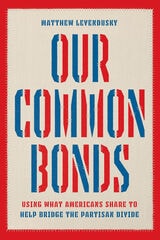
Our Common Bonds
Using What Americans Share to Help Bridge the Partisan DivideMatthew Levendusky
University of Chicago Press, 2023
One of the defining features of twenty-first-century American politics is the rise of affective polarization: Americans increasingly not only disagree with those from the other party but distrust and dislike them as well. This has toxic downstream consequences for both politics and social relationships. Is there any solution?
Our Common Bonds shows that—although there is no silver bullet that will eradicate partisan animosity—there are concrete interventions that can reduce it. Matthew Levendusky argues that partisan animosity stems in part from partisans’ misperceptions of one another. Democrats and Republicans think they have nothing in common, but this is not true. Drawing on survey and experimental evidence, the book shows that it is possible to help partisans reframe the lens through which they evaluate the out-party by priming commonalities—specifically, shared identities outside of politics, cross-party friendships, and common issue positions and values identified through civil cross-party dialogue. Doing so lessons partisan animosity, and it can even reduce ideological polarization. The book discusses what these findings mean for real-world efforts to bridge the partisan divide.
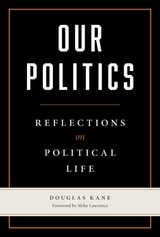
Our Politics
Reflections on Political LifeDouglas Kane, with a foreword by Mike Lawrence
Southern Illinois University Press, 2019
In Our Politics Kane reflects on his nearly fifty years of active engagement in state and local politics. In a series of essays, he seeks to understand the forces, motivations, incentives and technologies that shape our politics and produce the consequences that we live with every day. He describes how candidates and officeholders deal with the fundamental contradictions inherent in the democratic process, and how and why the political power structure has changed. He also explores the personal experience of being a legislator, from deciding how to vote to building relationships with party leaders, fellow legislators, the governor, and the voters in the district. Kane concludes by considering the possibility of change, how it might happen, and the steps that candidates, political parties, activists and others might take to better our politics with results more to our liking.
While many journalists record politics from the outside, and numerous political memoirs focus on personalities and what happened to whom and when, this book gives an insider’s view of politics at the level of state government. This book is not about those politicians but about our politics, which together we have created and together we must deal with.
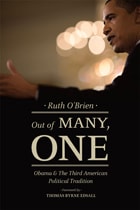
Out of Many, One
Obama and the Third American Political TraditionRuth O'Brien
University of Chicago Press, 2013
Bearing traces of Baruch Spinoza, John Dewey, and Saul Alinsky, Obama’s progressivism embraces the ideas of mutual reliance and collective responsibility, and adopts an interconnected view of the individual and the state. So, while Obama might emphasize difference, he rejects identity politics, which can create permanent minorities and diminish individual agency. Analyzing Obama’s major legislative victories—financial regulation, health care, and the stimulus package—O’Brien shows how they reflect a stakeholder society that neither regulates in the manner of the New Deal nor deregulates. Instead, Obama focuses on negotiated rule making and allows executive branch agencies to fill in the details when dealing with a deadlocked Congress. Similarly, his commitment to difference and his resistance to universal mandates underlies his reluctance to advocate for human rights as much as many on the Democratic left had hoped.
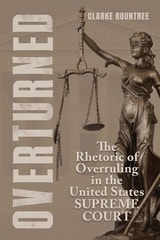
Overturned
The Rhetoric of Overruling in the United States Supreme CourtClarke Rountree
University of Alabama Press, 2025
A timely and lively summary and analysis of the Supreme Court’s justifications for overruling nearly 300 prior rulings in its history
An audacious US Supreme Court is overturning a number of long-standing precedents, and Overturned offers a lively account of the court’s history of overturning prior cases and examples and analyses of 300 cases overruled in its history.
The immense controversy surrounding the case of Dobbs v. Jackson Women’s Health Organization in 2022, which overruled Roe v. Wade and erased the constitutional right to abortion in the United States, has focused public attention on how and why the Supreme Court knocks down long-established precedents.
In his vivid and accessible style, scholar Clarke Rountree recounts the rhetorical pirouettes and linguistic acrobatics the court has deployed to explain its reversal of Dobbs and numerous other landmark decisions. He reviews strategies the court uses to undermine a previous court’s standing without undermining its own. He analyzes overrulings across time, by type (constitutional cases versus statutory and common law cases), by the ages of the overturned precedents, with changes in the court’s membership, and through other variables.
Rountree gives engrossing accounts of pivotal overrulings in the past, such as when Lincoln’s Treasury Secretary Salmon Chase used the Legal Tender Act in 1862 to raise money for the Civil War then ruled the same law unconstitutional in 1870 when he served as chief justice. Rountree retells Thomas Edison’s attempt to monopolize the burgeoning film industry, which was stopped only when the Supreme Court overturned an earlier patent-rights case in 1917. Finally, Rountree applies his myriad insights to the politically fraught Dobbs case.
Overturned makes a valuable contribution to law, rhetoric, politics, and history, and readers interested in the role and function of America’s highest court will find Rountree’s account fast-paced, lively, and engaging.