Results by title
402 books match the query 'American poetry' and 16 start with o
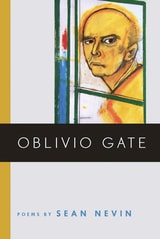
Oblivio Gate
Sean Nevin
Southern Illinois University Press, 2008
Suffused with lyrical grace and the language of loss, Sean Nevin's Oblivio Gate explores the mental and emotional struggles of Solomon, a veteran battling the onslaught of Alzheimer's disease. Set against Solomon's memories of the Korean War, Nevin's poems draw us into an intimate view of a man's confusion as everything he knows slowly unravels around him, leaving him abandoned in the suddenly unfamiliar landscape of his own mind. Readers experience first- hand Solomon's dismay as he watches himself inexorably slip away from reality, fighting to hold on to the shreds of his identity. Intertwined with his perspective are the voices of loved ones and caregivers who can only watch helplessly as Solomon is ravaged by the illness. Also central to the collection are the figures of Aurora and Tithonus, the famously doomed couple of mythology whose own happiness was destroyed by the inevitability of age and the betrayal of the body. But if this evocative portrait of Alzheimer's disease is tragic, it is also at moments inspiring.
Oblivio Gate reveals not only what is lost, but also what is found, what is pure, and even what is funny in our fleeting lives. Ultimately, Sean Nevin crafts an unforgettable collection of contemporary poetry that yields heartbreaking insight into memory, the mind, and an affliction that has left millions lost and looking for themselves.
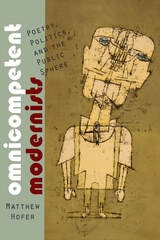
Omnicompetent Modernists
Poetry, Politics, and the Public SphereMatthew Hofer
University of Alabama Press, 2022
An innovative exploration of early twentieth-century avant-garde poetry’s relationship to the public sphere
“It is difficult / to get the news from poems / yet men die miserably every day / for lack / of what is found there,” as the poet William Carlos Williams memorably declared. In Omnicompetent Modernists: Poetry, Politics, and the Public Sphere, Matthew Hofer examines, through a multilayered literary critique of interwar modernist poetry, what it might mean to get the news, and more, from a poet.
Using pragmatist ideas about the public sphere as a tool, Hofer reveals how Langston Hughes, Ezra Pound, and Mina Loy sought to use literature to both express and enable thought. In Hughes, Pound, and Loy, Hofer attends to poets whose work vigorously imagined possible new relationships between language, thinking, and public society. Each poet had different goals and used different methods, but all found both inspiration and encouragement in popular political theory. Hughes advocated for a more just vision of color and class in the United States. Pound sought to condemn those whom he associated with public harm, linguistically, socially, economically, and politically. Loy championed the “psycho-democratic” representation of women, in both public and private life.
Although Hughes, Pound, and Loy are rarely considered together, what unites these three writers is how each reconceived the public realm, and revolutionized aesthetic form to articulate those visions. Hofer combines sharp intellectual historiography with rigorous literary criticism and the result is a study that reinvigorates both the poems and poets under consideration and speaks to the immense power of language in manipulating public opinion—with pertinent implications for the politics of the present.
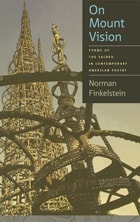
On Mount Vision
Forms of the Sacred in Contemporary American PoetryNorman Finkelstein
University of Iowa Press, 2010
Plumbing what the poet Michael Palmer calls “the dimension of the Spirit, with that troublesome, rebarbative capital letter,” Norman Finkelstein’s On Mount Vision asks how and why the sacred has remained a basic concern of contemporary experimental poets in our secular age. By charting the wandering, together and apart, of poetry and belief, Finkelstein illustrates the rich tapestry formed by the warp and woof of poetry, and the play of Gnosticism, antinomianism, spiritualism, and shamanism, which have commonly been regarded as heretical and sometimes been outright suppressed.
This beautifully written work begins with an overview of the spiritual problematics found in nineteenth- and early twentieth-century American poetry. Traveling slightly outside of the realm of the contemporary, Finkelstein’s discussions of Emerson, Whitman, and Eliot yield to close readings of the works of Robert Duncan, Jack Spicer, Ronald Johnson, Michael Palmer, Susan Howe, Nathaniel Mackey, and Armand Schwerner. In restoring verse to its place alongside scripture, Finkelstein reminds us why the sacred remains crucial to our understanding of postmodern American poetry.
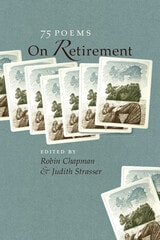
On Retirement
75 PoemsRobin Chapman
University of Iowa Press, 2007
This superb collection includes poems by men and women ranging in age from their fifties to their eighties and hailing from different cities, regions, and countries. The entire range of emotions and literary perspectives is represented here, whether the specter of death in Doug Anderson’s “Sixty One” or a sly grin in Roger Pfingston’s “Retired.”
Each poet—whether retired or just contemplating retirement—greets the prospect of this new chapter of life differently. George Bilgere purchases the complete works of Verdi and extravagant silk shirts, while Denise Levertov contemplates life alone. Alicia Ostriker implores readers to “keep on fighting, keep up the good work,” and Alberto Ríos recalls a lost love. However we contemplate retirement, this volume will illuminate the careful thoughts of those who have faced these questions before us.
Contributors Include:
Werner Aspenstrom, Chana Bloch, Philip Booth, Hayden Carruth, Lucille Clifton, Ruth Daigon, Susan Elbe, Sam Hamill, Mark Irwin, klipschutz, Ted Kooser, Maxine Kumin, Richard Moore, Naomi Shihab Nye, Grace Paley, Robert Pinsky, Carol Potter, Ishmael Reed, Claudette Mork Sigg, Ronald Wallace

On The Modernist Long Poem
Margaret Dickie
University of Iowa Press, 1986
Beyond Lionel Trilling's classic definition of Modernism as anticultural and subversive, Margaret Dickie posits American Modernist poetry as both conservative and affirmative—conservative because it was dominated by the composition of the long poem, affirmative because these poems aimed to restore public themes to poetry, to instruct and improve, to "affirm the gold thread in the pattern," as Ezra Pound claimed.
Each poet discussed in this new study—T. S. Eliot, Hart Crane, William Carlos Williams, and Ezra Pound—began his career as an experimenter in brief lyrics and then, paradoxically, developed an ambition to write a long public poem. The poems they wrote—The Waste Land, The Bridge, Paterson, and The Cantos—differed in length, in program, and in composition, but all were alike in their idealization of form, their commitment to the long poem, and the troubled and difficult process of their composition. Read together, they offer a new understanding of the Modernist sense of form shared by these quite different writers.
Tracing the development of each poem from the poet's initial announced plans through the lengthy writing and reconsideration of purpose, Dickie offers a new history not only of each poem but of the American Modernists and the ways they adapted the avant-garde tendencies of European Modernism to their own native needs.
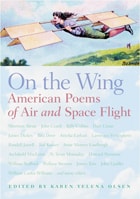
On the Wing
American Poems of Air and Space FlightOlsen, Karen Yelena
University of Iowa Press, 2005
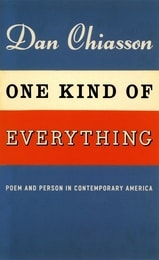
One Kind of Everything
Poem and Person in Contemporary AmericaDan Chiasson
University of Chicago Press, 2007
One Kind of Everything elucidates the uses of autobiography and constructions of personhood in American poetry since World War II, with helpful reference to American literature in general since Emerson. Taking on one of the most crucial issues in American poetry of the last fifty years, celebrated poet Dan Chiasson explores what is lost or gained when real-life experiences are made part of the subject matter and source material for poetry. In five extended, scholarly essays—on Robert Lowell, Elizabeth Bishop, Frank Bidart, Frank O’Hara, and Louise Glück—Chiasson looks specifically to bridge the chasm between formal and experimental poetry in the United States. Regardless of form, Chiasson argues that recent American poetry is most thoughtful when it engages most forcefully with autobiographical material, either in an effort to embrace it or denounce it.
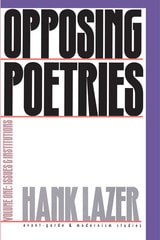
Opposing Poetries
Part One: Issues and InstitutionsHank Lazer
Northwestern University Press, 1996
Volume One examines the shift in the governing assumptions of contemporary poetic practice. Lazer inspects the key critical works addressing poetries in the 1980s and 1990s, as well as the political and aesthetic impact of modern critics, poetry reading programs, and of the publishing industry and libraries on contemporary poetic practice.
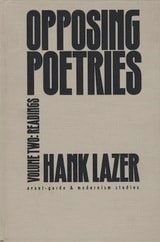
Opposing Poetries
Part Two: ReadingsHank Lazer
Northwestern University Press, 1996
In Volume Two, Lazer presents a series of sustained readings of important experimental texts. Included are the poets Susan Howe, Lyn Hejinian, Bruce Andrews, and James Sherry. Lazer places these poets in the context of contemporary literary theory, and inspects both the successes and failures of said theory to interpret these works.
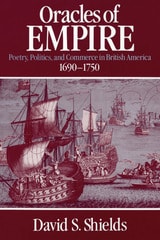
Oracles of Empire
Poetry, Politics, and Commerce in British America, 1690-1750David S. Shields
University of Chicago Press, 1990
British America's poetry of empire was dominated by three issues: mercantilism's promise that civilization and wealth would be transmitted from London to the provinces; the debate over the extent of metropolitan prerogatives in law and commerce when they obtruded upon provincial rights and interests; and the argument that Britain's imperium pelagi was an ethical empire, because it depended upon the morality of trade, while the empires of Spain and France were immoral empires because they were grounded upon conquest. In discussing these issues, Shields provides a virtual anthology of poems long lost to students of American literature.
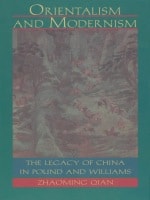
Orientalism and Modernism
The Legacy of China in Pound and WilliamsZhaoming Qian
Duke University Press, 1995
Consulting rare and unpublished materials, Qian traces Pound’s and Williams’s remarkable dialogues with the great Chinese poets—Qu Yuan, Li Bo, Wang Wei, and Bo Juyi—between 1913 and 1923. His investigation reveals that these exchanges contributed more than topical and thematic ideas to the Americans’ work and suggests that their progressively modernist style is directly linked to a steadily growing contact and affinity for similar Chinese styles. He demonstrates, for example, how such influences as the ethics of pictorial representation, the style of ellipsis, allusion, and juxtaposition, and the Taoist/Zen–Buddhist notion of nonbeing/being made their way into Pound’s pre-Fenollosan Chinese adaptations, Cathay, Lustra, and the Early Cantos, as well as Williams’s Sour Grapes and Spring and All. Developing a new interpretation of important work by Pound and Williams, Orientalism and Modernism fills a significant gap in accounts of American Modernism, which can be seen here for the first time in its truly multicultural character.
Orpheus and Company
Contemporary Poems on Greek MythologyEdited by Deborah De Nicola
Brandeis University Press, 1999
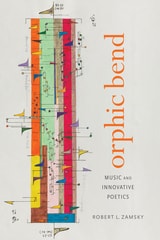
Orphic Bend
Music and Innovative PoeticsRobert L. Zamsky
University of Alabama Press, 2021
WINNER OF THE ELIZABETH AGEE PRIZE IN AMERICAN LITERATURE
Exploring how music reshapes the possibilities of poetry.
Orphic Bend: Music and Innovative Poetics explores the impact of music on recent pioneering literary practices in the United States. Adopting the myth of Orpheus as its framework, Robert L. Zamsky argues that works by Charles Bernstein, Robert Creeley, John Taggart, Tracie Morris, and Nathaniel Mackey restage ancient debates over the relationship between poetry and music even as they develop work that often sharply diverges from traditional literary forms. Opening each chapter with a consideration of the orphic roots of lyric, Zamsky integrates contemporary debates over the prospects and limitations of humanism, the meaningfulness of gesture and performance, and the nature of knowledge with the poetics of the writers under consideration, grounding his analysis in close readings of their work.
The myth of Orpheus is used as a lens throughout the book, its different facets illuminating sometimes dramatically different aspects of the shared framework of poetry and music. In the case of Bernstein, for instance, Zamsky highlights Ezra Pound’s meditations on the relationship between poetry and music (the ground upon which Pound seeks to recapture the lost possibilities of the Renaissance) and Bernstein’s incisive critique of Pound. For her part, Morris emphasizes the performative power of spoken language, foregrounding the fact that all spoken language bears cultural, communal, and personal marks of the speaker, improving an ensemble self even within the most elemental features of language. Meanwhile, in Mackey’s work, the orphic voice of the poet powerfully reaches toward an order of knowledge in which poetry and music are nearly indecipherable from one another. In this sense, music and the musicality of poetic language are the gateways for Mackey’s Gnosticism, the mechanisms of initiation into a realm, not of secrets to be learned, but of visionary knowing that continuously unfolds.
The text explores a range of musical influences on the writers under consideration, from opera to different iterations of jazz, and underscores the variety of ways in which music informs their work. Many of these writers effectively present a theory of music in their invocations of it as an inspiration for, or as an analog to, poetic practice. Zamsky’s focus on poetry and music echoes important interdisciplinary studies on literary modernism, a period for which the importance of music to literary practice is well established and extends that discussion to the contemporary context. In doing so, Orphic Bend provides an important opportunity to consider both the specific legacy of modernism, and to situate contemporary writers in broader historical contexts.
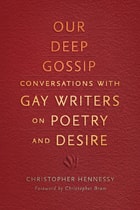
Our Deep Gossip
Conversations with Gay Writers on Poetry and DesireChristopher Hennessy; Foreword by Christopher Bram
University of Wisconsin Press, 2013
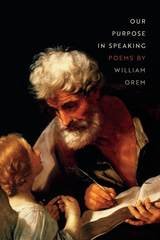
Our Purpose in Speaking
William Orem
Michigan State University Press, 2018
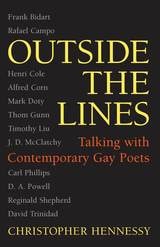
Outside the Lines
Talking with Contemporary Gay PoetsChristopher Hennessy, Editor
University of Michigan Press, 2005
---Bernard Cooper, author of Maps to Anywhere
Editor Christopher Hennessy gathers interviews with some of the most significant figures in contemporary American poetry. While each poet is gay, these encompassing, craft-centered interviews reflect the diversity of their respective arts and serve as a testament to the impact gay poets have had and will continue to have on contemporary poetics.
The book includes twelve frank, intense interviews with some of America's best-known and loved poets, who have not only enjoyed wide critical acclaim but who have had lasting impact on both the gay tradition and the contemporary canon writ large, for example, Frank Bidart, the late Thom Gunn, and J. D. McClatchy. Some of the most honored and respected poets, still in the middle of their careers, are also included, for example, Mark Doty, Carl Phillips, and Reginald Shepherd. Each interview explores the poet's complete work to date, often illuminating the poet's technical evolution and emotional growth, probing shifts in theme, and even investigating links between verse and sexuality.
In addition to a selected bibliography of works by established poets, the book also includes a list of works by newer and emerging poets who are well on their way to becoming important voices of the new millennium.