Results by title
3258 books match the query 'Art' and 75 start with o
Object Lessons
Zofia Rydet’s Sociological RecordEdited by Krzysztof Pijarski
Museum of Modern Art in Warsaw, 2017
Object Lessons, a new volume of essays inspired by an exhibition at the Museum of Modern Art in Warsaw, helps to dispel the myths that have formed around the project in recent years and introduces the photographer to a new global audience. The essays here contextualize and interpret “Sociological Record” from different perspectives, opening up the work to further inquiry as both an object of interpretation and a subject of theoretical interest. Rydet herself remained unresolved over the question of how to define her work, leaving the viewer to ponder whether her magnum opus is a piece of art or science. What does remain undisputed is that “Sociological Record” is a striking testimony of its time.
A fascinating celebration of Rydet’s work that is sure to spur on fresh debate about art as a social practice and a tool of knowledge, Object Lessons reminds us of photography’s incredible power to provide a visual way of thinking and a provocative method for archiving the world.
Object-Based Learning
Exploring Museums and Collections in EducationThomas Kador
University College London, 2025
This textbook provides an overview of some of the most important approaches to material culture and object analysis to illustrate broader themes and trends in museum studies and pedagogy. Covering diverse topics related to curatorial practice and exhibiting objects, including accessibility, curatorial ethics, colonialism and museums, audience engagement, and histories of collecting, Object-Based Learning weaves together important historical context and theoretical perspectives with practical case studies and exercises. It also includes discussion of timely issues like the role of digital technologies in teaching with objects, the psychosocial role of objects, and the use of collections in health and wellness.
Object-Oriented Feminism
Katherine Behar
University of Minnesota Press, 2016
The essays in Object-Oriented Feminism explore OOF: a feminist intervention into recent philosophical discourses—like speculative realism, object-oriented ontology (OOO), and new materialism—that take objects, things, stuff, and matter as primary. Object-oriented feminism approaches all objects from the inside-out position of being an object too, with all of its accompanying political and ethical potentials.
This volume places OOF thought in a long history of ongoing feminist work in multiple disciplines. In particular, object-oriented feminism foregrounds three significant aspects of feminist thinking in the philosophy of things: politics, engaging with histories of treating certain humans (women, people of color, and the poor) as objects; erotics, employing humor to foment unseemly entanglements between things; and ethics, refusing to make grand philosophical truth claims, instead staking a modest ethical position that arrives at being “in the right” by being “wrong.”
Seeking not to define object-oriented feminism but rather to enact it, the volume is interdisciplinary in approach, with contributors from a variety of fields, including sociology, anthropology, English, art, and philosophy. Topics are frequently provocative, engaging a wide range of theorists from Heidegger and Levinas to Irigaray and Haraway, and an intriguing diverse array of objects, including the female body as fetish object in Lolita subculture; birds made queer by endocrine disruptors; and truth claims arising in material relations in indigenous fiction and film. Intentionally, each essay can be seen as an “object” in relation to others in this collection.
Contributors: Irina Aristarkhova, University of Michigan; Karen Gregory, University of Edinburgh; Marina Gržinić, Slovenian Academy of Science and Arts; Frenchy Lunning, Minneapolis College of Art and Design; Timothy Morton, Rice University; Anne Pollock, Georgia Tech; Elizabeth A. Povinelli, Columbia University; R. Joshua Scannell, CUNY Graduate Center; Adam Zaretsky, VASTAL.
Objects in Air
Artworks and Their Outside around 1900Margareta Ingrid Christian
University of Chicago Press, 2021
Writers created an early theory of unbounded form that described what Christian calls an artwork’s ecstasis or its ability to stray outside its limits and engender its own space. Objects viewed in this perspective complicate the now-fashionable discourse of empathy aesthetics, the attention to self-projecting subjects, and the idea of the modernist self-contained artwork. For example, Christian invites us to historicize the immersive spatial installations and “environments” that have arisen since the 1960s and to consider their origins in turn-of-the-twentieth-century aesthetics. Throughout this beautifully written work, Christian offers ways for us to rethink entrenched narratives of aesthetics and modernism and to revisit alternatives.
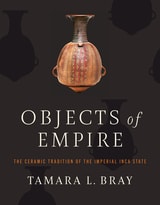
Objects of Empire
The Ceramic Tradition of the Imperial Inca StateTamara L. Bray
University of Texas Press, 2025
A comparative, empire-wide study of the ceramics associated with the imperial Inca state, theorizing the role of these highly recognizable vessel forms in legitimizing Inca rule and establishing imperial identities.
The beautiful polychrome ceramics of the imperial Inca state have long been noted for their seemingly repetitive nature but little considered beyond this basic observation. The widespread distribution and general uniformity of the Inca pottery, however, hints at its larger importance to the imperial project. Moving beyond the pervasive "seen one, seen 'em all" mentality, Objects of Empire brings to light the variability and rich semiotic content of imperial Inca vessels. Taking a comparative, empire-wide approach, Tamara Bray identifies the parameters and significance of this variability, and defines the core elements of the imperial state style. She then investigates where, when, and why differences and deviations from the perceived norm occur.
This study illuminates the strategies of territorial expansion and political control that lay at the heart of the Inca juggernaut, as well as the role of objects in the calculus of would-be rulers and subjects. Based on a unique and extensive database of imperial Inca pottery developed through detailed study of archaeologically recovered and museum-based collections, Objects of Empire reveals how power and legitimacy were produced and reproduced under the Inca through the material culture of everyday life.
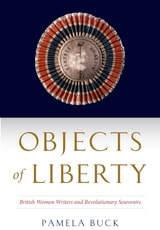
Objects of Liberty
British Women Writers and Revolutionary SouvenirsPamela Buck
University of Delaware Press, 2024
Object—Event— Performance
Art, Materiality, and Continuity Since the 1960sEdited by Hanna B. Hölling
Bard Graduate Center, 2021
Much of the artwork that rose to prominence in the second half of the twentieth century took on novel forms—such as installation, performance, event, video, film, earthwork, and intermedia works with interactive and networked components—that pose a new set of questions about what art actually is, both physically and conceptually. For conservators, this raises an existential challenge when considering what elements of these artworks can and should be preserved.
This provocative volume revisits the traditional notions of conservation and museum collecting that developed over the centuries to suit a conception of art as static, fixed, and permanent objects. Conservators and museums increasingly struggle with issues of conservation for works created from the mid-twentieth to the twenty-first century that are unstable over time. The contributors ask what it means to conserve artworks that fundamentally address and embody the notion of change and, through this questioning, guide us to reevaluate the meaning of art, of objects, and of materiality itself. Object—Event—Performance considers a selection of post-1960s artworks that have all been chosen for their instability, changeability, performance elements, and processes that pose questions about their relationship to conservation practices. This volume will be a welcome resource on contemporary conservation for art historians, scholars of dance and theater studies, curators, and conservators.
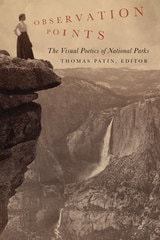
Observation Points
The Visual Poetics of National ParksThomas Patin
University of Minnesota Press, 2012
National parks are the places that present ideas of nature to Americans: Zion, Yosemite, Grand Canyon, Yellowstone bring to mind quintessential and awe-inspiring wilderness. By examining how rhetoric—particularly visual rhetoric—has worked to shape our views of nature and the “natural” place of humans, Observation Points offers insights into questions of representation, including the formation of national identity.
As Thomas Patin reveals, the term “nature” is artificial and unstable, in need of constant maintenance and reconstruction. The process of stabilizing its representation, he notes, is unavoidably political. America’s national parks and monuments show how visual rhetoric operates to naturalize and stabilize representations of the environment. As contributors demonstrate, visual rhetoric is often transparent, structuring experience while remaining hidden in plain sight. Scenic overlooks and turnouts frame views for tourists. Visitor centers, with their display cases and photographs and orientation films, provide their own points of view—literally and figuratively. Guidebooks, brochures, and other publications present still other ways of seeing. At the same time, images of America’s “natural” world have long been employed for nationalist and capitalist ends, linking expansionism with American greatness and the “natural” triumph of European Americans over Native Americans.
The essays collected here cover a wide array of subjects, including park architecture, landscape painting, public ceremonies, and techniques of display. Contributors are from an equally broad range of disciplines—art history, geography, museum studies, political science, American studies, and many other fields. Together they advance a provocative new visual genealogy of representation.
Contributors: Robert M. Bednar, Southwestern U, Georgetown, Texas; Teresa Bergman, U of the Pacific; Albert Boime, UCLA; William Chaloupka, Colorado State U; Gregory Clark, Brigham Young U; Stephen Germic, Rocky Mountain College; Gareth John, St. Cloud State U, Minnesota; Mark Neumann, Northern Arizona U; Peter Peters, Maastricht U; Cindy Spurlock, Appalachian State U; David A. Tschida, U of Wisconsin, Eau Claire; Sabine Wilke, U of Washington.
Observing Film Art
Themes from the Work of David BordwellCharlie Keil
Rutgers University Press, 2027
When David Bordwell died in 2024, he left behind a legacy of film scholarship and criticism whose influence is unmatched. Coauthor of a pair of textbooks adopted across the globe and the main force behind a blog read by thousands, Bordwell has influenced generations of film students, filmmakers, and film critics. Observing Film Art examines the breadth of Bordwell’s work through the perspectives of those who knew him best, collaborators, former students, and critics among them. This is the first collection devoted to the work of Bordwell, and it gives equal attention to each facet of his prodigious scholarship, structured to highlight his interest in theory, history, and analysis and criticism. The cornerstones of his approach to film study, including formalism, cognitivism, and historical poetics, are all examined in detail, as are key works, including The Classical Hollywood Cinema (coauthored with Kristin Thompson and Janet Staiger) and Narration in the Fiction Film.
Occupy
Three Inquiries in DisobedienceW. J. T. Mitchell, Bernard E. Harcourt, and Michael Taussig
University of Chicago Press, 2013
Odd Man Out
Readings of the Work and Reputation of Edgar DegasCarol M. Armstrong
University of Chicago Press, 1991
By reading several groups of the artist's images through the lens of a sequence of critical texts, Armstrong shows how our critical and popular expectations of Degas are overturned and subverted. Each of these groups of images is matched to different interpretive moves, each highlighting distinct themes: economics and vocation; narrative and semiotics; gender and corporeality; and the author and self. Armstrong's provocative analysis celebrates the tantalizing qualities of the artist's elusive career: the pluralism of his work, its conflation of positivistic and negational tactics, the modern and the traditional, the abstract and the representational.
"A lucid and searching study. . . . Armstrong has produced one of the most elegant and persuasive examples of the historian's use of 19th-century art criticism. In the process, she has achieved a reading of the artist which makes a difference to the way we understand the difference of Degas himself."—Neil McWilliam, Times Higher Education Supplement
"This is a brilliant, original, and beautifully articulated study. Carol Armstrong's scholarship is impressive in its richness, ambition, and sophistication: Degas's works have rarely been given such detailed, penetrating, and suggestive readings as those offered in this book."—Linda Nochlin, Yale University
"With brilliant insight and incisive analytical intelligence, Carol Armstrong introduces new ways to conceptualize the structural ambiguities of Degas's work. Her subtle and probing readings clarify the fundamental contrariness of Degas's images—their disturbing negativity, their anti-modern modernism. Odd Man Out catapults the criticism of Degas from the hinterlands of traditional art history to the foreground of contemporary critical theory in both literature and the visual arts."—Charles Bernheimer, University of Pennsylvania
Odilon Redon
Otherworldly VisionsDanielle Canter
J. Paul Getty Trust, The, 2026
Enigmatic and haunting, the work of the French Symbolist Odilon Redon (1840–1916) intrigues and entrances all who encounter it. During the first half of his career, Redon created dramatically monochromatic charcoal drawings and lithographs, dreamily dark images that plumbed the depths of his wild imagination. Eventually, however, he also turned to pastels, adopting a bold colorful palette in fantastical explorations of the natural world.
Featuring more than seventy illustrations, this publication offers an overview of Redon's career. The informative, accessible essays examine his disparate influences from the worlds of religion, mythology, literature, and music, and demonstrate why Redon’s mysterious work is an important precursor to Surrealism.
This volume is published to accompany an exhibition on view at the J. Paul Getty Museum at the Getty Center from July 14 to October 18, 2026.
Of Interest to the General Public
About a Coronation Cloak from EthiopiaMaaza Mengiste
Diaphanes, 2026
The work of Maaza Mengiste draws from voices and stories that have been excluded, from gaps that seem inexplicable, from images, objects, and places that pulse with pasts unresolved. While exploring the African collections at the Ethnological Museum of Berlin, she was struck by an elaborate coronation cloak from Ethiopia on display. Inspired by the history of the 1868 British Expedition to Abyssinia (now Ethiopia) and the burning of the palace fortress at Magdala, Of Interest to the General Public uses photography and words to reimagine the journey of the royal mantle—out of battle, through fire, over mountains, to cross the waters into Berlin.
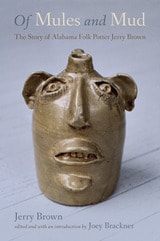
Of Mules and Mud
The Story of Alabama Folk Potter Jerry BrownJerry Brown, edited and with an introduction by Joey Brackner
University of Alabama Press, 2022
The life and times of Alabama folk potter Jerry Brown, as told in his own words
Born in 1942, Jerry Brown helped out in his father’s pottery shop as a young boy. There he learned the methods and techniques for making pottery in a family tradition dating back to the 1830s. His responsibilities included tending the mule that drove the mill that was used to mix clay (called “mud” by traditional potters). Business suffered as demand for stoneware churns, jugs, and chamber pots waned in the postwar years, and manufacture ceased following the deaths of Brown’s father and brother in the mid-1960s. Brown turned to logging for his livelihood, his skill with mules proving useful in working difficult and otherwise inaccessible terrain. In the early 1980s, he returned to the family trade and opened a new shop that relied on the same methods of production with which he had grown up, including a mule-powered mill for mixing clay and the use of a wood-fired rather than gas-fueled kiln.
Folklorist Joey Brackner met Brown in 1983, and the two quickly became close friends who collaborated together on a variety of documentary and educational projects in succeeding years—efforts that led to greater exposure, commercial success, and Brown’s recognition as a National Heritage Fellow by the National Endowment for the Arts. For years, Brown spoke of the urge to write his life story, but he never set pen to paper. In 2015, Brackner took the initiative and interviewed Brown, recording his life story over the course of a weekend at Brown’s home. Of Mules and Mud is the result of that marathon interview session, conducted one year before Brown passed away.
Brackner has captured Jerry Brown’s life in his own words as recounted that weekend, lightly edited and elaborated. Of Mules and Mud is illustrated with photos from all phases of Brown’s life, including a color gallery of 28 photos of vessel forms made by Brown throughout his career that collectors of folk pottery will find invaluable.
Of Walking in Ice
Munich-Paris, 23 November–14 December 1974Werner Herzog
University of Minnesota Press, 2015
In late November 1974, filmmaker Werner Herzog received a phone call from Paris delivering some terrible news. German film historian, mentor, and close friend Lotte Eisner was seriously ill and dying. Herzog was determined to prevent this and believed that an act of walking would keep Eisner from death. He took a jacket, a compass, and a duffel bag of the barest essentials, and wearing a pair of new boots, set off on a three-week pilgrimage from Munich to Paris through the deep chill and snowstorms of winter.
Of Walking in Ice is Herzog’s beautifully written, much-admired, yet often-overlooked diary account of that journey. Herzog documents everything he saw and felt on his quest to his friend’s bedside, from poetic descriptions of the frozen landscape and harsh weather conditions to the necessity of finding shelter in vacant or abandoned houses and the intense loneliness of his solo excursion.
Includes, for the first time, Werner Herzog’s 1982 “Tribute to Lotte Eisner” upon her receipt of the Helmut Käutner Prize
Of What One Cannot Speak
Doris Salcedo's Political ArtMieke Bal
University of Chicago Press, 2010
Doris Salcedo, a Colombian-born artist, addresses the politics of memory and forgetting in work that embraces fraught situations in dangerous places. Noted critic and theorist Mieke Bal narrates between the disciplines of contemporary culture in order to boldly reimagine the role of the visual arts. Both women are pathbreaking figures, globally renowned and widely respected. Doris Salcedo, meet Mieke Bal.
In Of What One Cannot Speak, Bal leads us into intimate encounters with Salcedo’s art, encouraging us to consider each work as a “theoretical object” that invites—and demands—certain kinds of considerations about history, death, erasure, and grief. Bal ranges widely through Salcedo’s work, from Salcedo’s Atrabiliarios series—in which the artist uses worn shoes to retrace los desaparecidos (“the disappeared”) from nations like Argentina, Chile, and Colombia—to Shibboleth, Salcedo’s once-in-a-lifetime commission by the Tate Modern, for which she created a rupture, as if by earthquake, that stretched the length of the museum hall’s concrete floor. In each instance, Salcedo’s installations speak for themselves, utilizing household items, human bones, and common domestic architecture to explore the silent spaces between violence, trauma, and identity. Yet Bal draws out even deeper responses to the work, questioning the nature of political art altogether and introducing concepts of metaphor, time, and space in order to contend with Salcedo’s powerful sculptures and installations.
An unforgettable fusion of art and essay, Of What One Cannot Speak takes us to the very core of events we are capable of remembering—yet still uncomfortably cannot speak aloud.

Off Book
Devised Performance and Higher EducationEdited by Heather Fitzsimmons Frey, Nicola Hyland, and James McKinnon
Intellect Books, 2022
In the theater industry, “off book” refers to the date by which performers are to have memorized their lines and will no longer carry their play script—the “book”—on stage. But for the authors of this volume, the question is not when the book needs to be memorized, but why is there a need to be “on” book in the first place? Practitioners of devised performance choose to compose live performances from scratch rather than follow instructions in someone else’s script; educators of devised performance prefer to practice learning, too, as a generative and creative process that can never be confused with mere memorization. In its usual context, “off book” implies that theater is (literally) authorized by the book—the dramatic text—that represents its essential core or contains its meaning. Yet the “book” is not essential, and the chapters here highlight higher education theater practices that throw away the “book” altogether, creating space for actors and learners to do more than memorize. The conventional rules and hierarchies of theater creation, research, training, and education are not always relevant, or desirable, in these contexts. Instead, the questions and practices that go beyond the “book” matter.
Lively and engaging, Off Book will be a valuable and unique resource for university students, drama educators, theater historians, and practicing devised theater artists.
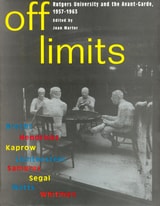
Off Limits
Rutgers University and the Avant-Garde, 1957-1963Marter, Joan
Rutgers University Press, 1999
Off Limits is the first examination of the Rutgers group, artists who came together on the Rutgers University, New Brunswick campus during the 1950s and revolutionized art practices and pedagogy. Based on interviews with artists, critics, and dealers from the period, the book connects the initiation of major trends such as Happenings, Pop Art, and Fluxus to the faculty, students, art curriculum, and events at the university. It is the first book to look not only at the work of individual artists, but to consider how interactions between these artists influenced their groundbreaking work.
Rutgers was clearly the place to be for experimental artists during the late 1950s and early 1960s. Allan Kaprow’s first Happening was presented at Rutgers. Roy Lichtenstein’s first Pop paintings, George Segal’s earliest figurative tableaux, Lucas Samaras’s radical exploration of media, and proto-Fluxus events by Robert Watts and George Brecht all took place on and around the campus. The innovative group rejected Abstract Expressionism for art based on the immediate experience of urban and industrial life, creating startling new artforms which remain startling and provocative.
Led by the theoretical writings and art practice of Kaprow, the group created a New Art—art beyond the limits of the conventional and predictable, even beyond accepted notions of progressive trends. Lichtenstein recalls in an interview, “Kaprow showed us that art didn’t have to look like art.” Along with Lichtenstein, Kaprow, Segal, and Watts taught at Rutgers and challenged one another to take art “Off Limits” — beyond the limits of the conventional, the predictable — even beyond the progressive, as defined by Abstract Expressionist gesturalism. Their art incorporated the gritty environs, the technological, the everyday, making art radical, outrageous, disturbing, and humorous.
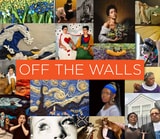
Off the Walls
Inspired Re-Creations of Iconic ArtworksSarah Waldorf
J. Paul Getty Trust, The, 2020
Van Gogh’s Starry Night made out of spaghetti? Cat with a Pearl Earring? Frida Kahlo self-portraits with pets and toilet paper? While the world reeled from the rapid spread of the novel coronavirus (COVID-19), thousands of people around the globe, inspired by challenges from Getty and other museums, raided toy chests, repurposed pantry items, and enlisted family, roommates, and animals to re-create famous works of art at home. Astonishing in their creativity, wit, and ingenuity, these creations remind us of the power of art to unite us and bring joy during troubled times. Off the Walls: Inspired Re-Creations of Iconic Artworks celebrates these imaginative re-creations, bringing highlights from this challenge together in one whimsical, irresistible volume. Getty Publications will donate all profits from the sale of this book to a charity supporting art and artists.
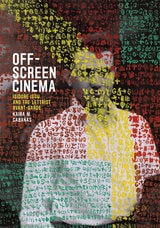
Off-Screen Cinema
Isidore Isou and the Lettrist Avant-GardeKaira M. Cabañas
University of Chicago Press, 2015
Off-Screen Cinema is the first monograph in English of the Lettrists. Offering a full portrait of the avant-garde scene of 1950s Paris, it focuses on the film works of key Lettrist figures like Gil J Wolman, Maurice Lemaître, François Dufrêne, and especially the movement's founder, Isidore Isou, a Romanian immigrant whose “discrepant editing” deliberately uncoupled image and sound. Through Cabañas's history, we see not only the full scope of the Lettrist project, but also its clear influence on Situationism, the French New Wave, the New Realists, as well as American filmmakers such as Stan Brakhage.
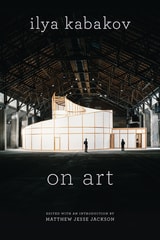
On Art
Ilya Kabakov
University of Chicago Press, 2018
Devoted to themes that range from the “cosmism” of pre-Revolutionary Russian modernism to the philosophical implications of Moscow’s garbage, Kabakov’s handmade booklets were typed out on paper, then stapled or sewn together using rough butcher paper for their covers. Among these writings are faux Socialist Realist verses, theoretical explorations, art historical analyses, accompaniments to installation projects, and transcripts of dialogues between the artist and literary theorists, critics, journalists, and other artists.
This volume offers for the first time in English the most significant texts written by Kabakov. The writings have been expressly selected for this English-language volume and there exists no equivalent work in any language.
On Art, Artists, Latin America, and Other Utopias
By Luis Camnitzer
University of Texas Press, 2009
Artist, educator, curator, and critic Luis Camnitzer has been writing about contemporary art ever since he left his native Uruguay in 1964 for a fellowship in New York City. As a transplant from the "periphery" to the "center," Camnitzer has had to confront fundamental questions about making art in the Americas, asking himself and others: What is "Latin American art"? How does it relate (if it does) to art created in the centers of New York and Europe? What is the role of the artist in exile? Writing about issues of such personal, cultural, and indeed political import has long been an integral part of Camnitzer's artistic project, a way of developing an idiosyncratic art history in which to work out his own place in the picture.
This volume gathers Camnitzer's most thought-provoking essays—"texts written to make something happen," in the words of volume editor Rachel Weiss. They elaborate themes that appear persistently throughout Camnitzer's work: art world systems versus an art of commitment; artistic genealogies and how they are consecrated; and, most insistently, the possibilities for artistic agency. The theme of "translation" informs the texts in the first part of the book, with Camnitzer asking such questions as "What is Latin America, and who asks the question? Who is the artist, there and here?" The texts in the second section are more historically than geographically oriented, exploring little-known moments, works, and events that compose the legacy that Camnitzer draws on and offers to his readers.
On Boredom
Essays in Art and WritingEdited by Rye Dag Holmboe and Susan Morris
University College London, 2021
What do we mean when we say that we are bored? Contributors to this volume, which include artists, art historians, psychoanalysts, and a novelist, examine boredom in its manifold and uncertain reality. Each part of the book takes up a crucial moment in the history of boredom and presents it in a new light, taking the reader from the trials of the consulting room to the experience of hysteria in the nineteenth century. The book pays particular attention to boredom’s relationship with the sudden and rapid advances in technology that have occurred in recent decades, specifically technologies of communication, surveillance, and automation. On Boredom is idiosyncratic for its combination of image and text, and the artworks included in its pages—featuring Mathew Hale, Martin Creed, and Susan Morris—help turn this volume into a material expression of boredom itself. It will appeal to readers in the fields of art history, literature, cultural studies, and visual culture.
On Borrowed Time
The Art and Economy of Living with DeadlinesHarald Weinrich
University of Chicago Press, 2008
Weinrich’s analysis of the roots of the word time connects it to the temples of the skull, demonstrating that humans first experienced time in the beating of their pulses. Tracing this corporeal perception of time across literary, religious, and philosophical works, Weinrich concludes that time functions as a kind of sixth sense—the crucial sense that enables the other five.
Written with Weinrich’s customary narrative elegance, On Borrowed Time is an absorbing—and, fittingly, succinct—meditation on life’s inexorable brevity.
On Broadway
Art and Commerce on the Great White WaySteven Adler
Southern Illinois University Press, 2004
At a critical, transitional moment in the history of Broadway—and, by extension, of American theatre itself—former Broadway stage manager Steven Adlerenlists insider perspectives from sixty-six practitioners and artists to chronicle the recent past and glimpse the near future of the Great White Way. From marquee names to behind-the-scenes power brokers, Adler has assembled a distinctly knowledgeable cast of theatre’s elite, including Stephen Sondheim, Arthur Laurents, Des McAnuff, Frank Rich, Robin Wagner, Rocco Landesman, Robert Longbottom, Todd Haimes, Bernard Gersten, and Alan Eisenberg.
On Broadway: Art and Commerce on the Great White Way spotlights the differing vantage points of performers, artists, writers, managers, producers, critics, lawyers, theatre owners, union leaders, city planners, and other influential players. Each details his or her firsthand account of the creative and economic forces that have wrought extraordinary changes in the way Broadway theatre is conceived, produced, marketed, and executed. Once the paramount site of American theatre, Broadway today is becoming a tourist-driven, family-friendly, middle-class entertainment oasis in Midtown, an enterprise inextricably bound to the larger mosaic of national and international professional theatre.
Accounting for this transformation and presaging Broadway’s identity for the twenty-first century, Adler and his interviewees assess the impact of the advent of corporate producers, the ascendance of not-for-profit theatres on Broadway, and the growing interdependence between regional and Broadway productions. Also critiqued are the important roles of the radical urban redevelopment staged in Times Square and the changing demographics and appetites of contemporary theatre audiences in New York and around the globe.
Actors and administrators, performers and producers, theatre students and theatregoers will all benefit from the perceptive insights in this authoritative account of theatre making for the new millennium.

On Chantal Akerman
Patricia White, special issue editor
Duke University Press, 0
Contributors. Claire Atherton, Janet Bergstrom, Kelley Conway, Sandy Flitterman-Lewis, Ute Holl, Heike Klippel, Eva Kuhn, Matias Lavin, Alisa Lebow, Brenda Longfellow, Babette Mangolte, Ivone Margulies, Michael Mazière, Eva Meyer, Sandra Percival, Jane Stein, Cécile Tourneur, Maureen Turim, Sonia Wieder-Atherton, Patricia White
On Following
Straight Lines and Infrastructural SensibilitiesIna Blom
University of Chicago Press, 2027
A cross-disciplinary examination of the relation between straight lines and sensory capacities in modern art, architecture, and music.
The human hand cannot draw a straight line, claimed nineteenth-century polymath John Ruskin. Straight lines are typically seen as incompatible with human bodies, and this is one of the reasons why their proliferation in modern art and architecture has been associated with the rational, universalist perspectives of a new industrial culture. With On Following, art historian Ina Blom traces a different genealogy of straight lines through modern and contemporary art, offering a perspective on straight-line works that addresses the close connections between the sensory capacities and experiences of human bodies and new media infrastructures. She considers what happens to aesthetic expression when bodies are surrounded by technologies that are themselves sensing systems.
Taking an expansive look at visual art, architecture, film, and music from the late nineteenth century to the present day, Blom considers practitioners including Walter De Maria, Marcel Duchamp, August Endell, Liam Gillick, Raoul Hausmann, Florian Hecker, Jenny Holzer, Ryoji Ikeda, Piero Manzoni, László Moholy-Nagy, Krzysztof Penderecki, Superstudio, Mies van der Rohe, and La Monte Young.
On Modern Art
Jean-Paul Sartre
Seagull Books, 2021
Iconic French novelist, playwright, and essayist Jean-Paul Sartre is widely recognized as one of the most important philosophers of the twentieth century, and his work has remained relevant and thought-provoking through the decades. The Seagull Sartre Library now presents some of his most incisive philosophical, cultural, and literary critical essays in twelve newly designed and affordable editions.
Sartre was a prodigious commentator on contemporary art, as is evident from the short but incisive essays that make up this important volume. Sartre examines here the work of a wide range of artists, including recognized masters such as Alberto Giacometti, Alexander Calder, and André Masson, alongside unacknowledged greats like French painter Robert Lapoujade and German painter-photographer Wols.
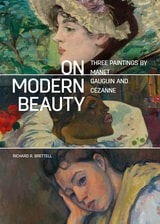
On Modern Beauty
Three Paintings by Manet, Gauguin, and CézanneRichard R. Brettell
J. Paul Getty Trust, The, 2019
Brettell shapes his manifesto around three masterworks from the collection of the J. Paul Getty Museum: Édouard Manet’s Jeanne (Spring), Paul Gauguin’s Arii Matamoe (The Royal End), and Paul Cézanne’s Young Italian Woman at a Table. The provocative discussion reveals how each of these exceptional paintings, though depicting very different subjects—a fashionable actress, a preserved head, and a weary working woman—enacts a revolutionary, yet enduring, icon of beauty.
On Obliteration
An Interview with Françoise Armengaud Concerning the Work of Sacha SosnoEmmanuel Levinas
Diaphanes, 2019
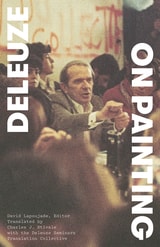
On Painting
Courses, March-June 1981Gilles Deleuze
University of Minnesota Press, 2025
Available for the first time in English: the complete and annotated transcripts of Deleuze’s 1981 seminars on painting
From 1970 until 1987, Gilles Deleuze held a weekly seminar at the Experimental University of Vincennes and, starting in 1980, at Saint-Denis. In the spring of 1981, he began a series of eight seminars on painting and its intersections with philosophy. The recorded sessions, newly transcribed and translated into English, are now available in their entirety for the first time. Extensively annotated by philosopher David Lapoujade, On Painting illuminates Deleuze’s thinking on artistic creation, significantly extending the lines of thought in his book Francis Bacon.
Through paintings and writing by Rembrandt, Delacroix, Turner, Cézanne, Van Gogh, Klee, Pollock, and Bacon, Deleuze explores the creative process, from chaos to the pictorial fact. The introduction and use of color feature prominently as Deleuze elaborates on artistic and philosophical concepts such as the diagram, modulation, code, and the digital and the analogical. Through this scrutiny, he raises a series of profound and stimulating questions for his students: How does a painter ward off grayness and attain color? What is a line without contour? Why paint at all?
Written and thought in a rhizomatic manner that is thoroughly Deleuzian—strange, powerful, and novel—On Painting traverses both the conception of art history and the possibility of color as a philosophical concept.
Retail e-book files for this title are screen-reader friendly with images accompanied by short alt text and/or extended descriptions.
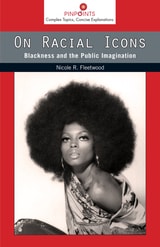
On Racial Icons
Blackness and the Public ImaginationFleetwood, Nicole R
Rutgers University Press, 2015
Nicole R. Fleetwood’s answers to these questions will change the way you think about the next photograph that you see depicting a racial event, black celebrity, or public figure. In On Racial Icons, Fleetwood focuses a sustained look on photography in documenting black public life, exploring the ways in which iconic images function as celebrations of national and racial progress at times or as a gauge of collective racial wounds in moments of crisis.
Offering an overview of photography’s ability to capture shifting race relations, Fleetwood spotlights in each chapter a different set of iconic images in key sectors of public life. She considers flash points of racialized violence in photographs of Trayvon Martin and Emmett Till; the political, aesthetic, and cultural shifts marked by the rise of pop stars such as Diana Ross; and the power and precarity of such black sports icons as Serena Williams and LeBron James; and she does not miss Barack Obama and his family along the way. On Racial Icons is an eye-opener in every sense of the phrase.
On Repetition
Writing, Performance and ArtEdited by Eirini Kartsaki
Intellect Books, 2016
On Stage
The Theatrical Dimension of Video ImageMathilde Roman
Intellect Books, 2016
On Withdrawal—Scenes of Refusal, Disappearance, and Resilience in Art and Cultural Practices
Edited by Sebastián Eduardo Dávila, Rebecca Hanna John, Ulrike Jordan, Thorsten Schneider, Judith Sieber, and Nele Wulff
Diaphanes, 2023
What forms does withdrawal—meaning either that which withdraws itself or which is being withdrawn—take in artistic and cultural practices? What movements does it create or follow in specific contexts, and with what theoretical, material, and political consequences? The contributors to this book address these questions in a variety of writing practices, each focusing on specific scenes.
Through interviews, artistic and literary texts, visual contributions, and academic texts, On Withdrawal explores various modalities of withdrawal, ranging from a silencing of critical voices to a political and aesthetic strategy of refusal.
Contributors: Arnika Ahldag, Sofia Bempeza, Lauren Berlant, Kathrin Busch, Helen Cammock, Knut Ebeling, Sebastián Eduardo Dávila, Mutlu Ergün-Hamaz, Stefanie Graefe, Rebecca Hanna John, Ulrike Jordan, Pinar Ögrenci, Pallavi Paul, Thorsten Schneider, Judith Sieber, Diana Taylor, Deniz Utlu, Marivi Véliz, Nele Wulff, and Akram Zaatari
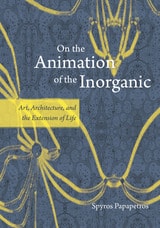
On the Animation of the Inorganic
Art, Architecture, and the Extension of LifeSpyros Papapetros
University of Chicago Press, 2012
Throughout human history, people have imagined inanimate objects to have intelligence, language, and even souls. In our secular societies today, we still willingly believe that nonliving objects have lives of their own as we find ourselves interacting with computers and other equipment. In On the Animation of the Inorganic, Spyros Papapetros examines ideas about simulated movement and inorganic life during and after the turn of the twentieth century—a period of great technical innovation whose effects continue to reverberate today.
Exploring key works of art historians such as Aby Warburg, Wilhelm Worringer, and Alois Riegl, as well as architects and artists like Fernand Léger, Mies van der Rohe, and Salvador Dalí, Papapetros tracks the evolution of the problem of animation from the fin de siècle through the twentieth century. He argues that empathy—the ability to identify with objects of the external world—was repressed by twentieth-century modernist culture, but it returned, projected onto inorganic objects such as machines, automobiles, and crystalline skyscrapers. These modern artifacts, he demonstrates, vibrated with energy, life, and desire of their own and had profound effects on people. Subtle and insightful, this book will change how we view modernist art, architecture, and their histories.
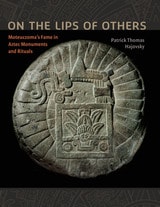
On the Lips of Others
Moteuczoma's Fame in Aztec Monuments and RitualsBy Patrick Thomas Hajovsky
University of Texas Press, 2015
Moteuczoma, the last king who ruled the Aztec Empire, was rarely seen or heard by his subjects, yet his presence was felt throughout the capital city of Tenochtitlan, where his deeds were recorded in hieroglyphic inscriptions on monuments and his command was expressed in highly refined ritual performances. What did Moteuczoma’s “fame” mean in the Aztec world? How was it created and maintained? In this innovative study, Patrick Hajovsky investigates the king’s inscribed and spoken name, showing how it distinguished his aura from those of his constituencies, especially other Aztec nobles, warriors, and merchants, who also vied for their own grandeur and fame. While Tenochtitlan reached its greatest size and complexity under Moteuczoma, the “Great Speaker” innovated upon fame by tying his very name to the Aztec royal office.
As Moteuczoma’s fame transcends Aztec visual and oral culture, Hajovsky brings together a vast body of evidence, including Nahuatl language and poetry, indigenous pictorial manuscripts and written narratives, and archaeological and sculptural artifacts. The kaleidoscopic assortment of sources casts Moteuczoma as a divine king who, while inheriting the fame of past rulers, saw his own reputation become entwined with imperial politics, ideological narratives, and eternal gods. Hajovsky also reflects on posthumous narratives about Moteuczoma, which created a very different sense of his fame as a conquered subject. These contrasting aspects of fame offer important new insights into the politics of personhood and portraiture across Aztec and colonial-period sources.
On the True Sense of Art
A Critical Companion to the Transfigurements of John SallisEdited by Jason M. Wirth, Michael Schwartz, and David Jones
Northwestern University Press, 2016
On the True Sense of Art collects essays by philosophers responding to John Sallis’s Transfigurements: On the True Sense of Art as well as his other works on the philosophy of art, including Force of Imagination and Logic of Imagination.
Each of the chapters, by some of the leading thinkers in Continental philosophy, engages Sallis’s work on both ancient and new senses of aesthetics—a transfiguration of aesthetics—as a beginning that is always beginning again. With a responsive essay by Sallis himself, On the True Sense of Art forms a critical introduction to the thought of this generation’s most important aesthetician.
One Hundred Years of Futurism
Aesthetics, Politics and PerformanceEdited by John London
Intellect Books, 2017
One Hundred Years of Futurism
Aesthetics, Politics and PerformanceEdited by John London
Intellect Books, 2017
One and Five Ideas
On Conceptual Art and ConceptualismTerry Smith
Duke University Press, 2017

Ontology Of Work Of Art
Musical Work, Picture, Arch., FilmRoman Ingarden
Ohio University Press, 1989
Ingarden elaborates upon the conception of concretization which he present in The Literary Work of Art and applies it to music and visual art. He also employs the concept of aspect to clarify the ontic structure of these art works and the distinction between the concretization of the work and the work itself. The distinction between the work’s concretization — effectuated in the mental experiences of the listener or viewer — and the work itself serves to help Ingarden confirm and account for the work’s intersubjective identity.
The problem of aesthetic value, Ingarden maintains, can be fruitfully treated only after the ontic structure of art work has been clarified. His primary concern in Ontology of the Work of Art is to ascertain and describe that structure and the mode of existence of works of art. In addition, he offers several discussions of aesthetic value, showing in the m the connections between questions of aesthetic value and the structure of the work of art.
Open Hand
Arguing as an Art of PeaceBarry M. Kroll
Utah State University Press, 2013
Kroll cultivates a bodily investigation of noncombative argument, offering direct pedagogical strategies anchored in three modalities of learning—conceptual-procedural, kinesthetic, and contemplative—and projects, activities, assignments, informal responses, and final papers for students. Kinesthetic exercises derived from martial arts and contemplative meditation and mindfulness practices are key to the approach, with Kroll specifically using movement as a physical analogy for tactics of arguing.
Collaboration, mediation, and empathy are important yet overlooked values in communicative exchange. This practical, engaging, and accessible guide for teachers contains clear examples and compelling discussions of pedagogical strategies that teach students not only how to write persuasively but also how to deal with personal conflict in their daily lives.
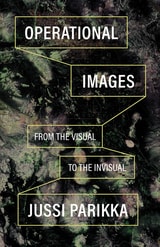
Operational Images
From the Visual to the InvisualJussi Parikka
University of Minnesota Press, 2023
An in-depth look into the transformation of visual culture and digital aesthetics
First introduced by the German filmmaker Harun Farocki, the term operational images defines the expanding field of machine vision. In this study, media theorist Jussi Parikka develops Farocki’s initial concept by considering the extent to which operational images have pervaded today’s visual culture, outlining how data technologies continue to develop and disrupt our understanding of images beyond representation.
Charting the ways that operational images have been employed throughout a variety of fields and historical epochs, Parikka details their many roles as technologies of analysis, capture, measurement, diagramming, laboring, (machine) learning, identification, tracking, and destruction. He demonstrates how, though inextricable from issues of power and control, operational images extend their reach far beyond militaristic and colonial violence and into the realms of artificial intelligence, data, and numerous aspects of art, media, and everyday visual culture.
Serving as an extensive guide to a key concept in contemporary art, design, and media theory, Operational Images explores the implications of machine vision and the limits of human agency. Through a wealth of case studies highlighting the areas where imagery and data intersect, this book gives us unprecedented insight into the ever-evolving world of posthuman visuality.
Cover alt text: Satellite photo on which white title words appear in yellow boxes. Yellow lines connect the boxes.
Optical Play
Glass, Vision, and Spectacle in Russian CultureJulia Bekman Chadaga
Northwestern University Press, 2014
Longlist finalist, 2015 Historia Nova Prize for Best Book on Russian Intellectual and Cultural History
Julia Bekman Chadaga’s ambitious study posits that glass—in its uses as a material and as captured in culture—is a key to understanding the evolution of Russian identity from the eighteenth century onward. From the contemporary perspective, it is easy to overlook how glass has profoundly transformed vision. Chadaga shows the far-reaching effects of this phenomenon.
Her book examines the similarities between glass and language, the ideological uses of glass, and the material’s associations with modernity, while illuminating the work of Lomonosov, Dostoevsky, Zamyatin, and Eisenstein, among others. In particular, Chadaga explores the prominent role of glass in the discourse around Russia’s contentious relationship with the West—by turns admiring and antagonistic—as the nation crafted a vision for its own future. Chadaga returns throughout to the spectacular aspect of glass and shows how both the tendentious capacity and the playfulness of this material have shaped Russian culture.
Orange Alert
essays on poetry, art, and the architecture of silenceKazim Ali
University of Michigan Press, 2010
"Orange Alert is a poetic and yogic salvo across the bows of our defensive imperial posturing. Kazim Ali's essays leap deftly from homages to avant-garde artists (Yoko Ono, Agnes Martin, John Cage) to awestruck meditations on ancient architecture, from analyses of poets (Jane Cooper, Agha Shahid Ali, Mahmoud Darwish, Lucille Clifton) to twitter aphorisms. Orange Alert is a revelation, a salve, an invitation to breathe again."
---Philip Metres, Associate Professor, Department of English, John Carroll University
"With their delicacy of attention and bold range of subjects, Kazim Ali's essays hold many quiet surprises. In each art he searches for insight and craft---the virtues of his own patient writing."
---Susan Stewart, Chancellor, Academy of American Poets; and Professor, Princeton University
"Kazim Ali's essays, like his poems, are alive with curiosity and humanity. . . . Orange Alert makes a compelling case for the necessity of poetry on a planet wracked by war and devastation."
---Timothy Yu, Associate Professor, English and Asian American Studies, University of Wisconsin-Madison
A volume in the Poets on Poetry series, which collects critical works by contemporary poets, gathering together the articles, interviews, and book reviews by which they have articulated the poetics of a new generation.
Whether he is discussing the way cell phones have altered physical intimacy and introduced new verb forms, or the way Emily Dickinson's mysteries are more clearly revealed in French translation, Kazim Ali is at once clear and complex, rigorous and charming, accessible and demanding.
In Orange Alert, Ali discusses poets including Agha Shahid Ali, Jane Cooper, Bhanu Kapil, Semezdin Mehmedinovic, and Samuel Beckett. He considers painters Agnes Martin and Piet Mondrian, musicians Alice Coltrane and Yoko Ono, and philosophers Slavoj Žižek and Jean Baudrillard. Ali links the poetic endeavor to such diverse texts as Moby-Dick, Battlestar Galactica, and Marilyn Buck's prison journals.
Ali discusses contemporary poetry in relation to other art forms and to contemporary television; film; and electronic media, including the Internet, YouTube, and Facebook.
He shines a light on the intersections between cultures in these essays on the craft of poetry, offering a hand to poets either geographically or metaphorically outside the mainstream of Western culture.
Kazim Ali is the author of two books of poetry, The Far Mosque and The Fortieth Day; two novels, Quinn's Passage and The Disappearance of Seth; and a memoir, Bright Felon: Autobiographyand Cities. He is Assistant Professor of Creative Writing at Oberlin College. He has been a regular columnist for American Poetry Review.
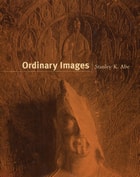
Ordinary Images
Stanley K. Abe
University of Chicago Press, 2002
Situating his study in the gaps between conventional categories such as Buddhism, Daoism, and Chinese popular art, Abe examines works—including some of the earliest known examples of Buddha-like images in China—that were commissioned by patrons of modest standing and produced by nameless artists and artisans. Sophisticated and lucidly written, Ordinary Images offers an unprecedented exploration of the lively and diverse nature of image making and popular practices.
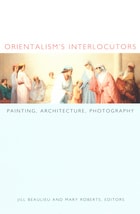
Orientalism's Interlocutors
Painting, Architecture, PhotographyJill Beaulieu and Mary Roberts, eds.
Duke University Press, 2002
Looking at the political significance of cross-cultural encounters refracted through the visual languages of Orientalism, the contributors engage with pressing recent debates about indigenous agency, postcolonial identity, and gendered subjectivities. The very range of artists, styles, and forms discussed in this collection broadens contemporary understandings of Orientalist art. Among the artists considered are the Algerian painters Azouaou Mammeri and Mohammed Racim; Turkish painter Osman Hamdi; British landscape painter Barbara Bodichon; and the French painter Henri Regnault. From the liminal "Third Space" created by mosques in postcolonial Britain to the ways nineteenth-century harem women negotiated their portraits by British artists, the essays in this collection force a rethinking of the Orientalist canon.
This innovative volume will appeal to those interested in art history, theories of gender, and postcolonial studies.
Contributors. Jill Beaulieu, Roger Benjamin, Zeynep Çelik, Deborah Cherry, Hollis Clayson, Mark Crinson, Mary Roberts
Origins of Pre-Columbian Art
By Terence Grieder
University of Texas Press, 1982
Since Columbus first called the natives of the Americas “Indians,” the sources of their art and culture have been a puzzle. The strange mixture of objects of Asian appearance with those decidedly un-Asian has provided fuel for controversy between those who see the American cultures as products of diffusion and those who see them as independent inventions. Origins of Pre-Columbian Art cuts through this old dispute to provide a fresh look at ancient cultural history in the Americas and the Pacific basin.
Using evidence from archaeology, ethnology, and psychology, Terence Grieder suggests that contact between individuals across cultural borders is the root of both invention and diffusion. By tracing the spread of early symbolic techniques, materials, and designs from Europe and Asia to the lands of the Pacific and to the Americas, he displays the threads woven through humanity’s common cultural heritage.
While archaeology provides examples of ancient symbols, ethnology reveals widely separated modern peoples still using these symbols and giving them similar meanings. Mapping these patterns of use and meaning, the author describes three waves of migration from Asia to the Americas, each carrying its own cluster of ideas and the symbols that expressed them.
First Wave cultures focused on their environment and on the human body, inventing symbols that compared people and nature. Second Wave symbolism emphasized the center and the periphery: the village and the horizon; the tree or pole as world axis; and the world’s rim, where spirits exist. These cultures created masks to give form to those beings beyond the horizon. The heavens were finally incorporated into the system of symbols by Third Wave peoples, who named the celestial bodies as gods, treasured heaven-colored stones, and represented the world in pyramids.
Emphasizing the interpretation of art in its many forms, Grieder has found that such seemingly minor decorations as bark cloth clothing and tattoos have deep meaning. Ancient art, he argues, was the vehicle for ancient science, serving to express insights into biology, astronomy, and the natural world.
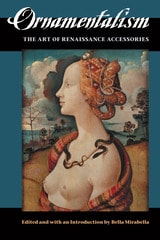
Ornamentalism
The Art of Renaissance AccessoriesEdited and with an Introduction by Bella Mirabella
University of Michigan Press, 2011
Lively, well-written, and richly illustrated with color plates, Ornamentalism will appeal to scholars of the material past and social practice, and those interested in fashion studies, manners and morals, gender and sexuality, theater and performance.