490 books match the query 'Asian' and 11 start with o
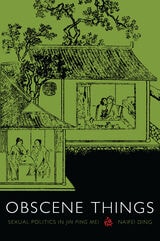
cover of Obscene Things: Sexual Politics in Jin Ping Mei

Obscene Things

Sexual Politics in Jin Ping Mei

Naifei Ding

Duke University Press, 2002

In Obscene Things Naifei Ding intervenes in conventional readings of Jin Ping Mei, an early scandalous Chinese novel of sexuality and sexual culture. After first appearing around 1590, Jin Ping Mei was circulated among some of China’s best known writers of the time and subsequently was published in three major recensions. A 1695 version by Zhang Zhupo became the most widely read and it is this text in particular on which Ding focuses. Challenging the preconceptions of earlier scholarship, she highlights the fundamental misogyny inherent in Jin Ping Mei and demonstrates how traditional biases—particularly masculine biases—continue to inform the concerns of modern criticism and sexual politics.
The story of a seductive bondmaid-concubine, sexual opportunism, domestic intrigue, adultery and death, Jin Ping Mei has often been critiqued based on the coherence of the text itself. Concentrating instead on the processes of reading and on the social meaning of this novel, Ding looks at the various ways the tale has been received since its first dissemination, particularly by critiquing the interpretations offered by seventeenth-century Ming literati and by twentieth-century scholars. Confronting the gender politics of this “pornographic” text, she troubles the boundaries between premodern and modern readings by engaging residual and emergent Chinese gender and hierarchic ideologies.
[more]
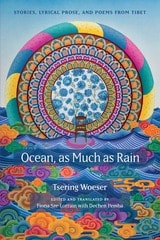
cover of Ocean, as Much as Rain: Stories, Lyrical Prose, and Poems from Tibet

Ocean, as Much as Rain

Stories, Lyrical Prose, and Poems from Tibet

Tsering Woeser. Edited and Translated by Fiona Sze-Lorrain with Dechen Pemba.

Duke University Press, 2026
Ocean, as Much as Rain presents for the first time in the English-language world a collection of masterfully translated literary writings by prominent Tibetan writer Tsering Woeser. In these stories, lyrical essays, and poetry, Woeser interweaves texts, photographs, silences, and documentary details. Featuring a distinctively imaginative use of satire and digressive rhetoric, Woeser’s stories bring to life Tibetan characters whose lives are entwined with politics, history, and religion. Woeser illuminates the ruins and places that she has come across during her various sojourns in Chinese-ruled Tibet, reviving sites from the past of her parents and their generation. These writings range from ingenious retellings of cultural encounters and confrontation to insightful commentaries on ecological issues and tourism in Tibet that never shun contradictions, dilemmas, or questions about the future. With an introduction by Fiona Sze-Lorrain and an author interview by editors-translators Sze-Lorrain and Dechen Pemba, Ocean, as Much as Rain is a landmark publication that celebrates the work of a steadfast dissident and a leading Tibetan literary figure of our times.
[more]
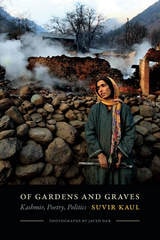
cover of Of Gardens and Graves: Kashmir, Poetry, Politics

Of Gardens and Graves

Kashmir, Poetry, Politics

Suvir Kaul

Duke University Press, 2017

In Of Gardens and Graves Suvir Kaul examines the disruption of everyday life in Kashmir in the years following the region's pervasive militarization in 1990. Kaul's autobiographical and analytical essays, which were prompted by his yearly visits to Kashmir, are a combination of political analysis, literary criticism, memoir, and journalistic observation. In them he explores Kashmir's pre- and post-Partition history, the effects of militarization, state repression, the suspension of civil rights on Kashmiris, and the challenge Kashmir represents to the practice of democracy in India. The volume also features translations of Kashmiri poetry written in these years of conflict. These poems constitute an archive of heightened feelings and desires that affectively interrogate official accounts of Kashmir while telling us much about those who face extraordinary political turbulence and violence. Of Gardens and Graves also contains a photo essay by Javed Dar, whose photographs work together with Kaul's essays and the poems to represent the interweaving of ordinary life, civic strife, and spectacular violence in Kashmir.
[more]
cover of On the Bullet Train with Emily Brontë: Wuthering Heights in Japan

On the Bullet Train with Emily Brontë

Wuthering Heights in Japan

Judith Pascoe

University of Michigan Press, 2017

While teaching in Japan, Judith Pascoe was fascinated to discover the popularity that Emily Brontë’s novel Wuthering Heights has enjoyed there. Nearly 100 years after its first formal introduction to the country, the novel continues to engage the imaginations of Japanese novelists, filmmakers, manga artists and others, resulting in numerous translations, adaptations, and dramatizations. On the Bullet Train with Emily Brontë is Pascoe’s lively account of her quest to discover the reasons for the continuous Japanese embrace of Wuthering Heights, including quite varied and surprising adaptations of the novel. At the same time, the book chronicles Pascoe’s experience as an adult student of Japanese. She contemplates the multiple Japanese translations of Brontë, as contrasted to the single (or non-existent) English translations of major Japanese writers. Carrying out a close reading of a distant country’s Wuthering Heights, Pascoe begins to see American literary culture as a small island on which readers are isolated from foreign literature.
 
In this and in her previous book, The Sarah Siddons Audio Files, Pascoe’s engaging narrative innovates a new scholarly form involving immersive research practice to attempt a cross-cultural version of reader-response criticism. On the Bullet Train with Emily Brontë will appeal to scholars in the fields of 19th-century British literature, adaptation studies, and Japanese literary history.

[more]
cover of Opposing Democracy in the Digital Age: The Yellow Shirts in Thailand

Opposing Democracy in the Digital Age

The Yellow Shirts in Thailand

Aim Sinpeng

University of Michigan Press, 2021

Opposing Democracy in the Digital Age is about why ordinary people in a democratizing state oppose democracy and how they leverage both traditional and social media to do so. Aim Sinpeng focuses on the people behind popular, large-scale antidemocratic movements that helped bring down democracy in 2006 and 2014 in Thailand. The yellow shirts (PAD—People’s Alliance for Democracy) that are the focus of the book are antidemocratic movements grown out of democratic periods in Thailand, but became the catalyst for the country’s democratic breakdown. Why, when, and how supporters of these movements mobilize offline and online to bring down democracy are some of the key questions that Sinpeng answers. While the book primarily uses a qualitative methodological approach, it also uses several quantitative tools to analyze social media data in the later chapters. This is one of few studies in the field of regime transition that focuses on antidemocratic mobilization and takes the role of social media seriously.
[more]
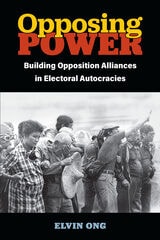
cover of Opposing Power: Building Opposition Alliances in Electoral Autocracies

Opposing Power

Building Opposition Alliances in Electoral Autocracies

Elvin Ong

University of Michigan Press, 2022
Opposing Power argues that perceptions of regime vulnerability and mutual dependency by opposition elites shape the building of opposition alliances. When electoral autocracies are consistently dominant, opposition parties eschew fully fledged alliances. At best, they allocate only one candidate to contest against the incumbent in each subnational electoral district to avoid splitting the opposition vote. However, when multiple regime-debilitating events strike within a short period of time, thus pushing an incumbent to the precipice of power, opposition elites expect victory, accepting costly compromises to build alliances and seize power. Opposing Power shows how oppositions build these alliances through case study comparisons in East and Southeast Asia—between the Philippines and South Korea in the late 1980s, and between Malaysia and Singapore from 1965 to 2020.
[more]
cover of Ordinary Images

Ordinary Images

Stanley K. Abe

University of Chicago Press, 2002

This richly illustrated book explores the large body of sculpture, paintings, and other religious imagery produced for China's common classes from the third to the sixth centuries C.E. In contrast to the works made for imperial patrons, illustrious monastics, or other luminaries, these ordinary images-modest in scale, mass produced, and at times incomplete-were created for those of lesser standing. Because they cannot be related to well-known historical figures or social groups, these images have been considered a largely nebulous, undistinguished mass of works.

Situating his study in the gaps between conventional categories such as Buddhism, Daoism, and Chinese popular art, Abe examines works—including some of the earliest known examples of Buddha-like images in China—that were commissioned by patrons of modest standing and produced by nameless artists and artisans. Sophisticated and lucidly written, Ordinary Images offers an unprecedented exploration of the lively and diverse nature of image making and popular practices.

[more]
cover of Oriental Philosophy

Oriental Philosophy

Stuart C. Hackett

University of Wisconsin Press, 1979

This insightful explication of oriental philosophy meets a long felt need for a critical introduction to four systems of eastern thought—Confucianism, Taoism, Buddhism, and Hinduism—presented in familiar western terms.

Students of comparative religion, eastern philosophy and civilization, and the philosophy of religion who have been trained in traditional western modes of thought often find the intuitive and aphorisic quality of eastern writing a major stumbling block to understanding. This is eastern philosophy presented to westerners by a westerner, a practical and understandable guide for students and for others who wish to expand their understanding in this important area.
[more]
cover of Orientalism's Interlocutors: Painting, Architecture, Photography

Orientalism's Interlocutors

Painting, Architecture, Photography

Jill Beaulieu and Mary Roberts, eds.

Duke University Press, 2002

Until now, Orientalist art—exemplified by paintings of harems, slave markets, or bazaars—has predominantly been understood to reflect Western interpretations and to perpetuate reductive, often demeaning stereotypes of the exotic East. Orientalism's Interlocutors contests the idea that Orientalist art simply expresses the politics of Western domination and argues instead that it was often produced through cross-cultural interactions. Focusing on paintings and other representations of North African and Ottoman cultures, by both local artists and westerners, the contributors contend that the stylistic similarities between indigenous and Western Orientalist art mask profound interpretive differences, which, on examination, can reveal a visual language of resistance to colonization. The essays also demonstrate how marginalized voices and viewpoints—especially women's—within Western Orientalism decentered and destabilized colonial authority.

Looking at the political significance of cross-cultural encounters refracted through the visual languages of Orientalism, the contributors engage with pressing recent debates about indigenous agency, postcolonial identity, and gendered subjectivities. The very range of artists, styles, and forms discussed in this collection broadens contemporary understandings of Orientalist art. Among the artists considered are the Algerian painters Azouaou Mammeri and Mohammed Racim; Turkish painter Osman Hamdi; British landscape painter Barbara Bodichon; and the French painter Henri Regnault. From the liminal "Third Space" created by mosques in postcolonial Britain to the ways nineteenth-century harem women negotiated their portraits by British artists, the essays in this collection force a rethinking of the Orientalist canon.

This innovative volume will appeal to those interested in art history, theories of gender, and postcolonial studies.

Contributors. Jill Beaulieu, Roger Benjamin, Zeynep Çelik, Deborah Cherry, Hollis Clayson, Mark Crinson, Mary Roberts
[more]
cover of Origins of Modern Japanese Literature

Origins of Modern Japanese Literature

Karatani Kojin

Duke University Press, 1993

Since its publication in Japan ten years ago, Origins of Modern Japanese Literature has become a landmark book, playing a pivotal role in defining discussions of modernity in that country. Against a history of relative inattention on the part of Western translators to modern Asian critical theory, this first English publication is sure to have a profound effect on current cultural criticism in the West. It is both the boldest critique of modern Japanese literary history to appear in the post-war era and a major theoretical intervention, which calls into question the idea of modernity that informs Western consciousness.
In a sweeping reinterpretation of nineteenth-and twentieth-century Japanese literature, Karatani Kojin forces a reconsideration of the very assumptions underlying our concepts of modernity. In his analysis, such familiar terms as origin, modern, literature, and the state reveal themselves to be ideological constructs. Karatani weaves many separate strands into an argument that exposes what has been hidden in both Japanese and Western accounts of the development of modern culture. Among these strands are: the "discovery" of landscape in painting and literature and its relation to the inwardness of individual consciousness; the similar "discovery" in Japanese drama of the naked face as another kind of landscape produced by interiority; the challenge to the dominance of Chinese characters in writing; the emergence of confessional literature as an outgrowth of the repression of sexuality and the body; the conversion of the samurai class to Christianity; the mythologizing of tuberculosis, cancer, and illness in general as a producer of meaning; and the "discovery" of "the child" as an independent category of human being.
A work that will be important beyond the confines of literary studies, Karatani's analysis challenges basic Western presumptions of theoretical centrality and originality and disturbs the binary opposition of the "West" to its so-called "other." Origins of Modern Japanese Literature should be read by all those with an interest in the development of cultural concepts and in the interrelating factors that have determined modernity.
[more]
cover of of Women: 20 Japanese Female Poets / 20 Waka Poems

of Women

20 Japanese Female Poets / 20 Waka Poems

Edited by Naoko Fujimoto

Tupelo Press, 2026

A collection of translated Japanese waka-poems, including text collage and haibun-style discourses on translation.

Of Women is a collection of translations of Japanese waka-poems from the seventh century to the twelfth century, featuring twenty female poets from this period, when Japanese women’s literature flourished. This book includes poems by famous writers from the era, such as Sei Shonagon (The Pillow Book) and Murasaki Shikibu (The Tale of Genji), and introduces some lesser-known female poets as well. 

Waka compacts much information in a short form: words with double meanings, unfamiliar phrases, habits foreign to non-Japanese speakers, and hidden historical backgrounds. Direct translations would fail to capture the author’s full intent, so Of Women takes several approaches to capture the original sensory images, including text collage and haibun, short essays that provide historical context and introduce the author before each waka.
[more]