109 books match the query 'Astronomy' and 5 start with o
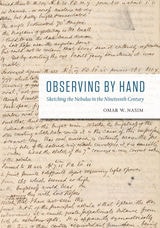
cover of Observing by Hand: Sketching the Nebulae in the Nineteenth Century

Observing by Hand

Sketching the Nebulae in the Nineteenth Century

Omar W. Nasim

University of Chicago Press, 2013
Today we are all familiar with the iconic pictures of the nebulae produced by the Hubble Space Telescope’s digital cameras. But there was a time, before the successful application of photography to the heavens, in which scientists had to rely on handmade drawings of these mysterious phenomena.
           
Observing by Hand sheds entirely new light on the ways in which the production and reception of handdrawn images of the nebulae in the nineteenth century contributed to astronomical observation. Omar W. Nasim investigates hundreds of unpublished observing books and paper records from six nineteenth-century observers of the nebulae: Sir John Herschel; William Parsons, the third Earl of Rosse; William Lassell; Ebenezer Porter Mason; Ernst Wilhelm Leberecht Tempel; and George Phillips Bond. Nasim focuses on the ways in which these observers created and employed their drawings in data-driven procedures, from their choices of artistic materials and techniques to their practices and scientific observation. He examines the ways in which the act of drawing complemented the acts of seeing and knowing, as well as the ways that making pictures was connected to the production of scientific knowledge.
           
An impeccably researched, carefully crafted, and beautifully illustrated piece of historical work, Observing by Hand will delight historians of science, art, and the book, as well as astronomers and philosophers.
[more]
cover of On Sunspots

On Sunspots

Galileo Galilei and Christoph Scheiner

University of Chicago Press, 2010

Galileo’s telescopic discoveries, and especially his observation of sunspots, caused great debate in an age when the heavens were thought to be perfect and unchanging. Christoph Scheiner, a Jesuit mathematician, argued that sunspots were planets or moons crossing in front of the Sun. Galileo, on the other hand, countered that the spots were on or near the surface of the Sun itself, and he supported his position with a series of meticulous observations and mathematical demonstrations that eventually convinced even his rival.


On Sunspots collects the correspondence that constituted the public debate, including the first English translation of Scheiner’s two tracts as well as Galileo’s three letters, which have previously appeared only in abridged form. In addition, Albert Van Helden and Eileen Reeves have supplemented the correspondence with lengthy introductions, extensive notes, and a bibliography. The result will become the standard work on the subject, essential for students and historians of astronomy, the telescope, and early modern Catholicism.
[more]
cover of Origin and Evolution of Planetary and Satellite Atmospheres

Origin and Evolution of Planetary and Satellite Atmospheres

Edited by S. K. Atreya, J. B. Pollack, and M.S. Matthews

University of Arizona Press, 1989
An integrated discussion of the similarities and differences between the atmospheres of various bodies of the solar system, including the Earth.
[more]
cover of Origin of the Earth and Moon

Origin of the Earth and Moon

Edited by R. M. Canup and K. Righter

University of Arizona Press, 2000

The age-old question of how our home planet and its satellite originated has in recent times undergone a minor revolution. The emergence of the "giant impact theory" as the most successful model for the origin of the Moon has been difficult to reconcile with some aspects of the Earth, and the development of an integrated model for the origin of the Earth-Moon system has been difficult for this reason. However, recent technical advances in experimental and isotopic work, together with intensified interest in the modeling of planetary dynamics, have produced a wealth of new results requiring a rethinking of models for the origin of the Earth and Moon.

This book is intended to serve as a resource for those scientists working closely in this field, while at the same time it provides enough balance and depth to offer an introduction for students or technically minded general readers. Its thirty chapters address isotopic and chemical constraints on accretion, the dynamics of terrestrial planet formation, the impact-triggered formation of the Earth-Moon system, differentiation of the Earth and Moon, the origin of terrestrial volatiles, and conditions on the young Earth and Moon.

Covering such subjects as the history and origin of the Moon's orbit, water on the Earth, and the implications of Earth-Moon interactions for terrestrial climate and life, the book constitutes a state-of-the-art overview of the most recent investigations in the field. Although many advances have been made in our ability to evaluate competing models of the formation of the Earth-Moon system, there are still many gaps in our understanding. This book makes great strides toward closing those gaps by highlighting the extensive progress that has been made and pointing toward future research.
[more]
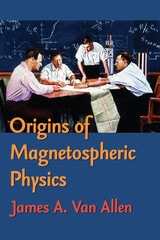
cover of Origins Of Magnetospheric Physics: An Expanded Edition

Origins Of Magnetospheric Physics

An Expanded Edition

James A. Van Allen

University of Iowa Press, 2004

Early in 1958, instruments on the space satellites Explorer I and Explorer III revealed the presence of radiation belts, enormous populations of energetic particles trapped in the magnetic field of the earth. Originally published in 1983 but long out of print until now, Origins of Magnetospheric Physics tells the story of this dramatic and hugely transformative period in scientific and Cold War history. Writing in an accessible style and drawing on personal journals, correspondence, published papers, and the recollections of colleagues, James Van Allen documents a trail-blazing era in space history
[more]