Results by title
428 books match the query 'Authorship' and 8 start with o
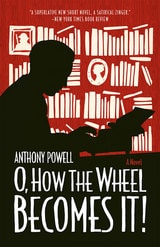
O, How the Wheel Becomes It!
A NovelAnthony Powell
University of Chicago Press, 2015
Written at the peak of the late British master’s extraordinary literary career, this novel offers profound insight into the mind of a great artist whose unequaled style, ear for dialogue, and eye for irony will delight devotees and new readers alike.
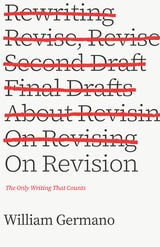
On Revision
The Only Writing That CountsWilliam Germano
University of Chicago Press, 2021
So you’ve just finished writing something? Congratulations! Now revise it. Because revision is about getting from good to better, and it’s only finished when you decide to stop. But where to begin? In On Revision, William Germano shows authors how to take on the most critical stage of writing anything: rewriting it.
For more than twenty years, thousands of writers have turned to Germano for his insider’s take on navigating the world of publishing. A professor, author, and veteran of the book industry, Germano knows what editors want and what writers need to know: Revising is not just correcting typos. Revising is about listening and seeing again. Revising is a rethinking of the principles from the ground up to understand why the writer is doing something, why they’re going somewhere, and why they’re taking the reader along with them.
On Revision steps back to take in the big picture, showing authors how to hear their own writing voice and how to reread their work as if they didn’t write it. On Revision will show you how to know when your writing is actually done—and, until it is, what you need to do to get it there.
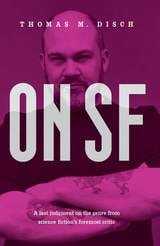
On SF
Thomas M. Disch
University of Michigan Press, 2005
"One of the most remarkably talented writers around."
---Washington Post Book World
"[Disch] is without doubt one of the really bright lights on the American SF scene."
---Fantasy and Science Fiction
This collection by the much-loved and lauded science-fiction writer Thomas Disch spans twenty-five years of his career, during which he has supplemented his creative output with reviews and critical essays in publications as diverse as the Nation, the New York Times Book Review, the Atlantic Monthly, and Twilight Zone.
Disch's perspectives on his genre are skeptical, novel, and often incendiary. The volume's opening essay, for example, characterizes writers of science fiction as "the provincials of literature." Other essays explore science fiction's roots-Poe, Bradbury, Clarke, Asimov, Vonnegut-as well as modern practitioners such as Stephen King, Philip Dick, Robert Heinlein, L. Ron Hubbard, and William Gibson.
Disch entertains and provokes with essays on UFOs, Science Fiction as a Church, and Newt Gingrich's Futurist Brain Trust. Close Encounters of the Third Kind and Madame Blavatsky also get the Disch treatment. Throughout, the writing is lively, agile, and irreverent, exhibiting an incisive honesty that is undiluted by Disch's own attachments as a sci-fi practitioner. On SF will appeal equally to lovers of science fiction and connoisseurs of the finest critical prose.
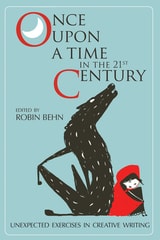
Once Upon a Time in the Twenty-First Century
Unexpected Exercises in Creative WritingEdited by Robin Behn
University of Alabama Press, 2020
Inspiring writers through creativity, experimentation, and unexpected discovery.
Once Upon a Time in the Twenty-First Century: Unexpected Exercises in Creative Writing is a unique creative writing text that will appeal to a wide range of readers and writers—from grade nine through college and beyond. Successful creative writers from numerous genres constructed these exercises, including poetry, fiction, and creative nonfiction to one-act plays, song lyrics, genre fiction, travel guides, comics and beyond. The exercises use a broad range of creative approaches, aesthetics, and voices, all with an emphasis on demystifying the writing process and having fun.
Editor Robin Behn has divided the book into three writing sections: Genres and Forms, Sources and Methods, and Style and Subject. In each section, Behn offers a brief introduction which explains how to get started and specific ways to develop one’s writing. Each introduction is followed by extensive exercises that draw on literature from classic to contemporary, as well as other art forms and popular culture. Examples range from Flannery O’Connor and Langston Hughes to Allen Ginsberg and Gertrude Stein, from Jamaica Kincaid and James Joyce to Arlo Guthrie and Harryette Mullen. Integrated within the exercises are apt examples of student writings that have emerged from actual use of the exercises in both the classroom and in writing groups. The book concludes with general advice and direction on how to get published.
Based on years of hands-on experiences in the teaching of creative writing in high schools, colleges, and after-school writing clubs, this volume of exercises offers inestimable value to students and teachers in the traditional classroom, as well as a growing number of homeschoolers, those who are part of a writing club or group, and independent writers and learners of all ages.
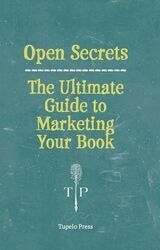
Open Secrets
The Ultimate Guide to Marketing Your BookTupelo Press
Tupelo Press, 2021
• This handbook will prepare you to take the lead in executing your own publicity plan. It is designed to guide you, step-by-step, through the process of making a success of your book. It’s jam-packed with the essential tools, ideas, and resources you’ll need to achieve that goal, from an independent publisher who has provided a launching pad for authors like Ilya Kaminsky, Aimee Nezhukumatathil, Jennifer Michael Hecht, Maggie Smith, Matthew Zapruder, and 250 others.
• Thoroughly and joyfully embrace the notion of self-promotion, knowing that it’s the book—your book—you’re breathing life into. You wouldn’t have written and published your book if you didn’t believe in it, and in yourself, as a writer with important artistic talent to share. Your publisher believes in you. Your family and friends believe in you. Your current readers believe in you. And future readers will believe in you.
Jeffrey Levine, Publisher, Tupelo Press
You’ll learn the essentials for book marketing as an indie author in a digital age:
• Develop your author image and brand across social channels
• Create an engaging social media presence
• Grow your audience and meaningfully connect with them
• Build an attractive, searchable website—no coding skills needed
• Launch a publicity campaign that gets you reviews
• Ensure your book is on bookstore and library shelves
• Practice mindful literary citizenship
• Learn from Tupelo authors (who were in your shoes not too long ago!)
Originality, Imitation, and Plagiarism
Teaching Writing in the Digital AgeCaroline Eisner and Martha Vicinus, Editors
University of Michigan Press, 2008
"At long last, a discussion of plagiarism that doesn't stop at 'Don't do it or else,' but does full justice to the intellectual interest of the topic!"
---Gerald Graff, author of Clueless in Academe and 2008 President, Modern Language Association
This collection is a timely intervention in national debates about what constitutes original or plagiarized writing in the digital age. Somewhat ironically, the Internet makes it both easier to copy and easier to detect copying. The essays in this volume explore the complex issues of originality, imitation, and plagiarism, particularly as they concern students, scholars, professional writers, and readers, while also addressing a range of related issues, including copyright conventions and the ownership of original work, the appropriate dissemination of innovative ideas, and the authority and role of the writer/author. Throughout these essays, the contributors grapple with their desire to encourage and maintain free access to copyrighted material for noncommercial purposes while also respecting the reasonable desires of authors to maintain control over their own work.
Both novice and experienced teachers of writing will learn from the contributors' practical suggestions about how to fashion unique assignments, teach about proper attribution, and increase students' involvement in their own writing. This is an anthology for anyone interested in how scholars and students can navigate the sea of intellectual information that characterizes the digital/information age.
"Eisner and Vicinus have put together an impressive cast of contributors who cut through the war on plagiarism to examine key specificities that often get blurred by the rhetoric of slogans. It will be required reading not only for those concerned with plagiarism, but for the many more who think about what it means to be an author, a student, a scientist, or anyone who negotiates and renegotiates the meaning of originality and imitation in collaborative and information-intensive settings."
---Mario Biagioli, Professor of the History of Science, Harvard University, and coeditor of Scientific Authorship: Credit and Intellectual Property in Science
"This is an important collection that addresses issues of great significance to teachers, to students, and to scholars across several disciplines. . . . These essays tackle their topics head-on in ways that are both accessible and provocative."
---Andrea Lunsford, Louise Hewlett Nixon Professor of English, Claude and Louise Rosenberg Jr. Fellow, and Director of the Program in Writing and Rhetoric at Stanford University and coauthor of Singular Texts/Plural Authors: Perspectives on Collaborative Writing
digitalculturebooks is an imprint of the University of Michigan Press and the Scholarly Publishing Office of the University of Michigan Library dedicated to publishing innovative and accessible work exploring new media and their impact on society, culture, and scholarly communication. Visit the website at www.digitalculture.org.
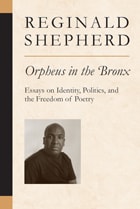
Orpheus in the Bronx
Essays on Identity, Politics, and the Freedom of PoetryReginald Shepherd
University of Michigan Press, 2010
"Orpheus in the Bronx not only extols the freedom language affords us; it embodies that freedom, enacting poetry's greatest gift---the power to recognize ourselves as something other than what we are. These bracing arguments were written by a poet who sings."
---James Longenbach
A highly acute writer, scholar, editor, and critic, Reginald Shepherd brings to his work the sensibilities of a classicist and a contemporary theorist, an inheritor of the American high modernist canon, and a poet drawing and playing on popular culture, while simultaneously venturing into formal experimentation.
In the essays collected here, Shepherd offers probing meditations unified by a "resolute defense of poetry's autonomy, and a celebration of the liberatory and utopian possibilities such autonomy offers." Among the pieces included are an eloquent autobiographical essay setting out in the frankest terms the vicissitudes of a Bronx ghetto childhood; the escape offered by books and "gifted" status preserved by maternal determination; early loss and the equivalent of exile; and the formation of the writer's vocation. With the same frankness that he brings to autobiography, Shepherd also sets out his reasons for rejecting "identity politics" in poetry as an unnecessary trammeling of literary imagination. His study of the "urban pastoral," from Baudelaire through Eliot, Crane, and Gwendolyn Brooks, to Shepherd's own work, provides a fresh view of the place of urban landscape in American poetry.
Throughout his essays---as in his poetry---Shepherd juxtaposes unabashed lyricism, historical awareness, and in-your-face contemporaneity, bristling with intelligence.
Othermindedness
The Emergence of Network CultureMichael Joyce
University of Michigan Press, 2001
Michael Joyce's new collection continues to examine the connections between the poles of art and instruction, writing and teaching in the form of what Joyce has called theoretical narratives, pieces that are both narratives of theory and texts in which theory often takes the form of narrative. His concerns include hypertext and interactive fiction, the geography of cyberspace, and interactive film, and Joyce here searches out the emergence of network culture in spaces ranging from the shifting nature of the library to MOOs and other virtual spaces to life along a river.
While in this collection Joyce continues to be one of our most lyrical, wide-ranging, and informed cultural critics and theorists of new media, his essays exhibit an evolving distrust of unconsidered claims for newness in the midst of what Joyce calls "the blizzard of the next," as well as a recurrent insistence upon grounding our experience of the emergence of network culture in the body.
Michael Joyce is Associate Professor of English, Vassar College. He is author of a number of hypertext fictions on the web and on disk, most notably Afternoon: A Story.
His previous books are Of Two Minds: Hypertext Pedagogy and Poetics and Moral Tale and Meditations: Technological Parables and Refractions.