Results by title
96 books match the query 'Buddhism' and 6 start with o
Ocean, as Much as Rain
Stories, Lyrical Prose, and Poems from TibetTsering Woeser. Edited and Translated by Fiona Sze-Lorrain with Dechen Pemba.
Duke University Press, 2026
Of Beggars and Buddhas
The Politics of Humor in the Vessantara Jataka in ThailandKatherine A. Bowie
University of Wisconsin Press, 2020
The Vessantara Jataka has served both monastic and royal interests, encouraging parents to give their sons to religious orders and intimating that kings are future Buddhas. But, as Bowie shows, characterizations of the beggar Jujaka in various regions and eras have also brought ribald humor and sly antiroyalist themes to the story. Historically, these subversive performances appealed to popular audiences even as they worried the conservative Bangkok court. The monarchy sporadically sought to suppress the comedic recitations. As Thailand has changed from a feudal to a capitalist society, this famous story about giving away possessions is paradoxically being employed to promote tourism and wealth.
Once a Peacock, Once an Actress
Twenty-Four Lives of the Bodhisattva from Haribhatta's "Jatakamala"Haribhatta
University of Chicago Press, 2017
Haribhatta’s Jåtakamålå is a sophisticated and personal adaptation of popular stories, mostly non-Buddhist in origin, all illustrating the future Buddha’s single-minded devotion to the good of all creatures, and his desire, no matter what his incarnation—man, woman, peacock, elephant, merchant, or king—to assist others on the path to nirvana. Haribhatta’s insight into human and animal behavior, his astonishing eye for the details of landscape, and his fine descriptive powers together make this a unique record of everyday life in ancient India as well as a powerful statement of Buddhist ethics. This translation will be a landmark in the study of Buddhism and of the culture of ancient India.
Once the Buddha Was a Monkey
Arya Sura's "Jatakamala"Arya Sùra
University of Chicago Press, 1989
Written most probably in the fourth century A.D., the Jatakamala is generally considered the masterpiece of Buddhist literature in Sanskrit. In elegant, courtly style, Arya Sura retells thirty-four traditional stories about the Buddha in his previous incarnations, human and animal. Whether as a king, a brahmin, a monkey, or a hare, the Great One is shown in assiduous pursuit of virtue and compassion. Though primarily intended as exemplary tales illustrating the Buddhist virtues, these stories also provide a vivid picture of life at a high point in ancient Indian culture—city life in ordinary households or at the royal court, and country life against a backdrop of mountain, desert, and jungle.
Fresh study of the Sanskrit manuscripts, now scattered in libraries all over the world, has enabled Peter Khoroche to make this new translation faithful to the original in both style and content. His explanatory notes will assist student and general reader alike in appreciating this classic from an ancient and exotic civilization.
“One would be a fool not to welcome the chance to read this book.”—Richard Gombrich, Journal of the Royal Asiatic Society
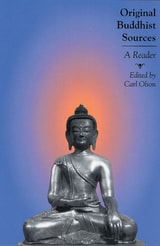
Original Buddhist Sources
A ReaderOlson, Carl
Rutgers University Press, 2005
Bringing together essential materials on the origins and development of Buddhist traditions from India, Sri Lanka, Tibet, China, and Japan, this anthology provides the broadest selection of primary source Buddhist literature available to date.
The volume is divided into two major parts: Theravada and Mahayana forms of Buddhism. The first section presents selections that explore major themes in Buddhist thought such as causality, Four Noble Truths, the doctrine of non-self, nibbana, meditation, and ethics, as well as literature about monastic life and regulations, women, and hagiography.
The second part includes selections from so-called wisdom literature and texts that represent the three major schools of Mahayana Buddhism: Pure Land, Madhyamika, and Yogacara. Selections also include sources from some of the major Chinese Buddhist schools such as Hua-yen, T'ien T'ai, Pure Land, and Ch'an. Readings by thinkers such as Tantric Buddhist reformer Tsong Khapa, Pure Land leaders Honen, Shinran, and Nichiren, as well as Zen Buddhists Dogen and Hakuin provide a perspective on regional and national traditions.
In addition to the general introduction, each major section is introduced by an essay that places the selections within the context of Buddhist history. This comprehensive reader stands on its own as an indispensable anthology of original textual sources for courses in Buddhism, while also serving as a companion volume to the text The Different Paths of Buddhism: A Narrative-Historical Introduction.
Osho Rajneesh
Studies in Contemporary ReligionJudith M. Fox
Signature Books, 2002
Highly unorthodox, he courted controversy and was condemned for being a “sex guru.” His Oregon headquarters, Rajneeshpuram, proved to be a short-lived utopia that provoked antagonism and only added to his notoriety. But his ashram in Poona, India, continues to thrive, as do Osho centers in Europe and elsewhere. His adherents number in the thousands. His books have become bestsellers around the globe.