Results by title
122 books match the query 'Climatic changes' and 6 start with o
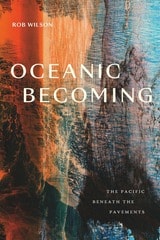
Oceanic Becoming
The Pacific beneath the PavementsRob Wilson
Duke University Press, 2025
From disappearing coral reefs and ocean acidification to floating great garbage patches, the Pacific Ocean is an ever-present reminder of the Anthropocene. In Oceanic Becoming, Rob Wilson demonstrates that in the midst of the planetary crises the Pacific now faces, it must be understood as interconnected to the other oceans. Wilson frames this interconnection as “Oceania,” reconceiving the world oceans as tied to sites of urban dwelling and life sustenance—from Boston to Brisbane—that are increasingly threatened by late capitalism. Confronting these threats, Wilson argues, requires a project he theorizes as “worlding”—a process of world-making and world-remaking across Oceania that would create new forms of belonging and connection at local, regional, and transnational levels. Wilson shows how Oceania is not just a site of peril but one charged with emergent literary and social formations that can provide the basis for new solidarities, futures, and ecologies.
[more]
On Interpretive Conflict
John Frow
University of Chicago Press, 2019
“Interpretation” is a term that encompasses both the most esoteric and the most fundamental activities of our lives, from analyzing medical images to the million ways we perceive other people’s actions. Today, we also leave interpretation to the likes of web cookies, social media algorithms, and automated markets. But as John Frow shows in this thoughtfully argued book, there is much yet to do in clarifying how we understand the social organization of interpretation.
On Interpretive Conflict delves into four case studies where sharply different sets of values come into play—gun control, anti-Semitism, the religious force of images, and climate change. In each case, Frow lays out the way these controversies unfold within interpretive regimes that establish what counts as an interpretable object and the protocols of evidence and proof that should govern it. Whether applied to a Shakespeare play or a Supreme Court case, interpretation, he argues, is at once rule-governed and inherently conflictual. Ambitious and provocative, On Interpretive Conflict will attract readers from across the humanities and beyond.
On Interpretive Conflict delves into four case studies where sharply different sets of values come into play—gun control, anti-Semitism, the religious force of images, and climate change. In each case, Frow lays out the way these controversies unfold within interpretive regimes that establish what counts as an interpretable object and the protocols of evidence and proof that should govern it. Whether applied to a Shakespeare play or a Supreme Court case, interpretation, he argues, is at once rule-governed and inherently conflictual. Ambitious and provocative, On Interpretive Conflict will attract readers from across the humanities and beyond.
[more]
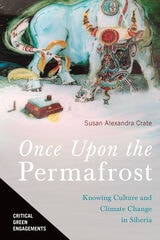
Once Upon the Permafrost
Knowing Culture and Climate Change in SiberiaSusan Alexandra Crate
University of Arizona Press, 2021
Once Upon the Permafrost is a longitudinal climate ethnography about “knowing” a specific culture and the ecosystem that culture physically and spiritually depends on in the twenty-first-century context of climate change.
The author, anthropologist Susan Alexandra Crate, has spent three decades working with Sakha, the Turkic-speaking horse and cattle agropastoralists of northeastern Siberia, Russia. Crate reveals Sakha’s essential relationship with alaas, the foundational permafrost ecosystem of both their subsistence and cultural identity. Sakha know alaas via an Indigenous knowledge system imbued with spiritual qualities. This counters the scientific definition of alaas as geophysical phenomena of limited range. Climate change now threatens alaas due to thawing permafrost, which, entangled with the rural changes of economic globalization, youth out-migration, and language loss, make prescient the issues of ethnic sovereignty and cultural survival.
Through careful integration of contemporary narratives, on-site observations, and document analysis, Crate argues that local understandings of change and the vernacular knowledge systems they are founded on provide critical information for interdisciplinary collaboration and effective policy prescriptions. Furthermore, she makes her message relevant to a wider audience by clarifying linkages to the global permafrost system found in her comparative research in Mongolia, Arctic Canada, Kiribati, Peru, and Chesapeake Bay, Virginia. This reveals how permafrost provides one of the main structural foundations for Arctic ecosystems, which, in turn, work with the planet’s other ecosystems to maintain planetary balance.
Metaphorically speaking, we all live on permafrost.
[more]
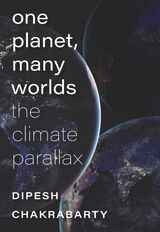
One Planet, Many Worlds
The Climate ParallaxDipesh Chakrabarty
Brandeis University Press, 2023
A historian offers a unique look at the pandemic, climate change, and the human versus nonhuman.
Climate change represents a deep conundrum for humans. It is difficult for humans to give up the unequal and yet accelerating pursuit of a good life based on an insatiable appetite for energy sourced mainly from fossil fuel. But the same pursuit, scientists insist, damages the geobiological system that supports the existence of interrelated forms of life, including ours, on this planet. The planet, seen thus, is one. The global sway of financial and extractive capital connects humans technologically, but they remain divided along multiple axes of inequality. Their worlds are many and their politics still global rather than planetary. In the narrative presented here, Chakrabarty continues to explore the temporal and intellectual fault lines that mark the collapse of the global and the planetary in human history.
Climate change represents a deep conundrum for humans. It is difficult for humans to give up the unequal and yet accelerating pursuit of a good life based on an insatiable appetite for energy sourced mainly from fossil fuel. But the same pursuit, scientists insist, damages the geobiological system that supports the existence of interrelated forms of life, including ours, on this planet. The planet, seen thus, is one. The global sway of financial and extractive capital connects humans technologically, but they remain divided along multiple axes of inequality. Their worlds are many and their politics still global rather than planetary. In the narrative presented here, Chakrabarty continues to explore the temporal and intellectual fault lines that mark the collapse of the global and the planetary in human history.
[more]
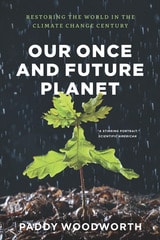
Our Once and Future Planet
Restoring the World in the Climate Change CenturyPaddy Woodworth
University of Chicago Press, 2013
The environmental movement is plagued by pessimism. And that’s not unreasonable: with so many complicated, seemingly intractable problems facing the planet, coupled with a need to convince people of the dangers we face, it’s hard not to focus on the negative
But that paints an unbalanced—and overly disheartening—picture of what’s going on with environmental stewardship today. There are success stories, and Our Once and Future Planet delivers a fascinating account of one of the most impressive areas of current environmental experimentation and innovation: ecological restoration. Veteran investigative reporter Paddy Woodworth has spent years traveling the globe and talking with people—scientists, politicians, and ordinary citizens—who are working on the front lines of the battle against environmental degradation. At sites ranging from Mexico to New Zealand and Chicago to Cape Town, Woodworth shows us the striking successes (and a few humbling failures) of groups that are attempting to use cutting-edge science to restore blighted, polluted, and otherwise troubled landscapes to states of ecological health—and, in some of the most controversial cases, to particular moments in historical time, before widespread human intervention. His firsthand field reports and interviews with participants reveal the promise, power, and limitations of restoration.
Ecological restoration alone won’t solve the myriad problems facing our environment. But Our Once and Future Planet demonstrates the role it can play, and the hope, inspiration, and new knowledge that can come from saving even one small patch of earth.
[more]
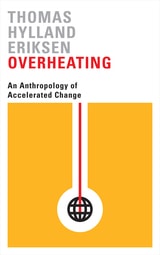
Overheating
An Anthropology of Accelerated ChangeThomas Hylland Eriksen
Pluto Press, 2016
We live in a time of global crisis—or, more appropriately, crises: overlapping, interlocking global problems that are inextricably tied to modernity. Overheating offers a groundbreaking new way of looking at the problems of the Anthropocene, exploring crises of the environment, economy, and identity through an anthropological lens. Thomas Hylland Eriksen argues that while each of these crises is global in scope, they are nonetheless perceived and responded to locally—and that once we realize that, we begin to see the contradictions that abound between the standardizing forces of global capitalism and the socially embedded nature of people and local practices. Only by acknowledging the primacy of the local, Eriksen shows, can we begin to even properly understand, let alone address, these problems on a global scale.
[more]