Results by title
104 books match the query 'Colombia' and 2 start with o
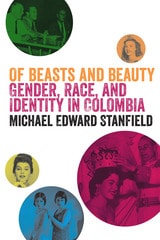
Of Beasts and Beauty
Gender, Race, and Identity in ColombiaBy Michael Edward Stanfield
University of Texas Press, 2013
All societies around the world and through time value beauty highly. Tracing the evolutions of the Colombian standards of beauty since 1845, Michael Edward Stanfield explores their significance to and symbiotic relationship with violence and inequality in the country. Arguing that beauty holds not only social power but also economic and political power, he positions it as a pacific and inclusive influence in a country “ripped apart by violence, private armies, seizures of land, and abuse of governmental authority, one hoping that female beauty could save it from the ravages of the male beast.” One specific means of obscuring those harsh realities is the beauty pageant, of which Colombia has over 300 per year. Stanfield investigates the ways in which these pageants reveal the effects of European modernity and notions of ethnicity on Colombian women, and how beauty for Colombians has become an external representation of order and morality that can counter the pathological effects of violence, inequality, and exclusion in their country.
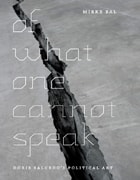
Of What One Cannot Speak
Doris Salcedo's Political ArtMieke Bal
University of Chicago Press, 2010
Doris Salcedo, a Colombian-born artist, addresses the politics of memory and forgetting in work that embraces fraught situations in dangerous places. Noted critic and theorist Mieke Bal narrates between the disciplines of contemporary culture in order to boldly reimagine the role of the visual arts. Both women are pathbreaking figures, globally renowned and widely respected. Doris Salcedo, meet Mieke Bal.
In Of What One Cannot Speak, Bal leads us into intimate encounters with Salcedo’s art, encouraging us to consider each work as a “theoretical object” that invites—and demands—certain kinds of considerations about history, death, erasure, and grief. Bal ranges widely through Salcedo’s work, from Salcedo’s Atrabiliarios series—in which the artist uses worn shoes to retrace los desaparecidos (“the disappeared”) from nations like Argentina, Chile, and Colombia—to Shibboleth, Salcedo’s once-in-a-lifetime commission by the Tate Modern, for which she created a rupture, as if by earthquake, that stretched the length of the museum hall’s concrete floor. In each instance, Salcedo’s installations speak for themselves, utilizing household items, human bones, and common domestic architecture to explore the silent spaces between violence, trauma, and identity. Yet Bal draws out even deeper responses to the work, questioning the nature of political art altogether and introducing concepts of metaphor, time, and space in order to contend with Salcedo’s powerful sculptures and installations.
An unforgettable fusion of art and essay, Of What One Cannot Speak takes us to the very core of events we are capable of remembering—yet still uncomfortably cannot speak aloud.