440 books match the query 'Colonialism & Post-Colonialism' and 5 start with o
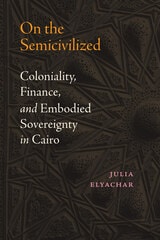
cover of On the Semicivilized: Coloniality, Finance, and Embodied Sovereignty in Cairo

On the Semicivilized

Coloniality, Finance, and Embodied Sovereignty in Cairo

Julia Elyachar

Duke University Press, 2025
On the Semicivilized by Julia Elyachar is a sweeping analysis of the coloniality that shaped—and blocked—sovereign futures for those dubbed barbarian and semicivilized in the former Ottoman Empire. Drawing on thirty years of ethnographic research in Cairo, family archives from Palestine and Egypt, and research on Ottoman debt and finance to rethink catastrophe and potentiality in Cairo and the world today, Elyachar theorizes a global condition of the “semicivilized” marked by nonsovereign futures, crippling debts, and the constant specter of violence exercised by those who call themselves civilized. Originally used to describe the Ottoman Empire, whose perceived “civilizational differences” rendered it incompatible with a Western-dominated global order, semicivilized came to denote lands where unitary territorial sovereignty was stymied at the end of WWI. Elyachar’s theorizing offers a new analytic vocabulary for thinking beyond territoriality, postcolonialism, and the “civilized"/"primitive” divide. Looking at the world from the perspective of the semicivilized, Elyachar argues, allows us to shift attention to embodied infrastructures, collective lives, and practices of moving and acting in common that bypass lingering assumptions of territorialism and unitary sovereign rule.
[more]
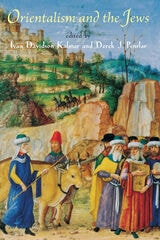
cover of Orientalism and the Jews

Orientalism and the Jews

Edited by Ivan Davidson Kalmar and Derek Penslar

Brandeis University Press, 2004
At the turn of the twenty-first century, in spite of growing globalization there remains in the world a split between the West and the rest. The manner in which this split has been imagined and represented in Western civilization has been the subject of intense cross-disciplinary scrutiny, much of it under the rubric of “orientalism.” This debate, sparked by the 1978 publication of Edward Said’s Orientalism identifies the “Orient” as the Islamic world and to a lesser extent Hindu India. “Orientalism” signifies the way the West imagined this terrain. Going beyond Said’s framework, in their introduction to the volume, Kalmar and Penslar argue that orientalism is based on the Christian West’s attempts to understand and manage its relations with both of its monotheistic Others—Muslims and Jews. According to the editors, Jews have almost always been present whenever occidentals talked about or imagined the East; and the Western image of the Muslim Orient has been formed and continues to be formed in inextricable conjunction with Western perceptions of the Jewish people. Bringing together essays by an array of international scholars in a wide range of disciplines, Orientalism and the Jews demonstrates that, since the Middle Ages, Jews have been seen in the Western world as both occidental and oriental. Jews formed the model for medieval depictions of Muslim warriors. Representations of biblical Jews in early modern Europe provided essential sustenance for Western fictions about the Muslim world. And many of the Western protagonists of imperialism “discovered” real or imaginary Jews wherever their expeditions took them. Today orientalist attitudes by Israelis target not only Arabs but also the mizrahi (“oriental”) Israelis with roots in the Arab world as Others.
[more]
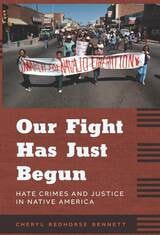
cover of Our Fight Has Just Begun: Hate Crimes and Justice in Native America

Our Fight Has Just Begun

Hate Crimes and Justice in Native America

Cheryl Redhorse Bennett

University of Arizona Press, 2022

Our Fight Has Just Begun is a timely and urgent work. The result of more than a decade of research, it revises history, documents anti-Indianism, and gives voice to victims of racial violence. Navajo scholar Cheryl Redhorse Bennett reveals a lesser-known story of Navajo activism and the courageous organizers that confronted racial injustice and inspired generations.

Illuminating largely untold stories of hate crimes committed against Native Americans in the Four Corners region of the United States, this work places these stories within a larger history, connecting historical violence in the United States to present-day hate crimes. Bennett contends that hate crimes committed against Native Americans have persisted as an extension of an “Indian hating” ideology that has existed since colonization, exposing how the justice system has failed Native American victims and families.

While this book looks deeply at multiple generations of unnecessary and ongoing pain and violence, it also recognizes that this is a time of uncertainty and hope. The movement to abolish racial injustice and racially motivated violence has gained fierce momentum. Our Fight Has Just Begun shows that racism, hate speech, and hate crimes are ever present and offers recommendations for racial justice.
 
[more]
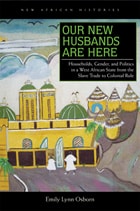
cover of Our New Husbands Are Here: Households, Gender, and Politics in a West African State from the Slave Trade to Colonial Rule

Our New Husbands Are Here

Households, Gender, and Politics in a West African State from the Slave Trade to Colonial Rule

Emily Lynn Osborn

Ohio University Press, 2011

In Our New Husbands Are Here, Emily Lynn Osborn investigates a central puzzle of power and politics in West African history: Why do women figure frequently in the political narratives of the precolonial period, and then vanish altogether with colonization? Osborn addresses this question by exploring the relationship of the household to the state. By analyzing the history of statecraft in the interior savannas of West Africa (in present-day Guinea-Conakry), Osborn shows that the household, and women within it, played a critical role in the pacifist Islamic state of Kankan-Baté, enabling it to endure the predations of the transatlantic slave trade and become a major trading center in the nineteenth century. But French colonization introduced a radical new method of statecraft to the region, one that separated the household from the state and depoliticized women’s domestic roles. This book will be of interest to scholars of politics, gender, the household, slavery, and Islam in African history.

[more]
cover of Out of the Frame: The Struggle for Academic Freedom in Israel

Out of the Frame

The Struggle for Academic Freedom in Israel

Ilan Pappe

Pluto Press, 2010

Even before he wrote his bestselling book The Ethnic Cleansing of Palestine, historian Ilan Pappe was a controversial figure in Israel. In Out of the Frame, he gives a full account of his break with mainstream Israeli scholarship and its consequences.

Here he traces his journey of discovery from the whispers of Palestinian classmates to his realisation that the 'enemy's' narrative of the events of 1948 was correct. After completing his thesis at Oxford University in the early 1980s, he returned to Palestine determined to protect the memory of the Nakbah. For the first time he gives the details of the formidable opposition he faced in Israel, including death threats fed by the media, denunciations by the Knesset and calls for him to be sacked from his post at Haifa university.

This revealing work, written with dignity and humour, highlights Israel's difficulty in facing up to its past and forging a peaceful, inclusive future in Palestine.

[more]