Results by title
231 books match the query 'Colonies' and 5 start with o
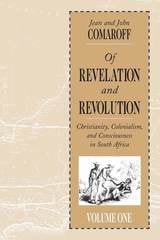
Of Revelation and Revolution, Volume 1
Christianity, Colonialism, and Consciousness in South AfricaJean Comaroff and John L. Comaroff
University of Chicago Press, 1991
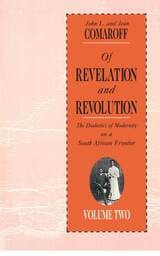
Of Revelation and Revolution, Volume 2
The Dialectics of Modernity on a South African FrontierJohn L. Comaroff and Jean Comaroff
University of Chicago Press, 1997
The Comaroffs trace many of the major themes of twentieth-century South African history back to these formative encounters. The relationship between the British evangelists and the Southern Tswana engendered complex exchanges of goods, signs, and cultural markers that shaped not only African existence but also bourgeois modernity "back home" in England. We see, in this volume, how the colonial attempt to "civilize" Africa set in motion a dialectical process that refashioned the everyday lives of all those drawn into its purview, creating hybrid cultural forms and potent global forces which persist in the postcolonial age.
This fascinating study shows how the initiatives of the colonial missions collided with local traditions, giving rise to new cultural practices, new patterns of production and consumption, new senses of style and beauty, and new forms of class distinction and ethnicity. As noted by reviewers of the first volume, the Comaroffs have succeeded in providing a model for the study of colonial encounters. By insisting on its dialectical nature, they demonstrate that colonialism can no longer be seen as a one-sided relationship between the conquering and the conquered. It is, rather, a complex system of reciprocal determinations, one whose legacy is very much with us today.

On the Eve of Conquest
The Chevalier de Raymond's Critique of New France in 1754Joseph L. Peyser
Michigan State University Press, 1997
In 1754, Charles de Raymond, chevalier of the Royal and Military Order of Saint Louis and a captain in the Troupes de la Marine wrote a bold, candid, and revealing expose; on the French colonial posts and settlements of New France. On the Eve of the Conquest, more than an annotated translation, includes a discussion on the historical background of the start of the French and Indian War, as well as a concise biography of Raymond and Michel Le Courtois de Surlaville, the army colonel at the French court to whom the report was sent. The events surrounding Raymond's controversial year as commandant of the post (now Fort Wayne, Indiana) in 1749-50, his disputed recall by Governor General Jacques-Pierre de Taffanel de La Jonquier, and the subsequent friction between La Jonquiere's successor, Ange de Menneville Duqesne, and Raymond are presented in detail and illustrated by translations of their correspondence.
Orientalists, Propagandists, and Ilustrados
Filipino Scholarship and the End of Spanish ColonialismMegan C. Thomas
University of Minnesota Press, 2012
The writings of a small group of scholars known as the ilustrados are often credited for providing intellectual grounding for the Philippine Revolution of 1896. Megan C. Thomas shows that the ilustrados’ anticolonial project of defining and constructing the “Filipino” involved Orientalist and racialist discourses that are usually ascribed to colonial projects, not anticolonial ones. According to Thomas, the work of the ilustrados uncovers the surprisingly blurry boundary between nationalist and colonialist thought.
By any measure, there was an extraordinary flowering of scholarly writing about the peoples and history of the Philippines in the decade or so preceding the revolution. In reexamining the works of the scholars José Rizal, Pardo de Tavera, Isabelo de los Reyes, Pedro Paterno, Pedro Serrano Laktaw, and Mariano Ponce, Thomas situates their writings in a broader account of intellectual ideas and politics migrating and transmuting across borders. She reveals how the ilustrados both drew from and refashioned the tools and concepts of Orientalist scholarship from Europe.
Interrogating the terms “nationalist” and “nationalism,” whose definitions are usually constructed in the present and then applied to the past, Thomas offers new models for studying nationalist thought in the colonial world.
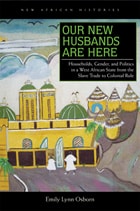
Our New Husbands Are Here
Households, Gender, and Politics in a West African State from the Slave Trade to Colonial RuleEmily Lynn Osborn
Ohio University Press, 2011
In Our New Husbands Are Here, Emily Lynn Osborn investigates a central puzzle of power and politics in West African history: Why do women figure frequently in the political narratives of the precolonial period, and then vanish altogether with colonization? Osborn addresses this question by exploring the relationship of the household to the state. By analyzing the history of statecraft in the interior savannas of West Africa (in present-day Guinea-Conakry), Osborn shows that the household, and women within it, played a critical role in the pacifist Islamic state of Kankan-Baté, enabling it to endure the predations of the transatlantic slave trade and become a major trading center in the nineteenth century. But French colonization introduced a radical new method of statecraft to the region, one that separated the household from the state and depoliticized women’s domestic roles. This book will be of interest to scholars of politics, gender, the household, slavery, and Islam in African history.