Results by title
167 books match the query 'Colorado' and 4 start with o
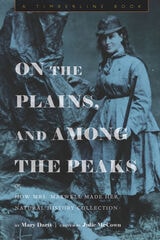
On the Plains, and Among the Peaks
or, How Mrs. Maxwell Made Her Natural History Collection: by Mary DarttJulie McCown
University Press of Colorado, 2021
Dartt’s book tells the story of Maxwell’s lifelong passion and dedication to work and education that made her a pioneer in more ways than one. It catalogs her important scientific contributions and development of museum habitat groupings and lifelike taxidermy mounts, showcases engaging accounts of wilderness excursions on the frontier of the Western United States in the 1860s and 1870s, and testifies to her resolve to show that women were capable of succeeding in traditionally male-dominated fields.
This scholarly edition of On the Plains, and Among the Peaks will spark renewed interest in Maxwell and Dartt as neglected figures in nineteenth-century US history and literature, opening a conversation that other literary scholars and historians will join to further situate their work within the numerous disciplines to which it speaks, including nineteenth-century American literature; women’s, western, environmental, and natural history; and gender, museum, and animal studies.
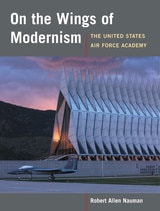
On the Wings of Modernism
The United States Air Force AcademyRobert Allen Nauman
University of Illinois Press, 2003
The United States Air Force Academy stands as one of the most extensive architectural projects of the cold war era. Key to a full understanding of American modernism, the project was also a volatile battleground involving competing ideas about aesthetics and politics. Arguing that the academy's production was squarely grounded in bureaucratic and political processes, Robert Allen Nauman demonstrates that selection of both the site and the design firm was the result of political maneuverings involving U.S. military leadership.
In the academy’s iconic design, myths and metaphors of flight and the American West were interwoven with those of modernism, both to justify the plan and to free it from any lingering socialist or European associations. Skidmore, Owings, and Merrill’s first public exhibition of plans and models for the project was designed by the former Bauhaus master Herbert Bayer, and it incorporated photographs of the Colorado Springs site by Ansel Adams and William Garnett. Using previously unexplored resources of the U.S. Air Force Academy, SOM, and the Air Force Academy Construction Agency, Nauman uncovered materials such as negatives of Adams’s original photographs of the sites. He also conducted extensive interviews with SOM’s project director for the academy, Walter Netsch, in tracing the complete history of the academy's construction, from its earliest conception to eventual completion.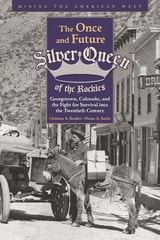
Once and Future Silver Queen of the Rockies
Georgetown, Colorado, and the Fight for Survival into the Twentieth CenturyChristine Bradley
University Press of Colorado, 2018
There are many studies of local communities during their heydays, but the life of a community in decline is rarely studied. The Once and Future Silver Queen of the Rockies delves into the life of Georgetown, Colorado, after the turn of the twentieth century as mining in Clear Creek County steadily declined and ultimately collapsed.
One of the earliest mining communities in the state, Georgetown began to struggle for survival as the nineteenth century drew to a close. The price of silver dropped precipitously while other mining camps were still opening around the region. The new, bright future once envisioned for the “Silver Queen of the Rockies” began to fade. Yet the community managed to survive and re-create itself in the new world of the twentieth century. Tourism, skiing, and historic preservation replaced mineral extraction as the basis of the regional economy. Today, Georgetown maintains the aesthetic feel of a nineteenth-century mining town and stands as an example of community-supported historic preservation.
This richly illustrated sequel to The Rise of the Silver Queen tells the compelling story of Georgetown’s survival, and ultimate flourishing, after the loss of its principal industry. It is an interesting and engaging addition to the history of Colorado and the West.
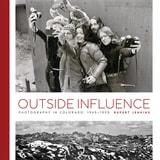
Outside Influence
Photography in Colorado, 1945–1995Rupert Jenkins
University Press of Colorado, 2025
Outside Influence: Photography in Colorado, 1945–1995 is the first detailed account of the state’s history of post–World War II expressive photography. The title “Outside Influence” alludes to the historic presence of the natural landscape as subject and to the transformative impact of out-of-state artists and educators. Their arrival in Colorado beginning in the 1960s galvanized interpretive photography by introducing innovative concepts, nontraditional materials, and emergent digital technologies to students, peers, and their audience-at-large.
Throughout the book’s nine chapters, Rupert Jenkins contextualizes Colorado photography’s postwar development with a social, political, and cultural abstract that encompasses national events and trends, the emerging presence of women and photographers of color, and institutional leadership. Drawing from more than 120 personal interviews, he identifies the medium’s principal in-state creators, mentors, and advocates from the modernist era of film processing to the emergence of interdisciplinary digital practice. Jenkins answers fundamental questions about the people and work of this era: Who generated this significant body of innovative, noncommercial photographic work? Where did they come from? Who inspired them, and who in turn did they inspire?
As Eric Paddock, curator of photography at the Denver Art Museum, discusses in his foreword, by looking at the schools, workshops, galleries, and museums that supported these artists, Jenkins stresses the importance of collaboration and community to any successful venture. Crucially, in examining the lives and careers of photographers like Robert Adams, Walter Chappell, Albert Chong, Cherie Hiser, Barbara Houghton, Winter Prather, Mark Sink, Melanie Walker, Myron Wood, and numerous others, Outside Influence seeks to affirm the medium’s legacy within Colorado’s fine arts canon.