Results by title
214 books match the query 'Constitutional' and 4 start with o
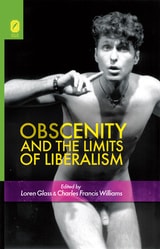
Obscenity and the Limits of Liberalism
Edited by Loren Glass and Charles Francis Williams
The Ohio State University Press, 2011
Over the course of the nineteenth century in both Europe and the United States, the state usurped the traditional authority of the church in regulating sexual expression and behavior. In the same century philosophers of classical liberalism identified that state function as a threat to individual liberty. Since then, liberalism has provided the framework for debates over obscenity around the globe.
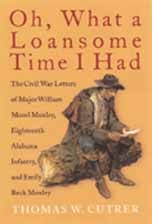
Oh, What a Loansome Time I Had
The Civil War Letters of Major William Morel Moxley, Eighteenth Alabama Infantry, and Emily Beck MoxleyEmily Beck Moxley
University of Alabama Press, 2002
Most surviving correspondence of the Civil War period was written by members of a literate, elite class; few collections exist in which the woman's letters to her soldier husband have been preserved. Here, in the exchange between William and Emily Moxley, a working-class farm couple from Coffee County, Alabama, we see vividly an often-neglected aspect of the Civil War experience: the hardships of civilian life on the home front.
Emily's moving letters to her husband, startling in their immediacy and detail, chronicle such difficulties as a desperate lack of food and clothing for her family, the frustration of depending on others in the community, and her growing terror at facing childbirth without her husband, at the mercy of a doctor with questionable skills. Major Moxley's letters to his wife reveal a decidedly unromantic side of the war, describing his frequent encounters with starvation, disease, and bloody slaughter.
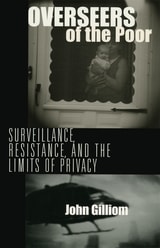
Overseers of the Poor
Surveillance, Resistance, and the Limits of PrivacyJohn Gilliom
University of Chicago Press, 2001
This powerful book lets us in on the conversations of low-income mothers from Appalachian Ohio as they talk about the welfare bureaucracy and its remarkably advanced surveillance system. In their struggle to care for their families, these women are monitored and assessed through a vast network of supercomputers, caseworkers, fraud control agents, and even grocers and neighbors.
In-depth interviews show that these women focus less on the right to privacy than on a critique of surveillance that lays bare the personal and political conflicts with which they live. And, while they have little interest in conventional forms of politics, we see widespread patterns of everyday resistance as they subvert the surveillance regime when they feel it prevents them from being good parents. Ultimately, Overseers of the Poor demonstrates the need to reconceive not just our understanding of the surveillance-privacy debate but also the broader realms of language, participation, and the politics of rights.
We all know that our lives are being watched more than ever before. As we struggle to understand and confront this new order, Gilliom argues, we need to spend less time talking about privacy rights, legislatures, and courts of law and more time talking about power, domination, and the ongoing struggles of everyday people.
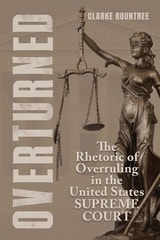
Overturned
The Rhetoric of Overruling in the United States Supreme CourtClarke Rountree
University of Alabama Press, 2025
A timely and lively summary and analysis of the Supreme Court’s justifications for overruling nearly 300 prior rulings in its history
An audacious US Supreme Court is overturning a number of long-standing precedents, and Overturned offers a lively account of the court’s history of overturning prior cases and examples and analyses of 300 cases overruled in its history.
The immense controversy surrounding the case of Dobbs v. Jackson Women’s Health Organization in 2022, which overruled Roe v. Wade and erased the constitutional right to abortion in the United States, has focused public attention on how and why the Supreme Court knocks down long-established precedents.
In his vivid and accessible style, scholar Clarke Rountree recounts the rhetorical pirouettes and linguistic acrobatics the court has deployed to explain its reversal of Dobbs and numerous other landmark decisions. He reviews strategies the court uses to undermine a previous court’s standing without undermining its own. He analyzes overrulings across time, by type (constitutional cases versus statutory and common law cases), by the ages of the overturned precedents, with changes in the court’s membership, and through other variables.
Rountree gives engrossing accounts of pivotal overrulings in the past, such as when Lincoln’s Treasury Secretary Salmon Chase used the Legal Tender Act in 1862 to raise money for the Civil War then ruled the same law unconstitutional in 1870 when he served as chief justice. Rountree retells Thomas Edison’s attempt to monopolize the burgeoning film industry, which was stopped only when the Supreme Court overturned an earlier patent-rights case in 1917. Finally, Rountree applies his myriad insights to the politically fraught Dobbs case.
Overturned makes a valuable contribution to law, rhetoric, politics, and history, and readers interested in the role and function of America’s highest court will find Rountree’s account fast-paced, lively, and engaging.