Results by title
56 books match the query 'Context' and 3 start with o
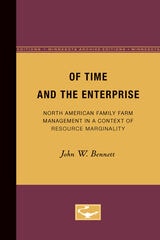
Of Time and the Enterprise
North American Family Farm Management in a Context of Resource MarginalityJohn Bennett
University of Minnesota Press, 1982
Of Time and the Enterprise was first published in 1982.Of Time and the Enterprise is the result of 12 years’ research in the Canadian sector of the northern Great Plains -- a 7,000-square-mile region that was one of the last areas in North America to be populated by agricultural settlers. This late settlement permitted a reconstruction of the area’s history and economic and social development unparalleled in the literature.This book has several dimensions. It is, first, a meticulous study of the North American family farm. Bennett considers such aspects of the family farm as the ways that family members relate to one another and how the various members, especially the wife, participate in management of the enterprise. The book is also a study of agricultural management as an adaptive process. Farm operators must juggle the demands of their families, communities, and the national market in determining the conduct of the business. Finally, the book is a study of the development process on a recent frontier and thus has many implications for agricultural and community development in the Third World.As the first detailed study of entrepreneurial agriculture in North America, Of Time and the Enterprise combines quantitative and qualitative analysis and looks at the family farm as a form of social behavior, not merely as a form of economic performance. Bennett presents a new interpretation of decision-making, resource allocation, and the influence of family, community, and cultural traditions which he argues must be seen as part of a larger social system.
[more]
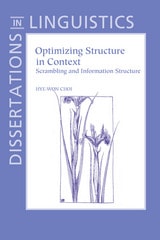
Optimizing Structure in Context
Scrambling and Information StructureHye-Won Choi
CSLI, 1999
This book examines the scrambling phenomena in German and Korean from the perspective that different ordering possibilities are motivated and constrained by interactions among syntactic, semantic, and discourse principles. Using Optimality Theory, Optimizing Structure in Context demonstrates how these principles from different modules of grammar interact and thus resolve conflicts among themselves to yield the most optimal output, that is, a sentence with a particular word order, in a given semantic and discoursal context. This way, it explains various meaning-related effects associated with scrambling such as definiteness effect and focus effect. While developing constraints in the discourse domain, it also proposes a new model of information structure based on basic discourse features. By expanding the core idea of constraint interaction in Optimality Theory to interactions 'between' modules of grammar as well as 'between', this book provides a model of interface theory.
[more]
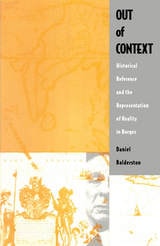
Out of Context
Historical Reference and the Representation of Reality in BorgesDaniel Balderston
Duke University Press, 1993
In Jorge Luis Borges's finely wrought, fantastic stories, so filigreed with strange allusions, critics have consistently found little to relate to the external world, to history--in short, to reality. Out of Context corrects this shortsighted view and reveals the very real basis of the Argentine master's purported "irreality." By providing the historical context for some of the writer's best-loved and least understood works, this study also gives us a new sense of Borges's place within the context of contemporary literature.
Through a detailed examination of seven stories, Daniel Balderston shows how Borges's historical and political references, so often misread as part of a literary game, actually open up a much more complex reality than the one made explicit to the reader. Working in tension with the fantastic aspects of Borges' work, these precise references to realities outside the text illuminate relations between literature and history as well as the author's particular understanding of both. In Borges's perspective as it is revealed here, history emerges as an "other" only partially recoverable in narrative form. From what can be recovered, Balderston is able to clarify Borges's position on historical episodes and trends such as colonialism, the Peronist movement, "Western culture," militarism, and the Spanish invasion of the Americas.
Informed by a wide reading of history, a sympathetic use of critical theory, and a deep understanding of Borges's work, this iconoclastic study provides a radical new approach to one of the most celebrated and—until now—hermetic authors of our time.
[more]