365 books match the query 'Correspondence' and 5 start with o
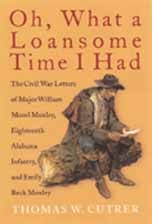
cover of Oh, What a Loansome Time I Had: The Civil War Letters of Major William Morel Moxley, Eighteenth Alabama Infantry, and Emily Beck Moxley

Oh, What a Loansome Time I Had

The Civil War Letters of Major William Morel Moxley, Eighteenth Alabama Infantry, and Emily Beck Moxley

Emily Beck Moxley

University of Alabama Press, 2002

This rare correspondence between a soldier and his wife relates in poignant detail the struggle for survival on the battlefield as well as on the home front and gives voice to the underrepresented class of small farmers

Most surviving correspondence of the Civil War period was written by members of a literate, elite class; few collections exist in which the woman's letters to her soldier husband have been preserved. Here, in the exchange between William and Emily Moxley, a working-class farm couple from Coffee County, Alabama, we see vividly an often-neglected aspect of the Civil War experience: the hardships of civilian life on the home front.

Emily's moving letters to her husband, startling in their immediacy and detail, chronicle such difficulties as a desperate lack of food and clothing for her family, the frustration of depending on others in the community, and her growing terror at facing childbirth without her husband, at the mercy of a doctor with questionable skills. Major Moxley's letters to his wife reveal a decidedly unromantic side of the war, describing his frequent encounters with starvation, disease, and bloody slaughter.
To supplement this revealing correspondence, the editor has provided ample documentation and research; a genealogical chart of the Moxley family; detailed maps of Alabama and Florida that allow the reader to trace the progress of Major Moxley's division; and thorough footnotes to document and elucidate events and people mentioned in the letters. Readers interested in the Civil War and Alabama history will find these letters immensely appealing while scholars of 19th-century domestic life will find much of value in Emily Moxley's rare descriptions of her homefront experiences.
[more]
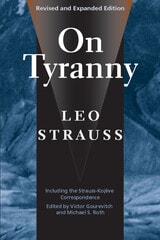
cover of On Tyranny

On Tyranny

Leo Strauss

University of Chicago Press, 2000

On Tyranny is Leo Strauss's classic reading of Xenophon's dialogue, Hiero or Tyrannicus, in which the tyrant Hiero and the poet Simonides discuss the advantages and disadvantages of exercising tyranny. This edition includes a translation of the dialogue, a critique of the commentary by the French philosopher Alexandre Kojève, Strauss's restatement of his position in light of Kojève's comments, and finally, the complete Strauss-Kojève correspondence.

"Through [Strauss's] interpretation Xenophon appears to us as no longer the somewhat dull and flat author we know, but as a brilliant and subtle writer, an original and profound thinker. What is more, in interpreting this forgotten dialogue, Strauss lays bare great moral and political problems that are still ours." —Alexandre Kojève, Critique

"On Tyranny is a complex and stimulating book with its 'parallel dialogue' made all the more striking since both participants take such unusual, highly provocative positions, and so force readers to face substantial problems in what are often wholly unfamiliar, even shocking ways." —Robert Pippin, History and Theory

"Every political scientist who tries to disentangle himself from the contemporary confusion over the problems of tyranny will be much indebted to this study and inevitably use it as a starting point."—Eric Voegelin, The Review of Politics

Leo Strauss (1899-1973) was the Robert Maynard Hutchins Distinguished Service Professor of Political Science at the University of Chicago.
[more]
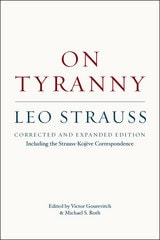
cover of On Tyranny: Corrected and Expanded Edition, Including the Strauss-Kojève Correspondence

On Tyranny

Corrected and Expanded Edition, Including the Strauss-Kojève Correspondence

Leo Strauss

University of Chicago Press, 2013
On Tyranny is Leo Strauss’s classic reading of Xenophon’s dialogue Hiero, or Tyrannicus, in which the tyrant Hiero and the poet Simonides discuss the advantages and disadvantages of exercising tyranny. Included are a translation of the dialogue from its original Greek, a critique of Strauss’s commentary by the French philosopher Alexandre Kojève, and the complete correspondence between the two.

This revised and expanded edition introduces important corrections throughout and expands Strauss’s restatement of his position in light of Kojève’s commentary to bring it into conformity with the text as it was originally published in France.
[more]
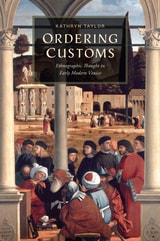
cover of Ordering Customs: Ethnographic Thought in Early Modern Venice

Ordering Customs

Ethnographic Thought in Early Modern Venice

Kathryn Taylor

University of Delaware Press, 2023
Ordering Customs explores how Renaissance Venetians sought to make sense of human difference in a period characterized by increasing global contact and a rapid acceleration of the circulation of information. Venice was at the center of both these developments. The book traces the emergence of a distinctive tradition of ethnographic writing that served as the basis for defining religious and cultural difference in new ways. Taylor draws on a trove of unpublished sources—diplomatic correspondence, court records, diaries, and inventories—to show that the study of customs, rituals, and ways of life not only became central in how Venetians sought to apprehend other peoples, but also had a very real impact at the level of policy, shaping how the Venetian state governed minority populations in the city and its empire. In contrast with the familiar image of ethnography as the product of overseas imperial and missionary encounters, the book points to a more complicated set of origins. 

 
[more]
cover of Ossium Carnes Multae e Marci Tullii Ciceronis Epistulis / The Bones’ Meats Abundant from the Epistles of Marcus Tullius Cicero

Ossium Carnes Multae e Marci Tullii Ciceronis Epistulis / The Bones’ Meats Abundant from the Epistles of Marcus Tullius Cicero

Reginaldus Thomas Foster

Catholic University of America Press, 2021

Beginners and experts alike will find a complete immersion into the workings and nature of the Latin language embodied in the incomparable, insuperable epistles of the great Marcus Tullius Cicero, something which other commentators pass over or scorn. This second volume puts “meat on the bones” of the Latin language presented in the first volume: Ossa Latinitatis Sola: The Mere Bones of Latin. The personal letters of Cicero provide ample meat to enflesh the skeletal structure of the language, thus the title: Ossium Carnes Multae: The Bones’ Meats Abundant from the epistles of Marcus Tullius Cicero. Part 1 presents 51 complete letters from the Tyrell-Purser text. Facing each letter is an image of its oldest manuscript edition as early as the ninth century, which are preserved and guarded in the Medicea Laurentiana library in Florence, Italy, witnessing to the human hand preserving this monument of world heritage for over two millennia. Part 2 follows with a most careful rendition into English of Tully’s living, telephone-like Latin discourse. A thorough treatment and explanation of noteworthy elements of his natural talk follows with numerous references to the Encounters in Volume I. All this has students, learners, teachers, experts of the Latin language in mind and is humbly designed to deepen the understanding and appreciation of specific expressions and peculiarities of Cicero’s language itself. Part 3 provides 500 sentences consisting of from 1 to 5 words and suited for the beginnings or continuation of Latin conversations: 200 declarations, 100 questions, 100 exclamations, 100 injunctions drawn from his letters. The volume is amply indexed. All this has been done to enhance the study and use of Latin, to popularize Cicero’s correspondence, to prepare the reader for Volume III which will deal again with the letters and their usefulness for Latin conversation.
[more]