Results by title
476 books match the query 'Criticism' and 14 start with o
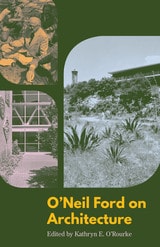
O'Neil Ford on Architecture
Edited by Kathryn E. O'Rourke
University of Texas Press, 2019
Winner, Publication Award, Southeastern Chapter of the Society of Architectural Historians (SESAH), 2019
Acclaimed for his designs of the Trinity University campus, the Little Chapel in the Woods, the Texas Instruments Semiconductor Components Division Building, and numerous private houses, O’Neil Ford (1905–1982) was an important twentieth-century architect and a pioneer of modernism in Texas. Collaborating with artists, landscape architects, and engineers, Ford created diverse and enduringly rich works that embodied and informed international developments in modern architecture. His buildings, lectures, and teaching influenced a generation of Texas architects.
O’Neil Ford on Architecture brings together Ford’s major professional writings and speeches for the first time. Revealing the intellectual and theoretical underpinnings of his distinctive modernism, they illuminate his fascination with architectural history, his pioneering uses of new technologies and construction systems, his deep concerns for the landscape and environment, and his passionate commitments to education and civil rights. An interlocutor with titans of the twentieth century, including Louis Kahn and J. Robert Oppenheimer, Ford understood architecture as inseparable from the social, political, and scientific developments of his day. An introductory essay by Kathryn E. O’Rourke provides a critical assessment of Ford’s essays and lectures and repositions him in the history of US architectural modernism. As some of his most important buildings turn sixty, O’Neil Ford on Architecture demonstrates that this Texas modernist deserves to be ranked among the leading midcentury American architects.
On Close Reading
John Guillory
University of Chicago Press, 2025
At a time of debate about the future of “English” as a discipline and the fundamental methods of literary study, few terms appear more frequently than “close reading,” now widely regarded as the core practice of literary study. But what exactly is close reading, and where did it come from? Here John Guillory, author of the acclaimed Professing Criticism, takes up two puzzles. First, why did the New Critics—who supposedly made close reading central to literary study—so seldom use the term? And second, why have scholars not been better able to define close reading?
For Guillory, these puzzles are intertwined. The literary critics of the interwar period, he argues, weren’t aiming to devise a method of reading at all. These critics were most urgently concerned with establishing the judgment of literature on more rigorous grounds than previously obtained in criticism. Guillory understands close reading as a technique, a particular kind of methodical procedure that can be described but not prescribed, and that is transmitted largely by demonstration and imitation.
Guillory’s short book will be essential reading for all college teachers of literature. An annotated bibliography, curated by Scott Newstok, provides a guide to key documents in the history of close reading along with valuable suggestions for further research.
On Creaturely Life
Rilke, Benjamin, SebaldEric L. Santner
University of Chicago Press, 2006
Santner traces this theme of creaturely life from its poetic and philosophical beginnings in the first half of the twentieth century to the writings of the enigmatic German novelist W. G. Sebald. Sebald’s entire oeuvre, Santner argues, can be seen as an archive of creaturely life. For Sebald, the work on such an archive was inseparable from his understanding of what it means to engage ethically with another person’s history and pain, an engagement that transforms us from indifferent individuals into neighbors.
An indispensable book for students of Sebald, On Creaturely Life is also a significant contribution to critical theory.
On Interpretive Conflict
John Frow
University of Chicago Press, 2019
On Interpretive Conflict delves into four case studies where sharply different sets of values come into play—gun control, anti-Semitism, the religious force of images, and climate change. In each case, Frow lays out the way these controversies unfold within interpretive regimes that establish what counts as an interpretable object and the protocols of evidence and proof that should govern it. Whether applied to a Shakespeare play or a Supreme Court case, interpretation, he argues, is at once rule-governed and inherently conflictual. Ambitious and provocative, On Interpretive Conflict will attract readers from across the humanities and beyond.

On Manly Courage
A Study of Plato's LachesWalter T. Schmid. Foreword by George Kimball Plochmann
Southern Illinois University Press, 1992
Walter T. Schmid offers the first original interpretation of the Laches since Hermann Bonitz in the nineteenth century in the only full-length commentary on the Laches available in English.
Schmid divides the book into five main discussions: the historical background of the dialogue; the relation of form and content in a Platonic dialogue and specific structural and aesthetic features of the Laches; the first half of the dialogue, which introduces the characters and considers the theme of the education of young men; the inquiry with Laches, which examines the traditional Greek conception of military courage; and the inquiry with Nicias in which two nontraditional conceptions of courage are mooted, one closely associated with the sophistic movement in Athens, the other with Socrates himself. Furnishing a detailed paragraph-by-paragraph reading that traces Socrates’ ongoing quest for virtue and wisdom—a wisdom founded in the action of a whole human life—Schmid conclusively shows how and why the Laches fills an important niche in Plato’s moral theory.
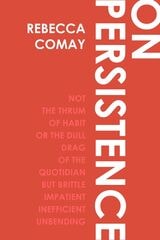
On Persistence
Rebecca Comay
Seagull Books, 2026
On Persistence is an exploration into the elusive, unruly force of endurance—not as moral virtue or capitalist work ethic, but as a temporal and affective structure that resists assimilation. In these wide-ranging philosophical and literary essays, Rebecca Comay interrogates what it means to persist when progress stalls and resolution fails to arrive. Engaging figures from Freud to Beckett, Proust to Benjamin, Hamlet to Niobe, Comay tracks the strange temporality of suspended life: interminable mourning, unfinished projects, the persistence of the past, the undead stirrings of the death drive. What emerges is a radically different model of time—neither static nor teleological, but a form of interruption that opens space for rethinking agency, grief, resistance, and repair.
On Persistence offers a profound meditation on what it means to endure—and to endure differently—in a time that demands something else of us.
On Posthuman War
Computation and Military ViolenceMike Hill
University of Minnesota Press, 2022
Tracing war’s expansion beyond the battlefield to the concept of the human being itself
As military and other forms of political violence become the planetary norm, On Posthuman War traces the expansion of war beyond traditional theaters of battle. Drawing on counterinsurgency field manuals, tactical manifestos, data-driven military theory, and asymmetrical-war archives, Mike Hill delineates new “Areas of Operation” within a concept of the human being as not only a social and biological entity but also a technical one.
Delving into three human-focused disciplines newly turned against humanity, OnPosthuman War reveals how demography, anthropology, and neuroscience have intertwined since 9/11 amid the “Revolution in Military Affairs.” Beginning with the author’s personal experience training with U.S. Marine recruits at Parris Island, Hill gleans insights from realist philosophy, the new materialism, and computational theory to show how the human being, per se, has been reconstituted from neutral citizen to unwitting combatant. As evident in the call for “bullets, beans, and data,” whatever can be parted out, counted, and reassembled can become war materiel. Hill shows how visible and invisible wars within identity, community, and cognition shift public-sphere activities, like racial identification, group organization, and even thought itself, in the direction of war. This shift has weaponized social activities against the very notion of society.
On Posthuman War delivers insights on the latest war technologies, strategies, and tactics while engaging in questions poised to overturn the foundations of modern political thought.
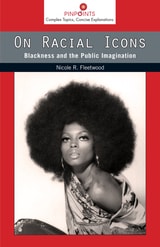
On Racial Icons
Blackness and the Public ImaginationFleetwood, Nicole R
Rutgers University Press, 2015
Nicole R. Fleetwood’s answers to these questions will change the way you think about the next photograph that you see depicting a racial event, black celebrity, or public figure. In On Racial Icons, Fleetwood focuses a sustained look on photography in documenting black public life, exploring the ways in which iconic images function as celebrations of national and racial progress at times or as a gauge of collective racial wounds in moments of crisis.
Offering an overview of photography’s ability to capture shifting race relations, Fleetwood spotlights in each chapter a different set of iconic images in key sectors of public life. She considers flash points of racialized violence in photographs of Trayvon Martin and Emmett Till; the political, aesthetic, and cultural shifts marked by the rise of pop stars such as Diana Ross; and the power and precarity of such black sports icons as Serena Williams and LeBron James; and she does not miss Barack Obama and his family along the way. On Racial Icons is an eye-opener in every sense of the phrase.
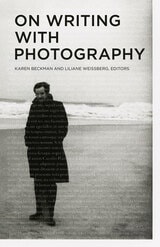
On Writing with Photography
Karen Beckman
University of Minnesota Press, 2013
From James Agee to W. G. Sebald, there has been an explosion of modern documentary narratives and fiction combining text and photography in complex and fascinating ways. However, these contemporary experiments are part of a tradition that stretches back to the early years of photography. Writers have been integrating photographs into their work for as long as photographs have existed, producing rich, multilayered creations; and photographers have always made images that incorporate, respond to, or function as writing. On Writing with Photography explores what happens to texts—and images—when they are brought together.
From the mid-nineteenth century to the present, this collection addresses a wide range of genres and media, including graphic novels, children’s books, photo-essays, films, diaries, newspapers, and art installations. Examining the works of Herman Melville, Don DeLillo, Claude McKay, Man Ray, Dare Wright, Guy Debord, Zhang Ailing, and Roland Barthes, among others, the essays trace the relationship between photographs and “reality” and describe the imaginary worlds constructed by both, discussing how this production can turn into testimony of personal and collective history, memory and trauma, gender and sexuality, and ethnicity.
Together, these essays help explain how writers and photographers—past and present—have served as powerful creative resources for each other.
Contributors: Stuart Burrows, Brown U; Roderick Coover, Temple U; Adrian Daub, Stanford U; Marcy J. Dinius, DePaul U; Marianne Hirsch, Columbia U; Daniel H. Magilow, U of Tennessee, Knoxville; Janine Mileaf; Tyrus Miller, U of California, Santa Cruz; Leah Rosenberg, U of Florida; Xiaojue Wang, U of Pennsylvania.
On the Appearance of the World
A Future for Aesthetics in ArchitectureMark Foster Gage
University of Minnesota Press, 2024
How can architecture develop better aesthetic directions for the twenty-first-century built environment?
Our world, increasingly defined by efficient but unconsidered architecture and cities, seems to be getting uglier. In On the Appearance of the World, Mark Foster Gage asks why. He imagines a future scenario where architectural design and ideas from aesthetic philosophy align toward the production of a built world that is more humane, habitable, beautiful, and just.
On the Way to Theory
Lawrence Grossberg
Duke University Press, 2024
Ordinary Language Criticism
Literary Thinking after Cavell after WittgensteinKenneth Dauber and Walter Jost
Northwestern University Press, 2003
Resisting master formulations and overarching theories, Ordinary Language Criticism does not so much dismiss the excitement of the last two decades of literary theorizing as it reminds us of the excitement of the shared common enterprises to which theory may still contribute. In this, the volume and the model it offers have wide implications for the academy, in which a widespread ersatz-sophistication has shorted the circuit between literary works and the real lives of those reading and teaching them.
With a definitive introduction by editors Kenneth Dauber and Walter Jost, and elaborations and practical examples by major figures such as Cavell himself, Martha Nussbaum, Marjorie Perloff, Anthony Cascardi, and Charles Altieri, among others, this volume clearly shows and explains how ordinary language criticism differs from current trends and what it exactly it can accomplish in theory and practice. These essays prove that by attending more faithfully to what we actually do when we read, we can make reading more productive--can reveal how extraordinary and rich, how really sophisticated, the ordinary actually is.
Oskar Hansen - Opening Modernism
On Open Form Architecture, Art and DidacticsM. Christine Boyer, Tomasz Fudala, Jola Gola, Aleksandra Kedziorek, Lukasz Ronduda, Felicity Scott, Karol Sienkiewicz, Mark Wasiuta, et al.
Museum of Modern Art in Warsaw, 2014
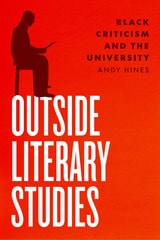
Outside Literary Studies
Black Criticism and the UniversityAndy Hines
University of Chicago Press, 2022
This striking contribution to Black literary studies examines the practices of Black writers in the mid-twentieth century to revise our understanding of the institutionalization of literary studies in America. Andy Hines uncovers a vibrant history of interpretive resistance to university-based New Criticism by Black writers of the American left. These include well-known figures such as Langston Hughes and Lorraine Hansberry as well as still underappreciated writers like Melvin B. Tolson and Doxey Wilkerson. In their critical practice, these and other Black writers levied their critique from “outside” venues: behind the closed doors of the Senate Permanent Subcommittee on Investigations, in the classroom at a communist labor school under FBI surveillance, and in a host of journals. From these vantages, Black writers not only called out the racist assumptions of the New Criticism, but also defined Black literary and interpretive practices to support communist and other radical world-making efforts in the mid-twentieth century. Hines’s book thus offers a number of urgent contributions to literary studies: it spotlights a canon of Black literary texts that belong to an important era of anti-racist struggle, and it fills in the pre-history of the rise of Black studies and of ongoing Black dissent against the neoliberal university.