87 books match the query 'Criticism, Textual' and 3 start with o

cover of Old English Literature in its Manuscript Context

Old English Literature in its Manuscript Context

JOYCE T. LIONARONS

West Virginia University Press, 2004

In Old English Literature in its Manuscript Context, editor Joyce Tally Lionarons has developed a multifaceted collection examining the issues facing the textual transmission of Anglo-Saxon writings. Eight established scholars consider the ideas of textual identity, authorship and translation, and editorial standards and obligations. This work also features a scholarly exchange of ideas and photographs of the original Anglo-Saxon manuscripts, making this essential reading for anyone interested in the history of Old English literature. The essays published in this text were originally composed at an NEH summer seminar conducted by Paul Szarmach and Timothy Graham at the Parker Library of Corpus Christi College, Cambridge in 1997.

[more]
cover of Olde Clerkis Speche: Chaucer's Troilus and Criseyde and the Implications of Authorial Recital

Olde Clerkis Speche

Chaucer's Troilus and Criseyde and the Implications of Authorial Recital

William A. Quinn

Catholic University of America Press, 2013

Olde Clerkis Speche affirms both the historical legitimacy and the interpretive benefits of reading Troilus and Criseyde as if the text were initially composed for Chaucer’s own recital before a familiar audience. Proposing a qualification rather than contradiction of the "persona" as a reading premise, Quinn revitalizes the interpretive context of Chaucer’s original performance milieu. The central five chapters offer a "close hearing" of the possible tonal strategies of each book of Troilus and Criseyde during actual recital. Particular attention is given to expressions now normally overlooked, phrasing that does not advance the modern reader’s appreciation of plot or character development or theme; such "filler" did, however, once offer Chaucer's own "reader response" (or ennaratio) during the recital event. These five chapters simultaneously evaluate the probability that Chaucer himself revised each recital installment for subsequent manuscript circulation. All together, these chapters provide a sustained case study of the interplay between the author's anticipations of recital presence and textual absence. Although this study does not pretend to detail an inaugural staging of Troilus and Criseyde , it does attend to the histrionic potential of Chaucer's own "speche/ In poetrie" (T&C V. 1854-5). The final chapter discusses how such a recital premise impacts several current controversies among Chaucerians, including the dating of Chaucer's individual acts of composition, the underlying assumptions regarding the "publication" of each text, the editorial imposition of punctuation on the manuscript record, and the poet’s increasing anxiety regarding his future absence from the reading event. Olde Clerkis Speche will be of interest to all readers of Chaucer as well as everyone interested in performance theory and the history of reading.
[more]
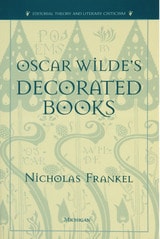
cover of Oscar Wilde's Decorated Books

Oscar Wilde's Decorated Books

Nicholas Frankel

University of Michigan Press, 2000

Oscar Wilde's Decorated Books addresses Wilde's obsession with the visual appearance or "look" of his published writings. It examines the role played by graphic designers in the production of Wilde's writings and demonstrates how marginal and decorative elements of the printed book affect interpretation. Nicholas Frankel approaches Wilde's writings as graphical or "printed" phenomena that reveal their significance through the beautiful and elaborate decorations with which they were published in Wilde's own lifetime. With extensive reference to and exposition on Wilde's theoretical writings and letters, the author shows that, far from being marginal elements of the literary text, these decorative devices were central to Wilde's understanding of his own writings as well as to his "aesthetic" theory of language. Extensive illustrations support Frankel's arguments. The first part of the book lays out a broadly historical view of Wilde’s writings, emphasizing their volatility at the hands of time as well as Wilde’s changing conceptions of his own work. The second part demonstrates the significance that Wilde and his publishers attached to the process of graphic design, showing how marginal and decorative elements of the printed book affect interpretation. Both parts stress the importance of late-Victorian publishing practices to our understanding of Wilde’s writings. The book further challenges the prevailing view of Wilde as essentially a playwright, demonstrating the importance of poetry to Wilde’s own understanding of himself as an author.The book attempts to do justice to Wilde’s own valorization of literature as one of the decorative arts. By emphasizing the visual and collaborative dimensions of Wilde’s texts, Frankel argues that visual decoration was central to Wilde’s theory of language as well as his practice as a writer. Anticipating Baudrillard's distinctionbetween appearance and the transparency, of the sign, Wilde’s writings argue that literary language is both a visual and a material phenomenon — what Wilde himself would call a “beautiful untrue thing” — that demands to be read with the eye as much as the brain.This book will appeal to specialists of Oscar Wilde and the Victorian fin de siècle, to textual and literary scholars, art historians, and linguistic philosophers interested in the graphical nature of the linguistic sign.
[more]