Results by title
102 books match the query 'Demography' and 2 start with o
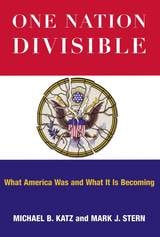
One Nation Divisible
What America Was and What It Is BecomingMichael B. Katz
Russell Sage Foundation, 2006
American society today is hardly recognizable from what it was a century ago. Integrated schools, an information economy, and independently successful women are just a few of the remarkable changes that have occurred over just a few generations. Still, the country today is influenced by many of the same factors that revolutionized life in the late nineteenth century—immigration, globalization, technology, and shifting social norms—and is plagued by many of the same problems—economic, social, and racial inequality. One Nation Divisible, a sweeping history of twentieth-century American life by Michael B. Katz and Mark J. Stern, weaves together information from the latest census with a century's worth of data to show how trends in American life have changed while inequality and diversity have endured. One Nation Divisible examines all aspects of work, family, and social life to paint a broad picture of the American experience over the long arc of the twentieth century. Katz and Stern track the transformations of the U.S. workforce, from the farm to the factory to the office tower. Technological advances at the beginning and end of the twentieth century altered the demand for work, causing large population movements between regions. These labor market shifts fed both the explosive growth of cities at the dawn of the industrial age and the sprawling suburbanization of today. One Nation Divisible also discusses how the norms of growing up and growing old have shifted. Whereas the typical life course once involved early marriage and living with large, extended families, Americans today commonly take years before marrying or settling on a career path, and often live in non-traditional households. Katz and Stern examine the growing influence of government on trends in American life, showing how new laws have contributed to more diverse neighborhoods and schools, and increased opportunities for minorities, women, and the elderly. One Nation Divisible also explores the abiding economic paradox in American life: while many individuals are able to climb the financial ladder, inequality of income and wealth remains pervasive throughout society. The last hundred years have been marked by incredible transformations in American society. Great advances in civil rights have been tempered significantly by rising economic inequality. One Nation Divisible provides a compelling new analysis of the issues that continue to divide this country and the powerful role of government in both mitigating and exacerbating them. A Volume in the Russell Sage Foundation Census Series
[more]
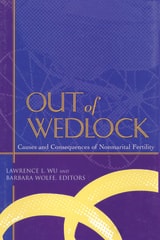
Out of Wedlock
Causes and Consequences of Nonmarital FertilityLarry Wu
Russell Sage Foundation, 2001
Today, one third of all American babies are born to unmarried mothers—a startling statistic that has prompted national concern about the consequences for women, children, and society. Indeed, the debate about welfare and the overhaul of the federal welfare program for single mothers was partially motivated by the desire to reduce out of wedlock births. Although the proportion of births to unwed mothers has stopped climbing for the first time since the 1960s, it has not decreased, and recent trends are too complex to attribute solely to policy interventions. What are these trends and how do they differ across groups? Are they peculiar to the United States, or rooted in more widespread social forces? Do children of unmarried mothers face greater life challenges, and if so what can be done to help them? Out of Wedlock investigates these questions, marshalling sociologists, demographers, and economists to review the state of current research and to provide both empirical information and critical analyses. The conflicting data on nonmarital fertility give rise to a host of vexing theoretical, methodological, and empirical issues, some of which researchers are only beginning to address. Out of Wedlock breaks important new ground, bringing clarity to the data and examining policies that may benefit these particularly vulnerable children.
[more]