Results by title
679 books match the query 'Ecology' and 15 start with o
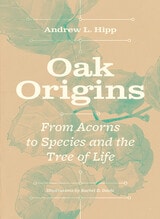
Oak Origins
From Acorns to Species and the Tree of LifeAndrew L. Hipp
University of Chicago Press, 2024
An oak begins its life with the precarious journey of a pollen grain, then an acorn, then a seedling. A mature tree may shed millions of acorns, but only a handful will grow. One oak may then live 100 years, 250 years, or even 13,000 years. But the long life of an individual is only a part of these trees’ story.
With naturalist and leading researcher Andrew L. Hipp as our guide, Oak Origins takes us through a sweeping evolutionary history, stretching back to a population of trees that lived more than 50 million years ago. We travel to the ancient tropical Earth to see the ancestors of the oaks evolving side by side with the dinosaurs. We journey from the oaks’ childhood in the once-warm forests of the Arctic to the montane cloud forests of Mexico and the broad-leaved evergreen forests of Southeast Asia. We dive into current research on oak genomes to see how scientists study genes’ movement between species and how oaks evolve over generations—spanning tens of millions of years. Finally, we learn how oak evolutionary history shapes the forests we know today, and how it may even shape the forests of the future.
Oaks are familiar to almost everyone, and beloved. They are embedded in our mythology. They have fed us, housed us, provided wood for our ships and wine barrels and homes and halls, planked our roads, and kept us warm. Every oak also has the potential to feed thousands of birds, squirrels, and mice and host countless insects, mosses, fungi, and lichens. But as Oak Origins makes clear, the story of the oaks’ evolution is not just the story of one important tree. It is the story of the Tree of Life, connecting all organisms that have ever lived on Earth, from oaks’ last common ancestor to us.
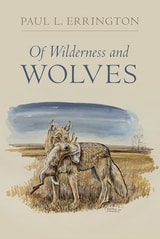
Of Wilderness and Wolves
Paul L. Errington
University of Iowa Press, 2015
Tracing his own relationship with wolves from his rural South Dakota upbringing through his formative years as a professional trapper to his landmark work as an internationally renowned wildlife biologist, Errington delves into our irrational fear of wolves. He forthrightly criticizes what he views as humanity’s prejudice against an animal that continues to serve as the very emblem of the wilderness we claim to love, but that too often falls prey to our greed and ignorance. A friend of Aldo Leopold, Errington was an important figure in the conservation efforts in the first half of the twentieth century. During his lifetime, wolves were considered vicious, wantonly destructive predators; by the mid-1900s, they had been almost completely eliminated from the lower forty-eight states. Their reintroduction to their historical range today remains controversial.
Lyrical yet unsentimental, Of Wilderness and Wolves provides a strong and still-timely dose of ecological realism for the abusive mismanagement of our natural resources. It is a testament to our shortsightedness and to Errington’s vision that this book, its publication so long delayed, still speaks directly to our environmental crises.
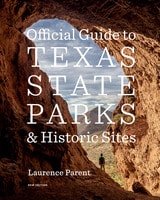
Official Guide to Texas State Parks and Historic Sites
New EditionBy Laurence Parent
University of Texas Press, 2018
Since it was first published in 1996, Official Guide to Texas State Parks and Historic Sites has become Texans’ one-stop source for information on great places to camp, fish, hike, backpack, swim, ride horseback, go rock climbing, view scenic landscapes, tour historical sites, and enjoy almost any other outdoor recreation.
Freshly redesigned, this revised edition includes eight new state parks and historical sites, completely updated information for every park, and beautiful new photographs for most of the parks. The book is organized by geographical regions to help you plan your trips around the state. For every park, Laurence Parent provides all of the essential information:
- The natural or historical attractions of the park
- Types of recreation offered
- Camping and lodging facilities
- Addresses and phone numbers
- Magnificent color photographs
So if you want to watch the sun set over Enchanted Rock, fish in the surf on the beach at Galveston, or listen for a ghostly bugle among the ruins of Fort Lancaster, let this book be your complete guide. Don’t take a trip in Texas without it.
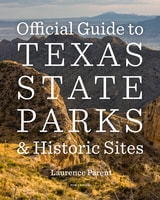
Official Guide to Texas State Parks and Historic Sites
New EditionLaurence Parent
University of Texas Press, 2024
The essential guide to Texas’s state parks and historic sites.
Updated with a new park, Palo Pinto Mountains State Park west of Forth Worth; new historic sites; and scores of beautiful new photographs, the Official Guide to Texas State Parks has all the essential information organized by geographical regions to help you plan your great Texas adventure. The only complete resource of its kind on Texas, Laurence Parent’s Official Guide to Texas State Parks is the trusted source, with more than sixty-five thousand copies sold over the past thirty years.
Praise for Previous Editions
“Texas state-park fans should be thrilled. . . . Official Guide to Texas State Parks is the ultimate book detailing Texas’s state parks.”—Dallas Morning News
“This book will make you want to hit the road to visit the natural splendor of Texas.”—Houston Chronicle
“It’s good enough for a coffee table or a campfire. The Official Guide to Texas State Parks gives you sleek photography, maps, narratives, and loads of information.”—Southern Living
“The newly updated Official Guide to Texas State Parks and Historic Sites . . . has beautiful color photographs and insights on camping, fishing, horseback riding, and other recreational opportunities around the state.”—Texas Journey
Oil Beach
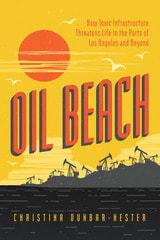
How Toxic Infrastructure Threatens Life in the Ports of Los Angeles and BeyondChristina Dunbar-Hester
University of Chicago Press, 2023
San Pedro Bay, which contains the contiguous Ports of Los Angeles and Long Beach, is a significant site for petroleum shipping and refining as well as one of the largest container shipping ports in the world—some forty percent of containerized imports to the United States pass through this so-called America’s Port. It is also ecologically rich. Built atop a land- and waterscape of vital importance to wildlife, the heavily industrialized Los Angeles Harbor contains estuarial wetlands, the LA River mouth, and a marine ecology where colder and warmer Pacific Ocean waters meet. In this compelling interdisciplinary investigation, award-winning author Christina Dunbar-Hester explores the complex relationships among commerce, empire, environment, and the nonhuman life forms of San Pedro Bay over the last fifty years—a period coinciding with the era of modern environmental regulation in the United States. The LA port complex is not simply a local site, Dunbar-Hester argues, but a node in a network that enables the continued expansion of capitalism, propelling trade as it drives the extraction of natural resources, labor violations, pollution, and other harms. Focusing specifically on cetaceans, bananas, sea birds, and otters whose lives are intertwined with the vitality of the port complex itself, Oil Beach reveals how logistics infrastructure threatens ecologies as it circulates goods and capital—and helps us to consider a future where the accumulation of life and the accumulation of capital are not in violent tension.
Oil Beach
How Toxic Infrastructure Threatens Life in the Ports of Los Angeles and BeyondChristina Dunbar-Hester
University of Chicago Press, 2023
Can the stories of bananas, whales, sea birds, and otters teach us to reconsider the seaport as a place of ecological violence, tied to oil, capital, and trade?
San Pedro Bay, which contains the contiguous Ports of Los Angeles and Long Beach, is a significant site for petroleum shipping and refining as well as one of the largest container shipping ports in the world—some forty percent of containerized imports to the United States pass through this so-called America’s Port. It is also ecologically rich. Built atop a land- and waterscape of vital importance to wildlife, the heavily industrialized Los Angeles Harbor contains estuarial wetlands, the LA River mouth, and a marine ecology where colder and warmer Pacific Ocean waters meet. In this compelling interdisciplinary investigation, award-winning author Christina Dunbar-Hester explores the complex relationships among commerce, empire, environment, and the nonhuman life forms of San Pedro Bay over the last fifty years—a period coinciding with the era of modern environmental regulation in the United States. The LA port complex is not simply a local site, Dunbar-Hester argues, but a node in a network that enables the continued expansion of capitalism, propelling trade as it drives the extraction of natural resources, labor violations, pollution, and other harms. Focusing specifically on cetaceans, bananas, sea birds, and otters whose lives are intertwined with the vitality of the port complex itself, Oil Beach reveals how logistics infrastructure threatens ecologies as it circulates goods and capital—and helps us to consider a future where the accumulation of life and the accumulation of capital are not in violent tension.

Oil Spills
Joanna Burger
Rutgers University Press, 1997
Okoboji Wetlands
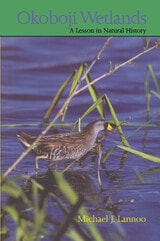
A Lesson in Natural HistoryMichael J. Lannoo
University of Iowa Press, 1996
Lake Okoboji in northwest Iowa is the jewel of the Iowa Great Lakes. A region of wetlands formed by prairie potholes, the area is rich with lakes, sloughs, fens, creeks, prairies, and kettleholes. In this readable and beautifully illustrated volume, Michael Lannoo presents an extensive natural history of Okoboji and its cherished wetlands that examines that world of our grandparents, compares it to today's world, and extrapolates to the world of our grandchildren.
On Land and Sea
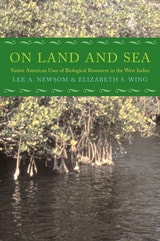
Native American Uses of Biological Resources in the West IndiesLee A. Newsom and Elizabeth S. Wing
University of Alabama Press, 2003
During the vast stretches of early geologic time, the islands of the Caribbean archipelago separated from continental land masses, rose and sank many times, merged with and broke from other land masses, and then by the mid-Cenozoic period settled into the current pattern known today. By the time Native Americans arrived, the islands had developed complex, stable ecosystems. The actions these first colonists took on the landscape—timber clearing, cultivation, animal hunting and domestication, fishing and exploitation of reef species—affected fragile land and sea biotic communities in both beneficial and harmful ways.
On Land and Sea examines the condition of biosystems on Caribbean islands at the time of colonization, human interactions with those systems through time, and the current state of biological resources in the West Indies. Drawing on a massive data set collected from long-term archaeological research, the study reconstructs past lifeways on these small tropical islands. The work presents a wide range of information, including types of fuel and construction timber used by inhabitants, cooking techniques for various shellfish, availability and use of medicinal and ritual plants, the effects on native plants and animals of cultivation and domestication, and diet and nutrition of native populations.
The islands of the Caribbean basin continue to be actively excavated and studied in the quest to understand the earliest human inhabitants of the New World. This comprehensive work will ground current and future studies and will be valuable to archaeologists, anthropologists, botanists, ecologists, Caribbeanists, Latin American historians, and anyone studying similar island environments.
On Water
Fluid PerspectivesEdited by Anna-Lisa Dieter
Diaphanes, 2027
Asks what we can learn from water's cycles, its adaptability, and its capacity for connection.
Water is ubiquitous: we drink it, bathe in it, and encounter it as rain, ice, rivers, and oceans. And yet it remains contradictory, both familiar and strange. In the context of climate change, growing cities, and global inequality, it poses a distinct challenge to established practices and ways of thinking. Contributors to this volume frame water as a dynamic element that fosters new scientific perspectives and inventive forms of social negotiation. On Water: Fluid Perspectives brings science, art, and society into conversation, exploring a single element and the many ways of thinking with it. This book accompanies the exhibition On Water—WasserWissen at Humboldt Labor in Berlin while extending its questions and perspectives beyond the show. Visual materials from the exhibition are interwoven with thoughtful essays from Berlin researchers that illuminate water as a compelling subject of inquiry.
Once a River
Bird Life and Habitat Changes on the Middle GilaAmadeo M. Rea
University of Arizona Press, 1983
It is no mystery how the desert swallowed up the Gila. Beaver trapping, overgrazing, and woodcutting first ruined natural watersheds, then damming confined the last drops of its surface flow. Historical sources and archaeological data inform us of the Gila's past, but its bird life further testifies to the changes.
Amadeo Rea traces the decline of bird life on the Middle Gila in a book that addresses the broader issue of habitat deterioration. Bird lovers will find it a storehouse of data on avian migration patterns and on ornithological classification based on skeletal structure. Anthropologists can draw on its Piman ethnoclassification of birds, which links the Gila River tribe with various other Uto-Aztecan peoples of Mexico's west coast.
But for all concerned with protecting our environment, Once a River offers evidence of change that might be apprehended elsewhere. It is a case history of a loss that perhaps need never have occurred.
One Planet, Many Worlds
The Climate ParallaxDipesh Chakrabarty
Brandeis University Press, 2023
Climate change represents a deep conundrum for humans. It is difficult for humans to give up the unequal and yet accelerating pursuit of a good life based on an insatiable appetite for energy sourced mainly from fossil fuel. But the same pursuit, scientists insist, damages the geobiological system that supports the existence of interrelated forms of life, including ours, on this planet. The planet, seen thus, is one. The global sway of financial and extractive capital connects humans technologically, but they remain divided along multiple axes of inequality. Their worlds are many and their politics still global rather than planetary. In the narrative presented here, Chakrabarty continues to explore the temporal and intellectual fault lines that mark the collapse of the global and the planetary in human history.
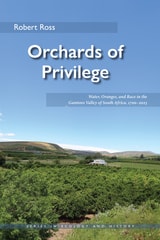
Orchards of Privilege
Water, Oranges, and Race in the Gamtoos Valley of South Africa, 1700–2023Robert Ross
Ohio University Press, 2025
This study of the Gamtoos River floodplain in South Africa’s Eastern Cape Province traces its transformation from an eighteenth-century natural landscape of thick bush into an agricultural zone now threatened by climate change. The first half of the book explains how missionaries from the London Missionary Society and residents of the Hankey Mission Station introduced irrigation, turning the area into a community of small-scale farmers. Despite early failures, by 1849 they had constructed South Africa’s first major irrigation tunnel and aqueduct. However, conflicts between the missionaries and residents led to the loss of communal lands to privatization, which ultimately impoverished the local farmers. The second half explores efforts to develop the valley for large-scale agriculture, addressing challenges like drought, flash floods, and saline water. By the mid-twentieth century, Afrikaners dominated the area, benefiting from the construction in 1970 of the Kouga Dam, which provided fresh water for the floodplain. This led to the rise of a wealthy white farming community, sustained by apartheid policies and labor from the “Coloured” and African populations. In the early twenty-first century, however, this prosperity has become threatened by severe droughts linked to global climate change. In view of these historical transformations, the Gamtoos River floodplain exemplifies the complex interplay between human ambition, environmental challenges, and sociopolitical forces.
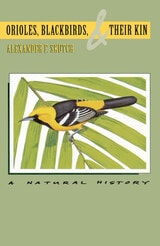
Orioles, Blackbirds, and Their Kin
A Natural HistoryAlexander F. Skutch
University of Arizona Press, 1996
The least known of these species are perhaps best known to Alexander Skutch, who has studied birds in a Costa Rican tropical valley for more than half a century. In this fascinating book the first devoted exclusively to the icterids—he combines his own observations with those of other naturalists to provide a comparative natural history and biology of this remarkable family of birds. Devoting a separate chapter to each major group or genus, he delineates the outstanding characteristics of each and includes observations of little-studied tropical species such as caciques and oropendolas.
Orioles, Blackbirds, and Their Kin is an eminently readable natural history in the classic style. Enhanced by 31 scratchboard illustrations, this book will delight nature enthusiasts everywhere with its fascinating exposition of avian diversity. Because so much of the published information on the icterids is widely scattered, Skutch's painstaking compilation has created a valuable reference work that will provide students and researchers with a wealth of new insights into the tropical members of this New World family.
Our Oldest Task
Making Sense of Our Place in NatureEric T. Freyfogle
University of Chicago Press, 2017
Passionate and pragmatic, extraordinarily well read and eloquent, Freyfogle details a host of forces that have produced our self-defeating ethos of human exceptionalism. It is this outlook, he argues, not a lack of scientific knowledge or inadequate technology, that is the primary cause of our ecological predicament. Seeking to comprehend both the multifaceted complexity of contemporary environmental problems and the zeitgeist as it unfolds, Freyfogle explores such diverse topics as morality, the nature of reality (and the reality of nature), animal welfare, social justice movements, and market politics. The result is a learned and inspiring rallying cry to achieve balance, a call to use our knowledge to more accurately identify the dividing line between living in and on the world and destruction. “To use nature,” Freyfogle writes, “but not to abuse it.”