Results by title
917 books match the query 'Economics' and 9 start with o

Obesity among Poor Americans
Is Public Assistance the Problem?Patricia K. Smith
Vanderbilt University Press, 2009
This book investigates the controversial claim by welfare critics that public assistance programs like Food Stamps and the National School Lunch programs contribute to obesity among the poor. The author synthesizes empirical evidence from an array of disciplines--anthropology, economics, epidemiology, medicine, nutrition science, marketing, psychology, public health, sociology, and urban planning--to test this claim and to test whether other causal processes are at work.
With a lucid presentation that makes it a model for applying research to questions of social policy, the book lays out the different hypotheses and the possible causal pathways within each. The four central chapters test whether "public assistance causes obesity," "obesity causes public assistance," "poverty causes both public assistance and obesity," and "Factor X causes both." The factors in the last category that may relate to both public assistance and obesity include stress, disability, and physical abuse.

Oikonomia
Ancient Greek Philosophers on the Meaning of Economic LifeÉtienne Helmer
University of Chicago Press, 2024
In this book, Étienne Helmer offers a comprehensive analysis of oikonomia in ancient Greek philosophy. Despite its similarity to the word “economy,” for the ancients, oikonomia named a branch of knowledge—the science of management—that was aimed at studying the practices we engage in to satisfy our needs. This began with the domestic sphere, but it radiated outward from the oikos (house) to encompass broader issues in the polis (city) as well. Helmer explores topics such as gender roles and marriage, property and the household, the acquisition and preservation of material goods, and how Greek philosophers addressed the issue of slavery in the ancient world. Even if we are not likely to share many of ancient thinkers’ beliefs today, Helmer shows that there was once a way of thinking of “economic life” that went beyond the mere accumulation of wealth, representing a key point of departure for understanding how to inhabit the world with others.
Old Assumptions, New Realities
Ensuring Economic Security for Working Families in the 21st CenturyRobert D. Plotnick
Russell Sage Foundation, 2011
On Economics and Society
Selected EssaysHarry G. Johnson
University of Chicago Press, 1982

On the Economic Theory of Socialism
Oskar Lange
University of Minnesota Press, 1938
On the Job
Is Long-Term Employment a Thing of the Past?David, editor Neumark
Russell Sage Foundation, 2000
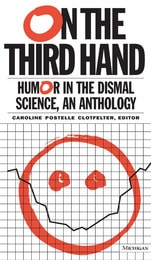
On the Third Hand
Wit and Humor in the Dismal ScienceCaroline Postelle Clotfelter, Editor
University of Michigan Press, 1996
Bringing economic humor into the light of day, Caroline Clotfelter gathers her collection of materials into recognizable categories: economists as others see them, the language and methods of economics, Econ 101, micro- and macroeconomics, and basic economic models and ideas. Aiding and abetting her include such luminaries as John Stuart Mill, George Bernard Shaw, Mad Magazine, Stephen Leacock, Emily Dickinson, Rube Goldberg, Pogo, and John Kenneth Galbraith. As no other, this book will challenge economists to enjoy jokes at their own expense; noneconomists may have even less difficulty finding something funny in this most dismal of sciences.
Caroline Postelle Clotfelter, former Professor of Economics, Mercer University, is now retired.

Opposition by Imitation
The Economics of Italian Anti-Mafia ActivismChristina Jerne
University of Minnesota Press, 2025
Defying the mafia with everyday acts of resistance
For more than 150 years, Italy has been home to a resilient and evolving resistance against the pervasive influence of mafias. While these criminal organizations are renowned for their vast international business enterprises, the collective actions taken to oppose them are less known. In Opposition by Imitation, Christina Jerne explores anti-mafia activism, revealing how ordinary people resist, counter, and prevent criminal economies from proliferating.
Drawing on ethnographic fieldwork among anti-mafia alliances in Campania, Sicily, and other parts of Italy, Jerne details a particular aspect of mafia activities: providing cash relief and other forms of patronage to individuals and groups. Her research shows how activism has evolved to imitate this sustaining role. Activists are increasingly challenging mafia control both by creating alternative economies—from producing food that interrupts mafia labor practices to organizing tourism that supports anti-mafia hospitality—and by subversively adopting business tactics similar to the mafia’s to compete with their social influence and legitimacy. Exposing the political implications of this mimetic opposition, Jerne points to its potential impact on crime prevention and criminalization, both in Italy and globally.
Opposition by Imitation shows how these modern-day Robin Hoods are redefining collective action, taking what was controlled by the mafias and returning it to the collective. This contentious economic turn, against the backdrop of broader social movements, reveals significant political possibilities afforded by imitative opposition.
Retail e-book files for this title are screen-reader friendly with images accompanied by short alt text and/or extended descriptions.
Origins of a Spontaneous Revolution
East Germany, 1989Karl-Dieter Opp, Peter Voss, and Christiane Gern
University of Michigan Press, 1995