Results by title
81 books match the query 'Educational equalization' and 2 start with o
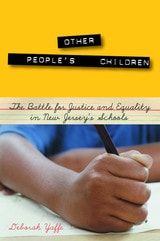
Other People's Children
The Battle for Justice and Equality in New Jersey's SchoolsYaffe, Deborah
Rutgers University Press, 2007
Winner of the 2008 NJ Studies Academic Alliance author's award for an outstanding non-fiction work about New Jersey
In 1981, when Raymond Abbott was a twelve-year-old sixth-grader in Camden, New Jersey, poor city school districts like his spent 25 percent less per student than the state’s wealthy suburbs did. That year, Abbott became the lead plaintiff in a landmark class-action lawsuit demanding that the state provide equal funding for rich and poor schools. Over the next twenty-five years, as the non-profit law firm representing the plaintiffs won ruling after ruling from the New Jersey Supreme Court, Abbott dropped out of school, fought a cocaine addiction, and spent time in prison before turning his life around.
Raymond Abbott’s is just one of the many human stories that have too often been forgotten in the policy battles New Jersey has waged for two generations over equal funding for rich and poor schools. Other People’s Children, the first book to tell the story of this decades-long school funding battle, interweaves the public story—an account of legal and political wrangling over laws and money—with the private stories of the inner-city children who were named plaintiffs in the state’s two school funding lawsuits, Robinson v. Cahill and Abbott v. Burke. Although these cases have shaped New Jersey’s fiscal and political landscape since the 1970s, most recently in legislative arguments over tax reform, the debate has often been too abstract and technical for most citizens to understand. Written in an accessible style and based on dozens of interviews with lawyers, politicians, and the plaintiffs themselves, Other People’s Children crystallizes the arguments and clarifies the issues for general readers.
Beyond its implications for New Jersey, this book is an important contribution to the conversations taking place in all states about the nation’s responsibility for its poor, and the role of public schools in providing equal opportunities and promising upward mobility for hard-working citizens, regardless of race or class.
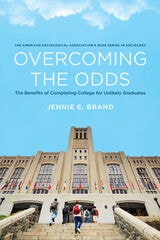
Overcoming the Odds
The Benefits of Completing College for Unlikely GraduatesJennie E. Brand
Russell Sage Foundation, 2023
Drawing on two cohorts of nationally representative data from the Bureau of Labor Statistics National Longitudinal Surveys program, Brand uses matching and machine learning methods to estimate the effects of college completion across students with varying likelihoods of completing four-year degrees. To illustrate her findings, Brand describes outcomes using matched vignettes of college and non-college graduates. Brand shows that four-year college completion enables graduates to increase wages and household income, while also circumventing unemployment, low-wage work, job instability, poverty, and social assistance. Completing college also increases civic engagement. Most of these benefits are larger for disadvantaged than for more advantaged students, rendering arguments that college has limited benefits for unlikely graduates as flawed. Brand concludes that greater long-term earnings, and less job instability and unemployment, and thus more tax revenue, less reliance on public assistance, and high levels of volunteering indicate that public investment in higher education for students from disadvantaged backgrounds yields far-reaching collective benefits. She asserts that it is better for our society when more people complete college.
Overcoming the Odds is an innovative and enlightening exploration of how college can transform lives.