Results by title
153 books match the query 'Egypt' and 5 start with o
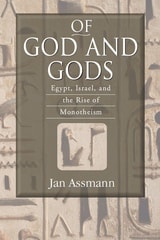
Of God and Gods
Egypt, Israel, and the Rise of MonotheismJan Assmann
University of Wisconsin Press, 2008
For thousands of years, our world has been shaped by biblical monotheism. But its hallmark—a distinction between one true God and many false gods—was once a new and radical idea. Of God and Gods explores the revolutionary newness of biblical theology against a background of the polytheism that was once so commonplace.
Jan Assmann, one of the most distinguished scholars of ancient Egypt working today, traces the concept of a true religion back to its earliest beginnings in Egypt and describes how this new idea took shape in the context of the older polytheistic world that it rejected. He offers readers a deepened understanding of Egyptian polytheism and elaborates on his concept of the “Mosaic distinction,” which conceives an exclusive and emphatic Truth that sets religion apart from beliefs shunned as superstition, paganism, or heresy.
Without a theory of polytheism, Assmann contends, any adequate understanding of monotheism is impossible.
Best Books for General Audiences, selected by the American Association of School Librarians, and Best Books for Special Interests, selected by the Public Library Association
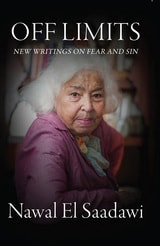
Off Limits
New Writings on Fear and SinNawal El Saadawi
Gingko, 2018
Off Limits presents a selection of El Saadawi’s most recent recollections and reflections in which she considers the role of women in Egyptian and wider Islamic society, the inextricability of imperialism from patriarchy, and the meeting points of East and West. These thoughtful and wide-reaching pieces leave no stone unturned and no view unchallenged, and the essays collected here offer further insight into this profound author’s ideas about women, society, religion, and national identity.
On the Semicivilized
Coloniality, Finance, and Embodied Sovereignty in CairoJulia Elyachar
Duke University Press, 2025
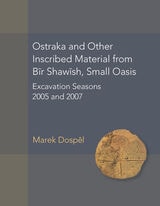
Ostraka and Other Inscribed Material from Bir Shawish, Small Oasis
Excavation Seasons 2005 and 2007Marek Dospel
University of Michigan Press, 2020
Informal documents and remains of material culture, when analyzed properly, offer a unique window into the daily lives and workings of ancient civilizations. Published here in their archaeological context and with any relevant artifacts, the documents and inscriptions excavated recently in Egypt’s Western Desert represent a valuable addition to our meager documentation of the Bahriya Oasis in the first centuries CE.
This is the first comprehensive treatment of an archaeological dataset from the archaeological exploration of Bīr Shawīsh. Dating to around 400 CE, these primary historical sources include documentary texts written on ostraka, informal inscriptions on various ceramic objects, plus a group of incised lids. The core of the volume consists of an annotated edition and analytical indices. This is prefaced by the historical and archaeological context and is followed by a synthesis of selected issues inherent to the published material. The book includes appendices and pictures of all published objects. Doubling the number of texts and inscriptions published to date from the Small Oasis, this new corpus furthers our understanding of the economic, administrative, and social history of Late Antique Egypt.
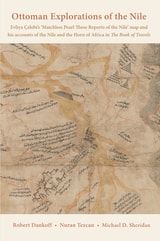
Ottoman Explorations of the Nile
Evliya Çelebi’s Map of the Nile and The Nile Journeys in the Book of Travels (Seyahatname)Robert Dankoff, Nuran Tezcan, and Michael D. Sheridan
Gingko, 2018
Evliya Çelebi’s account of his Nile journeys, in the tenth volume of his Book of Travels (Seyahatname), has been known to the scholarly world since 1938, when that volume was first published. The map, held in the Vatican Library, has been studied since at least 1949. Numerous new critical editions of both the map and the text have been published over the years, each expounding upon the last in an attempt to reach a definitive version. The Ottoman Explorations of the Nile provides a more accurate translation of the original travel account. Furthermore, the maps themselves are reproduced in greater detail and vivid color, and there are more cross-references to the text than in any previous edition. This volume gives equal weight and attention to the two parts that make up this extraordinary historical document, allowing readers to study the map or the text independently, while also using each to elucidate and accentuate the details of the other.