Results by title
60 books match the query 'Energy' and 4 start with o

Oil Wars
Yahia Said
Pluto Press, 2007
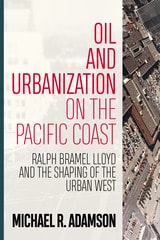
Oil and Urbanization on the Pacific Coast
Ralph Bramel Lloyd and the Shaping of the Urban WestMichael R. Adamson
West Virginia University Press, 2018
Oil and Urbanization on the Pacific Coast tells the story of oilman Ralph Bramel Lloyd, a small business owner who drove the development of one of America’s largest oil fields. Lloyd invested his petroleum earnings in commercial real estate—much of it centered around automobiles and the fuel they require—in several western cities, notably Portland, Oregon. Putting the history of extractive industry in dialogue with the history of urban development, Michael R. Adamson shows how energy is woven into the fabric of modern life, and how the “energy capital” of Los Angeles exerted far-flung influence in the US West.
A contribution to the relatively understudied history of small businesses in the United States, Oil and Urbanization on the Pacific Coast explores issues of interest to multiple audiences, such as the competition for influence over urban development waged among local growth machines and outside corporate interests; the urban rivalries of a region; the importance of public capital in mobilizing the commercial real estate sector during the Great Depression and World War II; and the relationships among owners, architects, and contractors in the execution of commercial building projects.
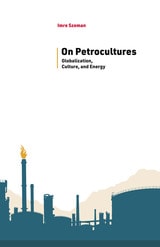
On Petrocultures
Globalization, Culture, and EnergyImre Szeman
West Virginia University Press, 2019
On Petrocultures brings together key essays by Imre Szeman, a leading scholar in the field of energy humanities and a critical voice in debates about globalization and neoliberalism. Szeman’s most important and influential essays, in dialogue with exciting new pieces written for the book, investigate ever-evolving circuits of power in the contemporary world, as manifested in struggles over space and belonging, redefinitions of work and individual autonomy, and the deep links between energy use and climate change.
These essays explore life lived in the twenty-first century by examining critically the vocabulary through which capitalism makes sense of itself, focusing on concepts like the nation, globalization, neoliberalism, creativity, and entrepreneurship. At the heart of the volume is the concept of “petrocultures,” which demands that we understand a fundamental fact of modern life: we are shaped by and through fossil fuels. Szeman argues that we cannot take steps to address global warming without fundamentally changing the social, cultural, and political norms and expectations developed in conjunction with the energy riches of the past century. On Petrocultures maps the significant challenge of our dependence on fossil fuels and probes ways we might begin to leave petrocultures behind.
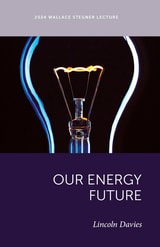
Our Energy Future
Lincoln Davies
University of Utah Press, 2025
In Our Energy Future, Lincoln Davies shines a bright light on the challenges the transition presents, including energy equity, political partisanship, the need for holistic solutions, and adaptability in the face of change. Our Energy Future makes the case for why the United States’ current transition to clean energy provides our world with something we so desperately need today: hope.