Results by title
1049 books match the query 'English, Irish, Scottish, Welsh' and 21 start with o
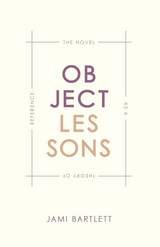
Object Lessons
The Novel as a Theory of ReferenceJami Bartlett
University of Chicago Press, 2016
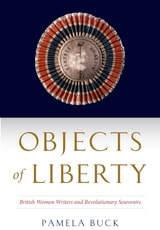
Objects of Liberty
British Women Writers and Revolutionary SouvenirsPamela Buck
University of Delaware Press, 2024
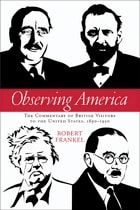
Observing America
The Commentary of British Visitors to the United States, 1890–1950Robert Frankel
University of Wisconsin Press, 2006
Robert Frankel examines the New World experiences of these commentators and the books they wrote about America. He also probes similar writings by other prominent observers from the British Isles, including Beatrice Webb, Rudyard Kipling, and George Bernard Shaw. The result is a book that offers keen insights into America’s national identity in a time of vast political and cultural change.
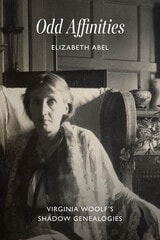
Odd Affinities
Virginia Woolf’s Shadow GenealogiesElizabeth Abel
University of Chicago Press, 2024
In recent decades, Virginia Woolf’s contribution to literary history has been located primarily within a female tradition. Elizabeth Abel dislodges Woolf from her iconic place within this tradition to uncover her shadowy presence in other literary genealogies. Abel elicits unexpected echoes of Woolf in four major writers from diverse cultural contexts: Nella Larsen, James Baldwin, Roland Barthes, and W. G. Sebald. By mapping the wayward paths of what Woolf called “odd affinities” that traverse the boundaries of gender, race, and nationality, Abel offers a new account of the arc of Woolf’s career and the transnational modernist genealogy constituted by her elusive and shifting presence. Odd Affinities will appeal to students and scholars working in New Modernist studies, comparative literature, gender and sexuality studies, and African American studies.
Odyssey of the Psyche
Jungian Patterns in Joyce's UlyssesJean Kimball
Southern Illinois University Press, 1997
The result of the interaction between Bloom and Dedalus, Kimball argues as a central tenet in her unique reading of Ulysses, is the gradual development of a relationship between the two protagonists that parallels C. G. Jung’s descriptions of the encounter between the Ego and the Shadow in that stage of his theoretical individuation process called "the realization of the shadow." These parallels form a unifying strand of meaning that runs throughout this multidimensional novel and is supported by the text and contexts of Ulysses.
Kimball has provided the first comprehensive study of the relationship between Jungian psychology and Joyce’s Ulysses. Bucking critical trends, she focuses on Stephen rather than Bloom. She also notes certain parallels—synchronicities—in the lives of both Jung and Joyce, not because the men influenced one another but because they speculated about personality at the same historical time. Finally, noting that both Jung and Joyce came from strong Christian backgrounds, she asserts that the doubleness of the human personality fundamental to Christian theology is carried over into Jung’s psychology and Joyce’s fiction.
Of Sondry Folk
The Dramatic Principle in the Canterbury TalesBy R. M. Lumiansky
University of Texas Press, 1955
Two hundred years before Shakespeare observed that “all the world’s a stage,” another writer with a flair for drama realized the same fact. This writer was Geoffrey Chaucer.
Chaucer, however, presented his dramatic efforts through the medium of short stories, and he is regularly referred to as one of the world’s great storytellers. Yet there are certain questions which arise time and again in the minds of literary scholars. Most of the tales in the Canterbury collection are excellent, but why did Chaucer include such obviously poor recitals as the dull “Melibeus” and the lengthy “Parson’s Tale”? Did he fail to recognize their lack of literary merit? Or were those of his stories which seem so dull to modern readers really popular in fourteenth-century England?
Of Sondry Folk is Lumiansky’s answer to such questions. But it is more than that. It is the revelation of Chaucer as dramatic writer. Chaucer, says Lumiansky, did not intend primarily to tell a series of good tales. Instead, he chose tales which suited his purpose of dramatic exposition of character. And the characters, though drawn from many walks of life, are not stereotypes. Their tales not only disclose what the Pilgrims think of themselves but reveal these Pilgrims as they really are—dull, romantic, egotistical, pious, or lustful.
Not all readers will agree with Lumiansky’s conclusions in this book. But his scholarship, his clear, uninvolved prose, and his wit and frankness make of it an excellent handbook for the student of the Canterbury Tales. Of Sondry Folk will increase the enjoyment and understanding of Chaucer’s art for any reader, lay or scholarly.
Of Spaces and Ideas
The Novels of Jim Crace and Simon MawerPetr Chalupský and Tereza Topolovská
Karolinum Press, 2024
Of Spaces and Ideas provides a deeper insight into the work of two contemporary British novelists, Jim Crace and Simon Mawer, with a particular emphasis on spatial sensibility as one of the defining elements of their poetics. Drawing on a range of literary-theoretical approaches to space, the study analyzes selected novels by the two writers to demonstrate the ways in which they render space and place and, above all, the ways in which their spatial representations allow them to express the key ideas behind their stories, namely those of identity, history, and the relationship between an individual and the environment in which they live.
On the Bullet Train with Emily Brontë
Wuthering Heights in JapanJudith Pascoe
University of Michigan Press, 2017
In this and in her previous book, The Sarah Siddons Audio Files, Pascoe’s engaging narrative innovates a new scholarly form involving immersive research practice to attempt a cross-cultural version of reader-response criticism. On the Bullet Train with Emily Brontë will appeal to scholars in the fields of 19th-century British literature, adaptation studies, and Japanese literary history.
One of Us
The Mastery of Joseph ConradGeoffrey Galt Harpham
University of Chicago Press, 1996
In this book, Geoffrey Galt Harpham delves not only into Conrad's literary work and reputation but also into the concept of mastery. Outlining a psychology of composition that embraces Conrad's personal as well as historical circumstances, Harpham sheds new light on traditional issues in Conrad criticism, such as his Polish background and his preoccupation with the sea, by linking them to less frequently discussed subjects, including his elusive sexuality and his idiosyncratic relation to the English language.
One of Us represents both a methodological innovation in the practice of literary criticism and an important contribution to our understanding of how masters—and canons based on them—are made.
Ornamentalism
The Art of Renaissance AccessoriesEdited and with an Introduction by Bella Mirabella
University of Michigan Press, 2011
Lively, well-written, and richly illustrated with color plates, Ornamentalism will appeal to scholars of the material past and social practice, and those interested in fashion studies, manners and morals, gender and sexuality, theater and performance.
Orwell
Life and ArtJeffrey Meyers
University of Illinois Press, 2010
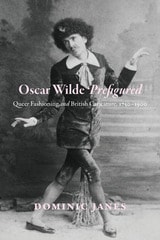
Oscar Wilde Prefigured
Queer Fashioning and British Caricature, 1750-1900Dominic Janes
University of Chicago Press, 2016
Oscar Wilde Prefigured is a study of the prehistory of this “queer moment” in 1895. Janes explores the complex ways in which men who desired sex with men in Britain had expressed such interests through clothing, style, and deportment since the mid-eighteenth century. He supplements the well-established narrative of the inscription of sodomitical acts into a homosexual label and identity at the end of the nineteenth century by teasing out the means by which same-sex desires could be signaled through visual display in Georgian and Victorian Britain. Wilde, it turns out, is not the starting point for public queer figuration. He is the pivot by which Georgian figures and twentieth-century camp stereotypes meet. Drawing on the mutually reinforcing phenomena of dandyism and caricature of alleged effeminates, Janes examines a wide range of images drawn from theater, fashion, and the popular press to reveal new dimensions of identity politics, gender performance, and queer culture.
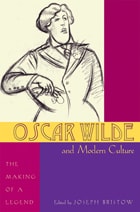
Oscar Wilde and Modern Culture
The Making of a LegendJoseph Bristow
Ohio University Press, 2009
Oscar Wilde and Modern Culture: The Making of a Legend explores the meteoric rise, sudden fall, and legendary resurgence of an immensely influential writer’s reputation from his hectic 1881 American lecture tour to recent Hollywood adaptations of his dramas. Always renowned—if not notorious—for his fashionable persona, Wilde courted celebrity at an early age. Later, he came to prominence as one of the most talented essayists and fiction writers of his time.
In the years leading up to his two-year imprisonment, Wilde stood among the foremost dramatists in London. But after he was sent down for committing acts of “gross indecency” it seemed likely that social embarrassment would inflict irreparable damage to his legacy. As this volume shows, Wilde died in comparative obscurity. Little could he have realized that in five years his name would come back into popular circulation thanks to the success of Richard Strauss’s opera Salome and Robert Ross’s edition of De Profundi. With each succeeding decade, the twentieth century continued to honor Wilde’s name by keeping his plays in repertory, producing dramas about his life, adapting his works for film, and devising countless biographical and critical studies of his writings.
This volume reveals why, more than a hundred years after his demise, Wilde’s value in the academic world, the auction house, and the entertainment industry stands higher than that of any modern writer.
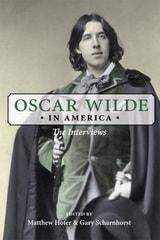
Oscar Wilde in America
The InterviewsEdited by Matthew Hofer and Gary Scharnhorst
University of Illinois Press, 2013
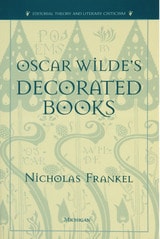
Oscar Wilde's Decorated Books
Nicholas Frankel
University of Michigan Press, 2000
Othello
William Shakespeare
Arizona Center for Medieval and Renaissance Studies, 2022
In her update of Shakespeare’s Othello, Mfoniso Udofia engages with the racial malice at the heart of the play. Udofia’s take on this complicated story emphasizes the rhythm and lyrical patterns of Othello’s speech. Opening up the text to modern ears, Udofia presents us with a code-switched Othello.
This translation of Othello was written as part of the Oregon Shakespeare Festival’s Play On! project, which commissioned new translations of thirty-nine Shakespeare plays. These translations present the work of “The Bard” in language accessible to modern audiences while never losing the beauty of Shakespeare’s verse. Enlisting the talents of a diverse group of contemporary playwrights, screenwriters, and dramaturges from diverse backgrounds, this project reenvisions Shakespeare for the twenty-first century. These volumes make these works available for the first time in print—a new First Folio for a new era.
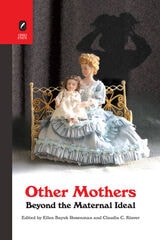
Other Mothers
Beyond the Maternal IdealEdited by Ellen Bayuk Rosenman and Claudia C. Klaver
The Ohio State University Press, 2008
This collection addresses this void, revealing the extraordinary diversity of Victorian motherhood. Exploring diaries, novels, and court cases, with contexts ranging from London to Egypt to Australia, these varied accounts take the collection “beyond the maternal ideal” to consider the multiple, unpredictable ways in which motherhood was experienced and imagined in this formative historical period.
Other Mothers joins revisionist approaches to femininity that now characterize Victorian studies. Its contents trace intersections among gender, race, and class; question the power of separate spheres ideology; and insist on the context-specific nature of social roles. The fifteen essays in this volume contribute to the fields of literary criticism, history, cultural studies, and history.
Our Lady Of Victorian Feminism
The Madonna in the Work of Anna Jameson, Margaret Fuller, and George EliotKimberly VanEsveld Adams
Ohio University Press, 2000
Our Lady of Victorian Feminism is about three nineteenth-century women, Protestants by background and feminists by conviction, who are curiously and crucially linked by their extensive use of the Madonna in arguments designed to empower women.
In the field of Victorian studies, few scholars have looked beyond the customary identification of the Christian Madonna with the Victorian feminine ideal—the domestic Madonna or the Angel in the House. Kimberly VanEsveld Adams shows, however, that these three Victorian writers made extensive use of the Madonna in feminist arguments. They were able to see this figure in new ways, freely appropriating the images of independent, powerful, and wise Virgin Mothers.
In addition to contributions in the fields of literary criticism, art history, and religious studies, Our Lady of Victorian Feminism places a needed emphasis on the connections between the intellectuals and the activists of the nineteenth-century women's movement. It also draws attention to an often neglected strain of feminist thought, essentialist feminism, which proclaimed sexual equality as well as difference, enabling the three writers to make one of their most radical arguments, that women and men are made in the image of the Virgin Mother and the Son, the two faces of the divine.
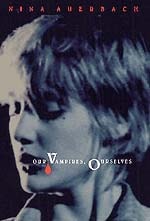
Our Vampires, Ourselves
Nina Auerbach
University of Chicago Press, 1995
"[Auerbach] has seen more Hammer movies than I (or the monsters) have had steaming hot diners, encountered more bloodsuckers than you could shake a stick at, even a pair of crossed sticks, such as might deter a very sophisticated ogre, a hick from the Moldavian boonies....Auerbach has dissected and deconstructed them with the tender ruthlessness of a hungry chef, with cogency and wit."—Eric Korn, Times Literary Supplement
"This seductive work offers profound insights into many of the urgent concerns of our time and forces us to confront the serious meanings that we invest, and seek, in even the shadiest manifestations of the eroticism of death."—Wendy Doniger, The Nation
"A vigorous, witty look at the undead as cultural icons."—Kirkus Review
"In case anyone should think this book is merely a boring lit-crit exposition...Auerbach sets matters straight in her very first paragraph. 'What vampires are in any given generation,' she writes, 'is a part of what I am and what my times have become. This book is a history of Anglo-American culture through its mutating vampires.'...Her book really takes off."—Maureen Duffy, New York Times Book Review
Our Vampires, Ourselves
Nina Auerbach
University of Chicago Press, 1995
Nina Auerbach shows how every age embraces the vampire it needs, and gets the vampire it deserves. Working with a wide range of texts, as well as movies and television, Auerbach locates vampires at the heart of our national experience and uses them as a lens for viewing the last two hundred years of Anglo-American cultural history.
"[Auerbach] has seen more Hammer movies than I (or the monsters) have had steaming hot diners, encountered more bloodsuckers than you could shake a stick at, even a pair of crossed sticks, such as might deter a very sophisticated ogre, a hick from the Moldavian boonies....Auerbach has dissected and deconstructed them with the tender ruthlessness of a hungry chef, with cogency and wit."—Eric Korn, Times Literary Supplement
"This seductive work offers profound insights into many of the urgent concerns of our time and forces us to confront the serious meanings that we invest, and seek, in even the shadiest manifestations of the eroticism of death."—Wendy Doniger, The Nation
"A vigorous, witty look at the undead as cultural icons."—Kirkus Review
"In case anyone should think this book is merely a boring lit-crit exposition...Auerbach sets matters straight in her very first paragraph. 'What vampires are in any given generation,' she writes, 'is a part of what I am and what my times have become. This book is a history of Anglo-American culture through its mutating vampires.'...Her book really takes off."—Maureen Duffy, New York Times Book Review
Oxford in Quotations
Compiled by Violet Moller
Bodleian Library Publishing, 2014
Oxford, “City of Dreaming Spires,” earns high marks from Hillaire Belloc, who writes that “there are few greater temptations on earth than to stay permanently at Oxford . . . and to read all the books in the Bodleian.” But it is also, according to Anthony Trollope, “the most dangerous place to which a young man can be sent.” And none other than Max Beerbohm blames it for making him insufferable.
For fans, foes, and those planning a trip to the city in the hopes of forming an opinion, this collection will be welcomed.