114 books match the query 'Enslaved persons' and 4 start with o
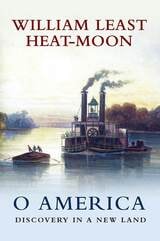
cover of O America: Discovery in a New Land

O America

Discovery in a New Land

William Least Heat-Moon

University of Missouri Press, 2027

In 1848 an English physician, Nathaniel Trennant, accepts an offer to serve as doctor on a ship carrying immigrants to America. When arriving in Baltimore, Trennant stumbles onto its slave market and witnesses the horrors of human bondage. One night in a boardinghouse he discovers under his bed a runaway slave. Disturbed and angered by the selling of human lives, he offers to help the young man escape, a criminal action that will put the fugitive slave and physician into flight from both the law and opportunistic slave hunters.

Traveling by foot, horse, stage, canal boat, and steamer, Nathaniel and Nicodemus explore the backcountry and forge a deep friendship as they encounter a host of memorable characters who reveal the nature of the American experiment, one still in its early stages but already under the stress of social injustices and economic inequities.
 
[more]
cover of On Slavery and the Slave Trade: <i>De Iustitia et lure</i>, Book 1, Treatise 2, Disputations 32-40

On Slavery and the Slave Trade

<i>De Iustitia et lure</i>, Book 1, Treatise 2, Disputations 32-40

Luis De Molina

Catholic University of America Press, 2023
In his monumental On Justice and Rights, the Jesuit Luis de Molina (1535-1600) discussed the legal and ethical aspects of the Portuguese trade in African and Asian enslaved persons. Molina surveys, develops, and problematizes the criteria necessary for the legitimate possession, sale, and purchase of human freedom. He insists that, even under legally valid slavery, persons who have sold or lost their freedom have inalienable rights as human beings, such as the freedom to make contracts, to marry, and even, under certain circumstances, to sue their owners in court. Molina also devotes attention to the ways in which slavery could be ended and whether and under what circumstances slaves had the right to escape from their owners. Well informed about the political structures and customs of many peoples in Africa, as well as Japan, China, and India, Molina paints a vivid and detailed picture of Portuguese trade. He gives specific accounts of the origins and development of the slave trade, region by region, and of the nature of the relationship between local rulers and the Portuguese kingdom. In doing so, he carefully describes the deception, coercion, and general indifference that pervades this trade regarding the rights to freedom of these people. It also attempts to identify the political, ecclesiastical, and market agents involved in this great injustice and their varying degrees of culpability. While Molina does not condemn slavery as a legal institution, the deeply flawed and even immoral behavior of sellers, buyers, regulators, and political rulers both in Portugal and in the slave-supplying regions that Molina denounces casts a heavy shadow on the morality of the trade.
[more]
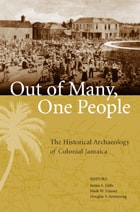
cover of Out of Many, One People: The Historical Archaeology of Colonial Jamaica

Out of Many, One People

The Historical Archaeology of Colonial Jamaica

Edited by James A. Delle, Mark W. Hauser, and Douglas W. Armstrong

University of Alabama Press, 2011

Normal0falsefalsefalseEN-USX-NONEX-NONEMicrosoftInternetExplorer4
As a source of colonial wealth and a crucible for global culture, Jamaica has had a profound impact on the formation of the modern world system. From the island's economic and military importance to the colonial empires it has hosted and the multitude of ways in which diverse people from varied parts of the world have coexisted in and reacted against systems of inequality, Jamaica has long been a major focus of archaeological studies of the colonial period.
 
This volume assembles for the first time the results of nearly three decades of historical archaeology in Jamaica. Scholars present research on maritime and terrestrial archaeological sites, addressing issues such as: the early Spanish period at Seville la Nueva; the development of the first major British settlement at Port Royal; the complexities of the sugar and coffee plantation system, and the conditions prior to, and following, the abolition of slavery in Jamaica. The everyday life of African Jamaican people is examined by focusing on the development of Jamaica's internal marketing system, consumer behavior among enslaved people, iron-working and ceramic-making traditions, and the development of a sovereign Maroon society at Nanny Town.
 
Out of Many, One People paints a complex and fascinating picture of life in colonial Jamaica, and demonstrates how archaeology has contributed to heritage preservation on the island.
[more]
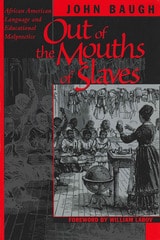
cover of Out of the Mouths of Slaves: African American Language and Educational Malpractice

Out of the Mouths of Slaves

African American Language and Educational Malpractice

By John Baugh

University of Texas Press, 1999

Winner, A Choice Outstanding Academic Book

When the Oakland, California, school board called African American English "Ebonics" and claimed that it "is not a black dialect or any dialect of English," they reignited a debate over language, race, and culture that reaches back to the era of slavery in the United States. In this book, John Baugh, an authority on African American English, sets new parameters for the debate by dissecting and challenging many of the prevailing myths about African American language and its place in American society.

Baugh's inquiry ranges from the origins of African American English among slaves and their descendants to its recent adoption by standard English speakers of various races. Some of the topics he considers include practices and malpractices for educating language minority students, linguistic discrimination in the administration of justice, cross-cultural communication between Blacks and whites, and specific linguistic aspects of African American English. This detailed overview of the main points of debate about African American language will be important reading for both scholars and the concerned public.

[more]