Results by title
118 books match the query 'Epistemology' and 7 start with o

Objectivity and Diversity
Another Logic of Scientific ResearchSandra Harding
University of Chicago Press, 2015
Sandra Harding is not ready to throw out objectivity quite yet. For all of its problems, she contends that objectivity is too powerful a concept simply to abandon. In Objectivity and Diversity, Harding calls for a science that is both more epistemically adequate and socially just, a science that would ask: How are the lives of the most economically and politically vulnerable groups affected by a particular piece of research? Do they have a say in whether and how the research is done? Should empirically reliable systems of indigenous knowledge count as "real science"? Ultimately, Harding argues for a shift from the ideal of a neutral, disinterested science to one that prizes fairness and responsibility.

On Doubt
Vilém Flusser
University of Minnesota Press, 2014
In On Doubt, Vilém Flusser refines Martin Heidegger’s famous declaration that “language is the dwelling of Being.” For Flusser, “the word is the dwelling of being,” because in fact, in the beginning, there was the word.
On Doubt is a treatise on the human intellect, its relation to language, and the reality-forming discourses that subsequently emerge. For Flusser, the faith that the modern age places in Cartesian doubt plays a role similar to the one that faith in God played in previous eras—a faith that needs to be challenged. Descartes doubts the world through his proposition cogito ergo sum, but leaves doubt itself untouched as indubitable and imperious. His cogito ergo sum may have proved to the Western intellect that thoughts exist, but it did not prove the existence of that which thinks: one can eliminate thinking and yet continue being.
Therefore, should we not doubt doubt itself? Should we not try to go beyond this last step of Cartesian doubt and look for a new faith? The twentieth century has seen many attempts to defeat Cartesian doubt, however, this doubt of doubt has instead generated a complete loss of faith, which the West experiences as existential nihilism. Hence, the emergent emptying of values that results from such extreme doubt. Everything loses its meaning. Can this climate be overcome? Will the West survive the modern age?
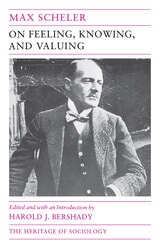
On Feeling, Knowing, and Valuing
Selected WritingsMax Scheler
University of Chicago Press, 1992
1928) ranks with Max Weber, Edmund Husserl, and Ernst
Troeltsch as being among the most brilliant minds of his
generation. Yet Scheler is now known chiefly for his
philosophy of religion, despite his groundbreaking work in
the sociology of knowledge, the sociology of emotions, and
phenomenological sociology. This volume comprises some of
Scheler's most interesting work—including an analysis of the
role of sentiments in social interaction, a sociology of
knowledge rooted in global social and cultural comparisons,
and a cross-cultural theory of values—and identifies some of
his important contributions to the discussion of issues at
the forefront of the social sciences today.
Editor Harold J. Bershady provides a richly detailed
biographical portrait of Scheler, as well as an incisive
analysis of how his work extends and integrates problems of
theory and method addressed by Durkheim, Weber, and Parsons,
among others.
Harold J. Bershady, professor of sociology at the University
of Pennsylvania, is the author of Ideology and Social
Knowledge and the editor of Social Class and
Democratic Leadership.
Heritage of Sociology series
On Knowing--The Social Sciences
Richard P. McKeon
University of Chicago Press, 2017
This volume—the second in a series—leaves behind natural science themes to embrace freedom, power, and history, which, McKeon argues, lay out the whole field of human action. The authors McKeon considers—Hobbes, Machiavelli, Spinoza, Kant, and J. S. Mill—show brilliantly how philosophic methods work in action, via analyses that do not merely reduce or deconstruct meaning, but enhance those texts by reconnecting them to the active history of philosophy and to problems of ethics, politics, and history. The waves of modernism and post-modernism are receding. Philosophic pluralism is now available, fully formulated, in McKeon’s work, spreading from the humanities to the social sciences.

On What We Know We Don't Know
Explanation, Theory, Linguistics, and How Questions Shape ThemSylvain Bromberger
University of Chicago Press, 1992
Operationism in Psychology
An Epistemology of ExplorationUljana Feest
University of Chicago Press, 2025
Psychology has seen an intense debate about the lack of replicability of results in recent years. Uljana Feest uses history and philosophy of science to shed light on the nature of experiment in psychology in general, but her aim reaches beyond debates about replication to provide a novel and comprehensive analysis of the investigative process in experimental psychology. She shows that the central unit of analysis for our epistemological considerations of psychological research should be not theories but, rather, concepts. Her guiding question is: How do psychological concepts figure in the experimental exploration of the objects of psychological research? For Feest, this question has two intertwined aspects: What role do concepts play in the design of experiments and the production of data, and how can concepts be revised or adapted in response to experimental results. Following the historical trajectory of debates about operationism in psychology, she argues that this debate was not concerned with philosophical theories of meaning but, instead, closely connected to the investigative practices of experimental psychologists. The book offers a broad analytical framework for thinking philosophically about the investigative process in psychology, including analyses of the relationship between data and phenomena in psychology, the relationship between folk- and scientific psychological concepts, the relationship between genuine results and experimental artifacts, and the nature and exploration of psychological kinds.
Osiris, Volume 14
Commemorative Practices in Science: Historical Perspectives on the Politics of Collective MemoryEdited by Pnina G. Abir-Am and Clark A. Elliot
University of Chicago Press, 2000
Contributors include Clark A. Elliott, Owen Gingerich, Dieter Hoffmann, Dominque Pestre, Robert W. Seidel, and V. Betty Smocovitis.