Results by title
187 books match the query 'Essays & Travelogues' and 7 start with o
Old Calabria
Norman Douglas
Northwestern University Press, 1996
Old Puglia
A Cultural Companion to South-Eastern ItalyDesmond Seward and Susan Mountgarret
Haus Publishing, 2016
On the Street of the Hidden Shops
One City Block, Two Thousand Years, and a Walk Through the Layered Lives of RomeElizabeth Rodini
University of Chicago Press, 2026
Delve into Rome’s lost history through the stories of a single city block.
Cutting through the heart of Rome is Via delle Botteghe Oscure, a time-worn street named for the mysterious “shops” said to run beneath it. History lies thick here, a museum atop a convent atop ancient ruins; layered in are traces of artisans and poets, pilgrims and saints, a Fascist deportation, a communist coffee bar, a political assassination, and shopkeepers, too. These stories all rest upon a single city block, the same place where, in 13 BCE, the triumphal Roman general Lucius Cornelius Balbus built a monumental theater complex in his own honor.
Elizabeth Rodini’s On the Street of the Hidden Shops digs deep into this corner of the city, uncovering a set of surprising, often poignant narratives that range across two thousand years. For as the walls of Balbus’s compound decayed and the neighborhood was rebuilt, this block would come to shelter Romans from all walks of life: the daughters of local prostitutes, an earnest young man in search of a bride, an entrepreneur determined to preserve the city’s colorful dialect, a Jewish family recently liberated from the nearby Ghetto, and a band of idealistic archaeologists unearthing a long-forgotten past, as well as a gifted baker, a medieval donkey, and a Renaissance ghost. Their stories survive in archives and artifacts but also in the enduring power of rumor and legend.
On the Street of the Hidden Shops invites us on a captivating journey to one place across many centuries. Its tight urban focus reveals a Rome most visitors miss, while uncovering some of the many Romes that have been largely lost to history.
On the Street of the Hidden Shops
One City Block, Two Thousand Years, and a Walk Through the Layered Lives of RomeElizabeth Rodini
University of Chicago Press, 2026
Delve into Rome’s lost history through the stories of a single city block.
Cutting through the heart of Rome is Via delle Botteghe Oscure, a time-worn street named for the mysterious “shops” said to run beneath it. History lies thick here, a museum atop a convent atop ancient ruins; layered in are traces of artisans and poets, pilgrims and saints, a Fascist deportation, a communist coffee bar, a political assassination, and shopkeepers, too. These stories all rest upon a single city block, the same place where, in 13 BCE, the triumphal Roman general Lucius Cornelius Balbus built a monumental theater complex in his own honor.
Elizabeth Rodini’s On the Street of the Hidden Shops digs deep into this corner of the city, uncovering a set of surprising, often poignant narratives that range across two thousand years. For as the walls of Balbus’s compound decayed and the neighborhood was rebuilt, this block would come to shelter Romans from all walks of life: the daughters of local prostitutes, an earnest young man in search of a bride, an entrepreneur determined to preserve the city’s colorful dialect, a Jewish family recently liberated from the nearby Ghetto, and a band of idealistic archaeologists unearthing a long-forgotten past, as well as a gifted baker, a medieval donkey, and a Renaissance ghost. Their stories survive in archives and artifacts but also in the enduring power of rumor and legend.
On the Street of the Hidden Shops invites us on a captivating journey to one place across many centuries. Its tight urban focus reveals a Rome most visitors miss, while uncovering some of the many Romes that have been largely lost to history.
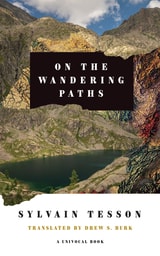
On the Wandering Paths
Sylvain Tesson
University of Minnesota Press, 2022
A walking journey through France’s vast interior becomes a meditation on both personal recovery and the role of history in the present—more than 425,000 copies sold in France
After a free-climbing accident lands him in a coma and a hospital for four months, the French writer Sylvain Tesson makes a promise to himself: if he’s ever able to walk again, he will traverse the entire country of France on foot.
Part literary adventure, part philosophical reflection on our contemporary consumer culture, On the Wandering Paths takes us deep into the heart of what Tesson terms France’s “hyperrural” zones. Tracing the obscure paths peasants once followed throughout the countryside, Tesson embarks on a three-month journey of solitude and personal contemplation as he walks along vast stretches of mountain ranges and rivers, encountering ancient Roman stone bridges and walkways, the French Foreign Legion, pagan prayer sites, Provençal villages, and the majestic Mont-Saint-Michel. Connecting deeply with the places he visits, his experiences inspire reflection on the essential need to disengage from the digital and immerse oneself in natural beauty.
Rich with humor, historical insight, and literary power, On the Wandering Paths is both a meditation on the act of recovery and a potent recognition of the traces of our past in the present. Asking us to reassess our values and our relationship to the land, Tesson’s exquisite chronicle through landscapes that continue to resist urbanization and technology is a thoughtful—and thought-provoking—glimpse into a poet’s adventurous life. Les Chemins de Pierre, a film based on the book starring Jean Dujardin, is due to release in 2022.

Organ Pipe
Life on the EdgeText by Carol Ann Bassett; Photographs by Michael Hyatt
University of Arizona Press, 2004
A terrain where one learns to pay attention to the details: the tracks of a sidewinder in the sand, the tiny eggs of a cactus wren, the flash of a vermilion flycatcher against the azure sky.
Organ Pipe Cactus National Monument lies in southwestern Arizona on the Mexican border. It is an isolated park that for Carol Ann Bassett has long been a place of solitude—a silent refuge where she often camped out alone to capture the natural rhythms of the desert. Photographer Michael Hyatt hiked through Organ Pipe to visually document its subtle beauty in the Ajo Mountains and the valley of the Ajo, and at Quitobaquito, a rare desert oasis.
Few visitors may brave Organ Pipe during summer, when the temperature can reach 120 degrees, but for Bassett and Hyatt the searing heat is but a harbinger of rain, when normally dry arroyos surge with rust-colored water and desert tarantulas come out to mate. Bassett introduces readers to Organ Pipe’s cultural heritage as well: Spanish missionaries, Anglo settlers, and the Tohono O’odham and the Hia Ced O’odham people who still travel there to gather cactus fruit during Hasan Bakmasad, "saguaro moon." She also considers the changes taking place throughout the park, including the onrush of immigrants passing through in search of better lives in the United States.
This small, lyrical book is a sensitive reflection on the heart of the Sonoran Desert. It reminds us of the beauty to be found in unexpected places—and of our intimate connection with the wild.
Orientations
An Anthology of European Travel Writing on EuropeWendy Bracewell
Central European University Press, 2009