Results by title
434 books match the query 'Ethics & Moral Philosophy' and 3 start with o

On Manly Courage
A Study of Plato's LachesWalter T. Schmid. Foreword by George Kimball Plochmann
Southern Illinois University Press, 1992
Walter T. Schmid offers the first original interpretation of the Laches since Hermann Bonitz in the nineteenth century in the only full-length commentary on the Laches available in English.
Schmid divides the book into five main discussions: the historical background of the dialogue; the relation of form and content in a Platonic dialogue and specific structural and aesthetic features of the Laches; the first half of the dialogue, which introduces the characters and considers the theme of the education of young men; the inquiry with Laches, which examines the traditional Greek conception of military courage; and the inquiry with Nicias in which two nontraditional conceptions of courage are mooted, one closely associated with the sophistic movement in Athens, the other with Socrates himself. Furnishing a detailed paragraph-by-paragraph reading that traces Socrates’ ongoing quest for virtue and wisdom—a wisdom founded in the action of a whole human life—Schmid conclusively shows how and why the Laches fills an important niche in Plato’s moral theory.
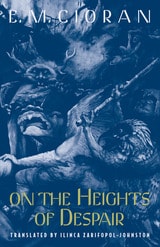
On the Heights of Despair
E. M. Cioran
University of Chicago Press, 1992
On the Heights of Despair shows Cioran's first grappling with themes he would return to in his later, mature works: despair and decay, absurdity and alienation, futility and the irrationality of existence. It also presents Cioran as a connoisseur of apocalypse, a theoretician of despair, for whom writing and philosophy both share the "lyrical virtues" that alone lead to a metaphysical revelation.
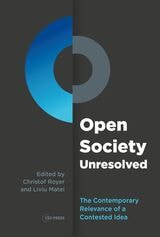
Open Society Unresolved
The Contemporary Relevance of a Contested IdeaChristof Royer
Central European University Press, 2023
Is the concept of open society still relevant in the 21st century? Do the current social, moral, and political realities call for a drastic revision of this concept? Here fifteen essays address real-world contemporary challenges to open society from a variety of perspectives. What unites the individual authors and chapters is an interest in open society’s continuing usefulness and relevance to address current problems. And what distinguishes them is a rich variety of geographical and cultural backgrounds, and a wide range of academic disciplines and traditions.
While focusing on probing the contemporary relevance of the concept, several chapters approach it historically. The book features a comprehensive introduction to the history and current ‘uses’ of the theory of open society. The authors link the concept to contemporary themes including education, Artificial Intelligence, cognitive science, African cosmology, colonialism, and feminism. The diversity of viewpoints in the analysis reflects a commitment to plurality that is at the heart of this book and of the idea of open society itself.