Results by title
230 books match the query 'Ethnicity' and 3 start with o
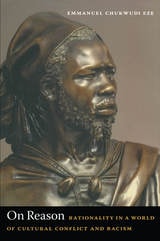
On Reason
Rationality in a World of Cultural Conflict and RacismEmmanuel Chukwudi Eze
Duke University Press, 2008
Eze draws on an extraordinary command of Western philosophical thought and a deep knowledge of African philosophy and cultural traditions. He explores models of rationality in the thought of philosophers from Aristotle, René Descartes, Francis Bacon, and Thomas Hobbes to Noam Chomsky, Richard Rorty, Hilary Putnam, and Jacques Derrida, and he considers portrayals of reason in the work of the African thinkers and novelists Chinua Achebe, Ngugi wa Thiong’o, and Wole Soyinka. Eze reflects on contemporary thought about genetics, race, and postcolonial historiography as well as on the interplay between reason and unreason in the hearings of South Africa’s Truth and Reconciliation Commission. He contends that while rationality may have a foundational formality, any understanding of its foundation and form is dynamic, always based in historical and cultural circumstances.
Our Blood
The Social Experience of HeritasMichael M. Bell, Loka Ashwood and Jay Orne
University of Chicago Press, 2026
From whom do I come? Our Blood describes the central importance of our sense not just of our heritage, but our embodied heritage: that our past is in our bodies and runs in our blood, and that our embodied past is central to our futures. Deeply felt heritas, as Michael M. Bell, Loka Ashwood, and Jay Orne call it, can be a source of great love and kindness for one another. But it can also be a beautiful horror, the source of some of our greatest hate and meanness towards one another. We think of our embodied heritage as natural and historical facts, beyond our choice, and therefore free of manipulation for social gain. We think of it as spirited presences in our bodies that we did not choose. We think of its origins as external to us, whether we are talking about family, class, caste, places, things, ethnoraciality, or our professions. We think of it as legitimate and rightful, therefore. But we do choose. We do select. Bell, Ashwood, and Orne argue that greater awareness of heritas’s social origins and social selectivity can help us cultivate a wider sense of mutual care and ease the divisiveness of our time. Ultimately, Our Blood asks us all to consider heritas, and in doing so, to perhaps even reconsider our very selves.
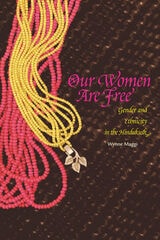
Our Women Are Free
Gender and Ethnicity in the HindukushWynne Maggi
University of Michigan Press, 2001
Yet despite their obvious religious differences with nearby communities, when asked what makes the Kalasha unique, both men and women often reply, "Our women are free" (homa istrizia azat asan). The concept that Kalasha women are "free" (azat), that they have "choice" (chit), is a topic of spirited conversation among the Kalasha. It touches at the heart of both individual women's identities and the collective identity of the community.
Our Women are Free introduces the historical and cultural landscape of the Kalasha and describes the role that "women's freedom" plays as an ethnic marker for the entire community. Throughout the narrative, Wynne Maggi stays close to conversations and events that illustrate the daily life of the community, focusing particularly on the Kalasha people's sense of humor; on the pleasure they take in work, children, ritual, and relationships; as well as on the complexity and seriousness of their social lives.
Accessible and thought-provoking, Our Women are Free will be of interest to professional anthropologists, area scholars, and other social scientists.
Wynne Maggi teaches anthropology and women's studies at the University of Colorado.