Results by title
1726 books match the query 'Film' and 22 start with o
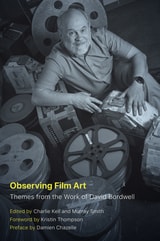
Observing Film Art
Themes from the Work of David BordwellCharlie Keil
Rutgers University Press, 2027
When David Bordwell died in 2024, he left behind a legacy of film scholarship and criticism whose influence is unmatched. Coauthor of a pair of textbooks adopted across the globe and the main force behind a blog read by thousands, Bordwell has influenced generations of film students, filmmakers, and film critics. Observing Film Art examines the breadth of Bordwell’s work through the perspectives of those who knew him best, collaborators, former students, and critics among them. This is the first collection devoted to the work of Bordwell, and it gives equal attention to each facet of his prodigious scholarship, structured to highlight his interest in theory, history, and analysis and criticism. The cornerstones of his approach to film study, including formalism, cognitivism, and historical poetics, are all examined in detail, as are key works, including The Classical Hollywood Cinema (coauthored with Kristin Thompson and Janet Staiger) and Narration in the Fiction Film.
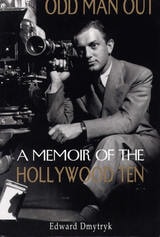
Odd Man Out
A Memoir of the Holllywood TenEdward Dmytryk
Southern Illinois University Press, 1996
In 1947, the House Un-American Activities Committee rudely interrupted the successful career and life of Edward Dmytryk, citing him with contempt of Congress. As a result, Dmytryk was fired by RKO and spent three years in England before returning to the United States to serve a six-month jail sentence and undergo a second round of hearings, during which he recanted and provided evidence against several of his former colleagues.
In this personal and perceptive book, Dmytryk sharply chronicles the history of a particularly turbulent era in American political life while examining his own life before and after the events universally called the witch hunts. He details his brief membership in the Communist Party of America, explaining his initial commitment to what he perceived as communist ideals of civil liberties, economic justice, and antifacism, followed by his eventual disillusionment with the party as itbetrayed those ideals. He goes on to provide a fair assessment of what then happened to him and the effect it had on the rest of his life.
Dmytryk describes the activities, prejudices, and personal behaviors of all the parties enmeshed in the congressional hearings on communism in Hollywood. His reactions to other members of the Hollywood Ten and his recollection of conversations with them lend his book an immediacy that is not only informative but also absorbing. Most importantly, he does not uphold an ideology but rather presents the events as he perceived them, understood them, and responded to them. Dmytryk’s account is characterized by an openness born of a mature awareness of personal trial as history.
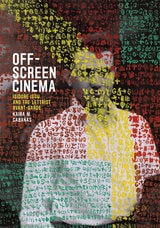
Off-Screen Cinema
Isidore Isou and the Lettrist Avant-GardeKaira M. Cabañas
University of Chicago Press, 2015
Off-Screen Cinema is the first monograph in English of the Lettrists. Offering a full portrait of the avant-garde scene of 1950s Paris, it focuses on the film works of key Lettrist figures like Gil J Wolman, Maurice Lemaître, François Dufrêne, and especially the movement's founder, Isidore Isou, a Romanian immigrant whose “discrepant editing” deliberately uncoupled image and sound. Through Cabañas's history, we see not only the full scope of the Lettrist project, but also its clear influence on Situationism, the French New Wave, the New Realists, as well as American filmmakers such as Stan Brakhage.
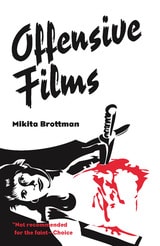
Offensive Films
Mikita Brottman
Vanderbilt University Press, 2005
While most critics have been quick to dismiss such films as mere shock-fests (if they even bother to talk about them at all), Brottman argues that these movies tell us quite a bit about who we are as a society, what makes us anxious, and what taboos we truly believe cannot be crossed. Part anthropology, part psychoanalysis, Offensive Films vivisects these movies in order to figure out just what about them is so offensive, obscene, or bizarre. In the end, Brottman proves that these films, shunned from the cinematic canon, work on us in sophisticated ways we often choose to remain unaware of.
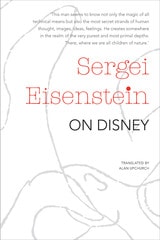
On Disney
Sergei Eisenstein
Seagull Books, 2017
Seagull Books is embarking on a series of translations of key works by Eisenstein into English. On Disney, which was begun in 1940 but was never finished, was part of a series of essays Eistenstein wrote on masters of cinema; for Eisenstein, Walt Disney offered a way to think about how such impulses and animism and totemism survived in modern consciousness and art. This edition presents the original, unfinished essay along with material on Disney that Eisenstein worked on in subsequent years but never succeeded in integrating with the original.
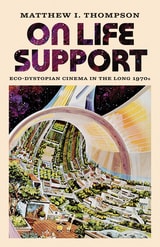
On Life Support
Eco-Dystopian Cinema in the Long 1970sMatthew I Thompson
University of Minnesota Press, 2026
Finding strategies for today’s environmental movement in classic science fiction films
What can science fiction film tell us about the course of the modern ecological movement? On Life Support traces how the environmental concerns of the 1970s were embedded in the eco-dystopian cinema of the era—and considers its implications for ecological thought and activism today.
Illuminating the patterns that shape our thinking about nonhuman nature, Matthew I. Thompson pairs iconic films such as Soylent Green and Silent Running with the transformational environmentalist texts that inspired them and kick-started the modern environmental movement, including Rachel Carson’s Silent Spring and Buckminster Fuller’s Operating Manual for Spaceship Earth. Thompson examines this confluence of literature and cinema to show how, as they translated environmentalism for Hollywood’s audiences, these movies distilled the movement’s concepts into a form that revealed their inherent contradictions.
A sensitive analysis of the tensions that complicate environmentalist praxis—especially between desire and fear in the activist impulse—On Life Support offers a timely critique of the politics of environmental containment and control, calling instead for a politics of interconnection and contamination. It is, after all, by inviting complexity and chaos that we begin to undermine the myth of human mastery, letting nature flourish on its own terms.
Retail e-book files for this title are screen-reader friendly with images accompanied by short alt text and/or extended descriptions.
On Story - Screenwriters and Their Craft
Austin Film Festival
University of Texas Press, 2013
Austin Film Festival (AFF) is the first organization of its kind to focus on the writer’s creative contribution to film. Its annual Film Festival and Conference offers screenings, panels, workshops, and roundtable discussions that help new writers and filmmakers connect with mentors and gain advice and insight from masters, as well as refreshing veterans with new ideas. To extend the Festival’s reach, AFF produces On Story, a television series currently airing on PBS-affiliated stations and streaming online that presents footage of high-caliber artists talking candidly and provocatively about the art and craft of screenwriting and filmmaking, often using examples from their own films.
This book distills the advice of renowned, award-winning screenwriters who have appeared on On Story, including John Lee Hancock, Peter Hedges, Lawrence Kasdan, Whit Stillman, Robin Swicord, and Randall Wallace. In their own lively words and stories transcribed from interviews and panel discussions, they cover the entire development of a screenplay, from inspiration, story, process, structure, characters, and dialogue to rewriting and collaboration. Their advice is fresh, practical, and proven—these writers know how to tell a story on screen. Enjoy this collection of ideas and use it to jumpstart your own screenwriting career.
On Story—Screenwriters and Filmmakers on Their Iconic Films
Austin Film Festival, Edited by Barbara Morgan and Maya Perez
University of Texas Press, 2016
“On Story is film school in a box, a lifetime’s worth of filmmaking knowledge squeezed into half-hour packages.”
—Kenneth Turan, film critic for the Los Angeles Times
Austin Film Festival (AFF) is the first organization focused on the writer’s creative contribution to film. Its annual Film Festival and Conference offers screenings, panels, workshops, and roundtable discussions that help new writers and filmmakers connect with mentors and gain advice and insight from masters, as well as refreshing veterans with new ideas. To extend the festival’s reach, AFF produces On Story, a television series currently airing on PBS-affiliated stations and streaming online that presents footage of high-caliber artists talking candidly and provocatively about the art and craft of screenwriting and filmmaking, often using examples from their own films.
On Story—Screenwriters and Filmmakers on Their Iconic Films presents renowned, award-winning screenwriters and filmmakers discussing their careers and the stories behind the production of their iconic films such as L.A. Confidential, Thelma & Louise, Groundhog Day, Guardians of the Galaxy, The Silence of the Lambs, In the Name of the Father, Apollo 13, and more. In their own lively words transcribed from interviews and panel discussions, Ron Howard, Callie Khouri, Jonathan Demme, Ted Tally, Jenny Lumet, Harold Ramis, and others talk about creating stories that resonate with one’s life experiences or topical social issues, as well as how to create appealing characters and bring them to life. Their insights, production tales, and fresh, practical, and proven advice make this book ideal for film lovers, screenwriting students, and filmmakers and screenwriters seeking inspiration.
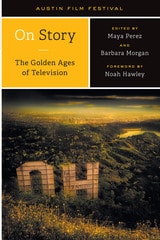
On Story—The Golden Ages of Television
Edited by Maya Perez and Barbara Morgan; foreword by Noah Hawley
University of Texas Press, 2018
“On Story is film school in a box, a lifetime’s worth of filmmaking knowledge squeezed into half-hour packages.”
—Kenneth Turan, film critic for the Los Angeles Times
Austin Film Festival (AFF) is the first organization to focus on writers’ creative contributions to film and television. Its annual Film Festival and Conference offers screenings, panels, workshops, and roundtable discussions that help new writers and filmmakers connect with mentors and gain advice and insight from masters, as well as reinvigorate veterans with new ideas. To extend the Festival’s reach, AFF produces On Story, a television series currently airing on PBS-affiliated stations and streaming online that presents high-caliber artists talking candidly and provocatively about the art and craft of screenwriting and filmmaking, often using examples from their own work.
On Story—The Golden Ages of Television explores the transformation of television’s narrative content over the past several decades through interviews with some of TV’s best creators and writers, including Garry Shandling (The Larry Sanders Show), Carl Reiner (The Dick Van Dyke Show), Issa Rae (Insecure), Vince Gilligan (Breaking Bad), Greg Daniels (The Office), Paula Pell (Saturday Night Live), Noah Hawley (Fargo), Liz Meriwether (New Girl), David Chase (The Sopranos), Alan Yang (Master of None), Marta Kauffman (Friends), Jenji Kohan (Orange Is the New Black), and many more. Their insights, behind-the-scenes looks at the creative process, production tales, responses to audiences’ reactions, and observations on how both TV narratives and the industry have changed make this book ideal for TV lovers, pop culture fans, students taking screenwriting courses, and filmmakers and writers seeking information and inspiration.
On the Sleeve of the Visual
Race as Face ValueAlessandra Raengo
Dartmouth College Press, 2013
On-Demand Culture
Digital Delivery and the Future of MoviesTryon, Chuck
Rutgers University Press, 2013
Chuck Tryon offers a compelling introduction to a world in which movies have become digital files. He navigates the complexities of digital delivery to show how new modes of access—online streaming services like YouTube or Netflix, digital downloads at iTunes, the popular Redbox DVD kiosks in grocery stores, and movie theaters offering digital projection of such 3-D movies as Avatar—are redefining how audiences obtain and consume motion picture entertainment. Tryon also tracks the reinvention of independent movies and film festivals by enterprising artists who have built their own fundraising and distribution models online.
Unique in its focus on the effects of digital technologies on movie distribution, On-Demand Culture offers a corrective to address the rapid changes in the film industry now that movies are available at the click of a button.
One Man’s Documentary
A Memoir of the Early Years of the National Film BoardGraham McInnes
University of Manitoba Press, 2004
Only Among Women
Philosophies of Community in the Russian and Soviet Imagination, 1860–1940Anne Eakin Moss
Northwestern University Press, 2020
Only at Comic-Con
Hollywood, Fans, and the Limits of ExclusivityErin Hanna
Rutgers University Press, 2020

Open Roads, Closed Borders
The Contemporary French-Language Road MovieEdited by Michael Gott and Thibaut Schilt
Intellect Books, 2013
Orson Welles and the Unfinished RKO Projects
A Postmodern PerspectiveMarguerite H. Rippy
Southern Illinois University Press, 2009
Orson Welles and the Unfinished RKO Projects: A Postmodern Perspective traces the impact of legendary director Orson Welles on contemporary mass media entertainment and suggests that, ironically, we can see Welles’s performance genealogy most clearly in his unfinished RKO projects.
Author Marguerite H. Rippy provides the first in-depth examination of early film and radio projects shelved by RKO or by Welles himself. While previous studies of Welles largely fall into the categories of biography or modernist film studies, this book extends the understanding of Welles via postmodern narrative theory and performance analysis, weaving his work into the cultural and commercial background of its production. By identifying the RKO years as a critical moment in performance history, Rippy synthesizes scholarship that until now has been scattered among film studies, narrative theory, feminist critique, American studies, and biography.
Building a bridge between auteur and postmodern theories, Orson Welles and the Unfinished RKO Projects offers a fresh look at Welles in his full complexity. Rippy trains a postmodern lens on Welles’s early projects and reveals four emerging narrative modes that came to define his work: deconstructions of the first-person singular; adaptations of classic texts for mass media; explorations of the self via primitivism; and examinations of the line between reality and fiction. These four narrative styles would greatly influence the development of modern mass media entertainment.
Rippy finds Welles’s legacy alive and well in today’s mockumentaries and reality television. It was in early, unfinished projects where Welles first toyed with fact and fiction, and the pleasure of this interplay still resonates with contemporary culture. As Rippy suggests, the logical conclusion of Welles’s career-long exploration of “truthiness” lies in the laughs of fake news shows. Offering an exciting glimpse of a master early in his career, Orson Welles and the Unfinished RKO Projects documents Welles’s development as a storyteller who would shape culture for decades to come.

Our Movie Heritage
Tom McGreevey and Joanne L Yeck
Rutgers University Press, 1997
Our Movie Heritage should be read by anyone interested in motion picture history. Without film preservation, there can be no valid film history. Documents, autobiographies, oral histories, and secondary sources are of importance, but viewing the actual films preserved or restored to a state comparable to the way they were originally viewed is of inestimable importance.Rudy Behlmer, film historian and author of Memo from David O. Selznick
Our Movie Heritage is an enticing, up to the minute account of the complex National Film preservation effort, and should be read by anyone interested in our rich cinematic heritage.Mary Lea Bandy, chief curator, The Museum of Modern Art
Imagine an America without any images of itself no Judy Garland in the Wizard of Oz, no Orson Welles in Citizen Kane, and no Bogart and Bergman in Casablanca. Movies are an extraordinary personal and collective history of the American people. Unfortunately, over 90 percent of America's silent films are already lost to us, and more than half of the American feature films made before 1950 no longer exist. Whether it is a piece of cellulose nitrate exposed in 1910 or a strip of Eastman Color acetate stock produced in the 1970s all film self-destructs. Rapidly.
Our Movie Heritage is a highly readable and informative view of the world of film preservation, showing the work being done to save our national treasure trove of film history. Full of tales of discovery and rescue, the book is an urgent plea for preservation. Our Movie Heritage describes the race against time currently under way both in the public and private sectors in order to salvage what is left in vaults, theaters, and private collections. The book explains the basics of film preservation, covering the who, what, when, where, and how of the field, with top archivists and film restoration experts expressing their concerns and hopes for the future of movies. This beautifully produced book, with over one hundred pictures of top stars, directors, and film people, is itself a treasure that showcases the importance of this legacy.
Ousmane Sembene
Dialogues with Critics and WritersThomas Cassirer
University of Massachusetts Press, 1993
This volume celebrates the work of Ousmane Sembène, the brilliant African filmmaker and writer. Since the 1950s, working in his native Senegal, Sembène has produced a series of films and novels that incisively depict the realities of contemporary African experience, particularly that of urban and industrial Africa. The book begins with critical essays on Sembène’s oeuvre by Frederick Ivor Case, Françoise Pfaff, Mbye Cham, and Claire Andrade-Warkins. There follows a series of presentations by distinguished black writers who discuss their craft and the ways in which language can function as a political act of cultural legitimation. These writers include Toni Cade Bambara, Earl Lovelace, Ngũgĩ wa Thiong’o, John Edgar Wideman, and Sembène.
The next section reproduces Sembène’s remarks on his film Camp de Thiaroye and an extended interview he recorded in Toronto in 1992. His comments are presented in both French and English. The volume concludes with annotated bibliographies of Sembène’s novels and of the films he has written and directed.
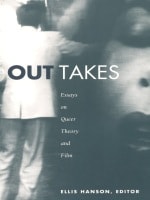
Out Takes
Essays on Queer Theory and FilmEllis Hanson, ed.
Duke University Press, 1999
The essays examine a wide array of films, including Calamity Jane, Rear Window, The Hunger, Heavenly Creatures, and Bound , and discuss such figures as Doris Day, Elizabeth Taylor, and Alfred Hitchcock. Divided into three sections, the first part reconsiders the construction of masculinity and male homoerotic desire—especially with respect to the role of women—in classic cinema of the 1940s and 1950s. The second section offers a deconstructive consideration of lesbian film spectatorship and lesbian representation. Part three looks at the historical trajectory of independent queer cinema, including works by H.D., Kenneth Anger, and Derek Jarman.
By exploring new approaches to the study of sexuality in film, Out Takes will be useful to scholars in gay and lesbian studies, queer theory, and cinema studies.
Contributors. Bonnie Burns, Steven Cohan, Alexander Doty, Lee Edelman, Michelle Elleray, Jim Ellis, Ellis Hanson, D. A. Miller, Eric Savoy, Matthew Tinkcom, Amy Villarejo, Jean Walton
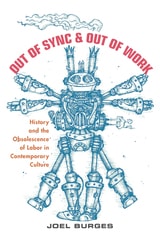
Out of Sync & Out of Work
History and the Obsolescence of Labor in Contemporary CultureBurges, Joel
Rutgers University Press, 2018
Outback
Westerns in Australian CinemaBrian McFarlane
Intellect Books, 2026
Focusing on the influence of the cinematic Western in Australian cinema history, Outback explores how the American genre has been adapted to the changing Australian social, political, and cultural contexts of its production, including the shifting emphases in the representation of the Indigenous population.
Brian McFarlane emphasizes the ways film can, without didacticism, provide evidence of changing politics and culture. McFarlane explores Australian history with the genre by analyzing such films as Charles Tait’s 1906 The Story of the Kelly Gang and Justin Kurzel’s 2020 adaptation of Peter Carey’s The True History of the Kelly Gang. He further explores other key matters, including the changing attitudes to and representation of Indigenous peoples and of women's roles in Australian Westerns.
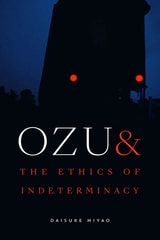
Ozu and the Ethics of Indeterminacy
Daisuke Miyao
Duke University Press, 2026