Results by title
279 books match the query 'Film & Video' and 11 start with o
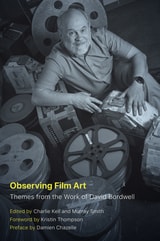
Observing Film Art
Themes from the Work of David BordwellCharlie Keil
Rutgers University Press, 2027
When David Bordwell died in 2024, he left behind a legacy of film scholarship and criticism whose influence is unmatched. Coauthor of a pair of textbooks adopted across the globe and the main force behind a blog read by thousands, Bordwell has influenced generations of film students, filmmakers, and film critics. Observing Film Art examines the breadth of Bordwell’s work through the perspectives of those who knew him best, collaborators, former students, and critics among them. This is the first collection devoted to the work of Bordwell, and it gives equal attention to each facet of his prodigious scholarship, structured to highlight his interest in theory, history, and analysis and criticism. The cornerstones of his approach to film study, including formalism, cognitivism, and historical poetics, are all examined in detail, as are key works, including The Classical Hollywood Cinema (coauthored with Kristin Thompson and Janet Staiger) and Narration in the Fiction Film.
Of Walking in Ice
Munich-Paris, 23 November–14 December 1974Werner Herzog
University of Minnesota Press, 2015
In late November 1974, filmmaker Werner Herzog received a phone call from Paris delivering some terrible news. German film historian, mentor, and close friend Lotte Eisner was seriously ill and dying. Herzog was determined to prevent this and believed that an act of walking would keep Eisner from death. He took a jacket, a compass, and a duffel bag of the barest essentials, and wearing a pair of new boots, set off on a three-week pilgrimage from Munich to Paris through the deep chill and snowstorms of winter.
Of Walking in Ice is Herzog’s beautifully written, much-admired, yet often-overlooked diary account of that journey. Herzog documents everything he saw and felt on his quest to his friend’s bedside, from poetic descriptions of the frozen landscape and harsh weather conditions to the necessity of finding shelter in vacant or abandoned houses and the intense loneliness of his solo excursion.
Includes, for the first time, Werner Herzog’s 1982 “Tribute to Lotte Eisner” upon her receipt of the Helmut Käutner Prize
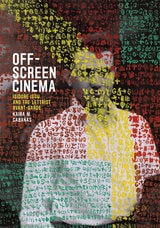
Off-Screen Cinema
Isidore Isou and the Lettrist Avant-GardeKaira M. Cabañas
University of Chicago Press, 2015
Off-Screen Cinema is the first monograph in English of the Lettrists. Offering a full portrait of the avant-garde scene of 1950s Paris, it focuses on the film works of key Lettrist figures like Gil J Wolman, Maurice Lemaître, François Dufrêne, and especially the movement's founder, Isidore Isou, a Romanian immigrant whose “discrepant editing” deliberately uncoupled image and sound. Through Cabañas's history, we see not only the full scope of the Lettrist project, but also its clear influence on Situationism, the French New Wave, the New Realists, as well as American filmmakers such as Stan Brakhage.

On Chantal Akerman
Patricia White, special issue editor
Duke University Press, 0
Contributors. Claire Atherton, Janet Bergstrom, Kelley Conway, Sandy Flitterman-Lewis, Ute Holl, Heike Klippel, Eva Kuhn, Matias Lavin, Alisa Lebow, Brenda Longfellow, Babette Mangolte, Ivone Margulies, Michael Mazière, Eva Meyer, Sandra Percival, Jane Stein, Cécile Tourneur, Maureen Turim, Sonia Wieder-Atherton, Patricia White

On Stage
The Theatrical Dimension of Video ImageMathilde Roman
Intellect Books, 2016
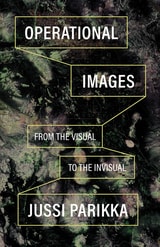
Operational Images
From the Visual to the InvisualJussi Parikka
University of Minnesota Press, 2023
An in-depth look into the transformation of visual culture and digital aesthetics
First introduced by the German filmmaker Harun Farocki, the term operational images defines the expanding field of machine vision. In this study, media theorist Jussi Parikka develops Farocki’s initial concept by considering the extent to which operational images have pervaded today’s visual culture, outlining how data technologies continue to develop and disrupt our understanding of images beyond representation.
Charting the ways that operational images have been employed throughout a variety of fields and historical epochs, Parikka details their many roles as technologies of analysis, capture, measurement, diagramming, laboring, (machine) learning, identification, tracking, and destruction. He demonstrates how, though inextricable from issues of power and control, operational images extend their reach far beyond militaristic and colonial violence and into the realms of artificial intelligence, data, and numerous aspects of art, media, and everyday visual culture.
Serving as an extensive guide to a key concept in contemporary art, design, and media theory, Operational Images explores the implications of machine vision and the limits of human agency. Through a wealth of case studies highlighting the areas where imagery and data intersect, this book gives us unprecedented insight into the ever-evolving world of posthuman visuality.
Cover alt text: Satellite photo on which white title words appear in yellow boxes. Yellow lines connect the boxes.
Orphan Black
Performance, Gender, BiopoliticsEdited by Andrea Goulet and Robert A. Rushing
Intellect Books, 2018
Contributors come from a range of backgrounds and explore the digital innovations and technical interactions between human and machine that allow the show to challenge conventional notions of performance and identity, address family themes, and Orphan Black’s own textual genealogy within the contexts of science, reproductive technology, and the politics of gender, and extend their inquiry to the broader question of community in a "posthuman" world of biopolitical power. Mobilizing philosophy, history of science, and literary theory, scholars analyze the ways in which Orphan Black depicts resistance to the many forms of power that attempt to capture, monitor, and shape life today.
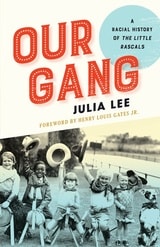
Our Gang
A Racial History of The Little RascalsJulia Lee
University of Minnesota Press, 2015
It was the age of Jim Crow, riddled with racial violence and unrest. But in the world of Our Gang, black and white children happily played and made mischief together. They even had their own black and white version of the KKK, the Cluck Cluck Klams—and the public loved it.
The story of race and Our Gang, or The Little Rascals, is rife with the contradictions and aspirations of the sharply conflicted, changing American society that was its theater. Exposing these connections for the first time, Julia Lee shows us how much this series, from the first silent shorts in 1922 to its television revival in the 1950s, reveals about black and white American culture—on either side of the silver screen. Behind the scenes, we find unconventional men like Hal Roach and his gag writers, whose Rascals tapped into powerful American myths about race and childhood. We meet the four black stars of the series—Ernie “Sunshine Sammy” Morrison, Allen “Farina” Hoskins, Matthew “Stymie” Beard, and Billie “Buckwheat” Thomas—the gang within the Gang, whose personal histories Lee pursues through the passing years and shifting political landscape.
In their checkered lives, and in the tumultuous life of the series, we discover an unexplored story of America, the messy, multiracial nation that found in Our Gang a comic avatar, a slapstick version of democracy itself.
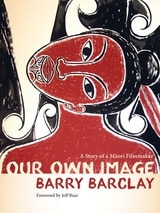
Our Own Image
A Story of a Maori FilmmakerBarry Barclay
University of Minnesota Press, 2015
Acclaimed Maori filmmaker Barry Barclay’s Our Own Image relates the experiences of making his documentaries and his critically acclaimed feature-length film Ngati (1987), widely credited as the first fiction feature by a member of an indigenous community. Barclay details his views on the process of filmmaking within his own Maori community and discusses how his work differed from popular cinema, advocating for indigenous control, participation, and perspectives in media.
Our Own Image gives an in-depth depiction of the changes Barclay’s approach contributed to the field of documentaries, as well as displaying the respect for community Barclay brought to his filming technique. His insistence on letting people speak for themselves demonstrated authenticity to audiences, creating awareness of indigenous cinema in New Zealand and worldwide.
Out of Time
Desire in Atemporal CinemaTodd McGowan
University of Minnesota Press, 2010
Outback
Westerns in Australian CinemaBrian McFarlane
Intellect Books, 2026
Focusing on the influence of the cinematic Western in Australian cinema history, Outback explores how the American genre has been adapted to the changing Australian social, political, and cultural contexts of its production, including the shifting emphases in the representation of the Indigenous population.
Brian McFarlane emphasizes the ways film can, without didacticism, provide evidence of changing politics and culture. McFarlane explores Australian history with the genre by analyzing such films as Charles Tait’s 1906 The Story of the Kelly Gang and Justin Kurzel’s 2020 adaptation of Peter Carey’s The True History of the Kelly Gang. He further explores other key matters, including the changing attitudes to and representation of Indigenous peoples and of women's roles in Australian Westerns.