Results by title
198 books match the query 'Food' and 4 start with o
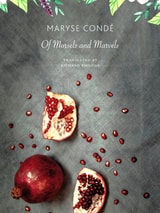
Of Morsels and Marvels
Maryse Condé
Seagull Books, 2019
For many, cooking is simply the mechanical act of reproducing standard recipes. To Maryse Condé, however, cooking implies creativity and personal invention, on par with the complexity of writing a story. A cook, she explains, uses spices and flavors the same way an author chooses the music and meaning of words.
In Of Morsels and Marvels, Condé takes us on a literary journey around places she has travelled to in India, Indonesia, and South Africa. She highlights the tastes and culinary traditions that are fascinating examples of a living museum. Such places, Condé explains, provide important insights into lesser-known aspects of contemporary life. One anecdote illustrates what becomes of the standard Antillean dishes of fish stew and goat curry by two Antilleans who own a restaurant in Sydney, Australia. Cuisine changes not only according to the individual cook but also adapts to foreign skies under which it is created. The author also recounts personal memories of her lifelong relationship with cooking, such as when Adélia, her family’s servant, wrongly blames little Maryse for mixing raisins with fish and using her imagination in the kitchen.
Blending travel with gastronomy, this enchanting volume from the winner of the 2018 Alternative Nobel Prize will delight all who marvel at the wonders of the kitchen or seek to taste the world.
[more]
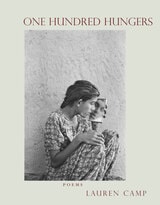
One Hundred Hungers
Lauren Camp
Tupelo Press, 2016
In her Dorset Prize-winning new collection, Lauren Camp explores the lives of a first-generation Arab-American girl and her Jewish-Iraqi parent. One Hundred Hungers tells overlapping stories of food and ritual, immigration and adaptation, evoking her father's boyhood in Baghdad in the 1940s at a time when tensions began to emerge along ethnic and religious lines. She also draws upon memories of Sabbath dinners in her grandparents' new home in America to reveal how family culture persists.
[more]

Our Precious Corn
YukwanénsteRebecca M. Webster
Michigan State University Press, 2023
For the Oneida people, yukwanénste has two meanings: our corn and our precious. Corn has walked alongside the Oneida and other Haudenosaunee people since creation, playing an integral role in their daily and ceremonial lives throughout their often turbulent history. The relationship between corn and the Oneida has changed over time, but the spirit of this important resource has remained by their side, helping them heal along the way. In Our Precious Corn: Yukwanénste, author Rebecca M. Webster (Kanyʌʔtake·lu), an Oneida woman and Indigenous corn grower, weaves together the words of explorers, military officers, and anthropologists, as well as historic and other contemporary Haudenosaunee people, to tell a story about their relationships with corn. Interviews with over fifty Oneida community members describe how the corn has made positive impacts on their lives, as well as hopeful visions for its future. As an added bonus, the book includes an appendix of different cooking and preparation methods for corn, including traditional and modern recipes.
[more]
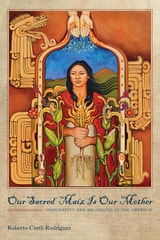
Our Sacred Maíz Is Our Mother
Indigeneity and Belonging in the AmericasRoberto Cintli Rodríguez
University of Arizona Press, 2014
“If you want to know who you are and where you come from, follow the maíz.” That was the advice given to author Roberto Cintli Rodriguez when he was investigating the origins and migrations of Mexican peoples in the Four Corners region of the United States.
Follow it he did, and his book Our Sacred Maíz Is Our Mother changes the way we look at Mexican Americans. Not so much peoples created as a result of war or invasion, they are people of the corn, connected through a seven-thousand-year old maíz culture to other Indigenous inhabitants of the continent. Using corn as the framework for discussing broader issues of knowledge production and history of belonging, the author looks at how corn was included in codices and Mayan texts, how it was discussed by elders, and how it is represented in theater and stories as a way of illustrating that Mexicans and Mexican Americans share a common culture.
Rodriguez brings together scholarly and traditional (elder) knowledge about the long history of maíz/corn cultivation and culture, its roots in Mesoamerica, and its living relationship to Indigenous peoples throughout the continent, including Mexicans and Central Americans now living in the United States. The author argues that, given the restrictive immigration policies and popular resentment toward migrants, a continued connection to maíz culture challenges the social exclusion and discrimination that frames migrants as outsiders and gives them a sense of belonging not encapsulated in the idea of citizenship. The “hidden transcripts” of corn in everyday culture—art, song, stories, dance, and cuisine (maíz-based foods like the tortilla)—have nurtured, even across centuries of colonialism, the living maíz culture of ancient knowledge.
[more]