Results by title
341 books match the query 'Geography' and 3 start with o
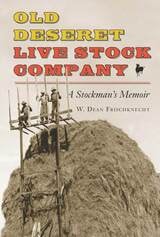
Old Deseret Live Stock Company
A Stockman's MemoirW. Dean Frischknecht
Utah State University Press, 2008
In the high country of the northern Wasatch Mountains, lies what is left of one of the West’s largest ranches. Deseret Live Stock Company was reputed at various times to be the largest private landholder in Utah and the single biggest producer of wool in the world. The ranch began as a sheep operation, but as it found success, it also ran cattle. Incorporated in the 1890s by a number of northern Utah ranchers who pooled their resources, the company was at the height of successful operations in the mid-twentieth century when a young Dean Frischknecht, bearing a recent degree in animal science, landed the job of sheep foreman. In his memoir he recounts in detail how Deseret managed huge herds of livestock, vast lands, and rich wildlife and recalls through lively anecdotes how stockmen and their families lived and worked in the Wasatch Mountains and Skull Valley’s desert wintering grounds.
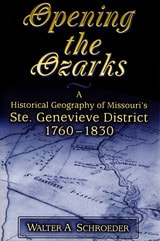
Opening the Ozarks
A Historical Geography of Missouri's Ste. Genevieve District, 1760-1830Walter A. Schroeder
University of Missouri Press, 2002
The study begins with the French Creole settlement at Old Ste. Genevieve in the middle of the eighteenth century. It describes the movement of the French into the Ozark hills during the rest of that century and continues with that of the American immigrants into Upper Louisiana after 1796, ending with the Americanization of the district after the Louisiana Purchase. Walter Schroeder examines the cultural transition from a French society, operating under a Spanish administration, to an American society in which French, Indians, and Africans formed minorities.
Schroeder used thousands of French- and Spanish-language documents, including the Archives of the Indies in Seville, Spain, as well as documents from Ste. Genevieve and St. Louis to gather his information. He also utilized thousands of land records from the American period, including deeds of land sales and sales from the public domain, and plats from both the Spanish and American periods. In addition, Schroeder performed years of fieldwork and perused aerial photography of the area, interviewing residents and searching for vestiges of the past in the landscape.
As the only study to deal with the cradle of Missouri and the first trans-Mississippi expansion of the Anglo-American frontier, Opening the Ozarks will be invaluable to anyone interested in America’s geographical history, particularly that of Missouri.

Operatic Geographies
The Place of Opera and the Opera HouseEdited by Suzanne Aspden
University of Chicago Press, 2019
Operatic Geographies invites us to reconsider the opera house’s spatial production. Looking at opera through the lens of cultural geography, this anthology rethinks the opera house’s landscape, not as a static backdrop, but as an expression of territoriality. The essays in this anthology consider moments across the history of the genre, and across a range of geographical contexts—from the urban to the suburban to the rural, and from the “Old” world to the “New.” One of the book’s most novel approaches is to consider interactions between opera and its environments—that is, both in the domain of the traditional opera house and in less visible, more peripheral spaces, from girls’ schools in late seventeenth-century England, to the temporary arrangements of touring operatic troupes in nineteenth-century Calcutta, to rural, open-air theaters in early twentieth-century France. The essays throughout Operatic Geographies powerfully illustrate how opera’s spatial production informs the historical development of its social, cultural, and political functions.