Results by title
156 books match the query 'Geology' and 6 start with o
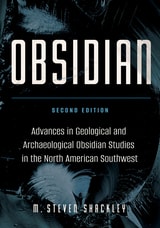
Obsidian, Second Edition
Advances in Geological and Archaeological Obsidian Studies in the North American SouthwestM. Steven Shackley
University of Arizona Press, 2027
Archaeological obsidian studies in the American Southwest and beyond have significantly matured in the last two decades. Like ceramic analysis, obsidian artifact analysis has become a key factor in many archaeological projects because obsidian used to produce chipped stone tools is common across time periods in the Southwest—from Paleoindian through colonial periods. Even today, making stone tools from obsidian is used in teaching.
In the last twenty years, not only have the ways archaeologists use obsidian provenance to address twenty-first-century issues changed, but we now also see geologists and paleontologists using obsidian in ways never before imagined.
In the second edition of Obsidian, author M. Steven Shackley examines the newly discovered sources of archaeological obsidian and other volcanic rocks on both sides of the U.S.-Mexico border. This work has aided in building new inferences concerning exchange, group interaction, and social networks: subjects that were only emerging twenty years ago in obsidian studies.
The field of obsidian provenance studies is truly international, linking archaeologists and geologists in the United States like never before. While the obsidian sources covered in this volume are regionally specific, the applications and methods used in the understanding of source recording, composition issues, and provenance are relevant worldwide.
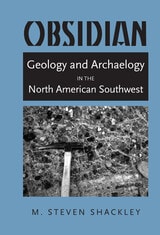
Obsidian
Geology and Archaeology in the North American SouthwestM. Steven Shackley
University of Arizona Press, 2005
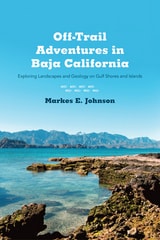
Off-Trail Adventures in Baja California
Exploring Landscapes and Geology on Gulf Shores and IslandsMarkes E. Johnson
University of Arizona Press, 2014
Off-Trail Adventures in Baja California describes—and maps and illustrates—nine hikes along outcrops on islands and peninsular shores where geography, geology, and ecology meet in singular ways. Each spot tells a story about the nature of the place—the cumulative effects of millions of years of natural forces at work. During the course of his long teaching career, Markes E. Johnson has hiked much of Baja California, often with students in tow. He brings a lifetime of study to his simple descriptions of the stories that are revealed by looking closely at natural phenomena framed by rocks and fossils.
This hiking guide offers a wealth of stories that seem to encompass everything, and can clearly communicate Johnson’s deep understanding of how our planet’s ecosystems function. Whether you like to hike with your boots on or from the comfort of your favorite chair, this book is a must-have for anyone who has visited or hopes to visit Baja California’s Gulf Coast.
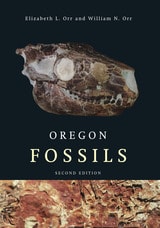
Oregon Fossils, Second Edition
Elizabeth L. Orr
Oregon State University Press, 2009
Unique among fossil field guides, Oregon Fossils includes both specimen identification and interesting notes about their discovery, naming, and conservation. The narrative is sprinkled with biographical sketches of paleontologists who have contributed to the state’s fossil record, and the text is richly illustrated with photographs, line drawings, charts, and maps. A complete bibliography lists full citations to fossil material. The only single volume that provides Oregon’s fossil record and history, Oregon Fossils is a well-written, well-organized guide. It is an excellent reference for classroom and library use, for researchers, and for private collectors and hobbyists.
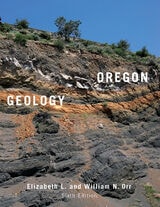
Oregon Geology
Elizabeth L. Orr and William N. Orr
Oregon State University Press, 2012
A comprehensive treatment of the state’s geologic history, Oregon Geology moves through Oregon’s regions to closely examine the unique geologic features of each, from the Blue Mountains to the Willamette Valley, from the high lava Plains to the Coast Range.
The book includes biographical sketches of notable geologists. It is lavishly illustrated and includes an extensive bibliography.
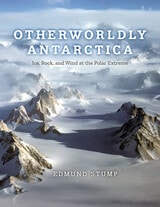
Otherworldly Antarctica
Ice, Rock, and Wind at the Polar ExtremeEdmund Stump
University of Chicago Press, 2024
The interior of Antarctica is an utterly pristine wilderness, a desolate landscape of ice, wind, and rock; a landscape so unfamiliar as to seem of another world. This place has been known to only a handful of early explorers and the few scientists fortunate enough to have worked there. Edmund Stump is one of the lucky few. Having climbed, photographed, and studied more of the continent-spanning Transantarctic Mountains than any other person on Earth, this geologist, writer, and photographer is uniquely suited to share these alien sights.
With stories of Stump’s forty years of journeys and science, Otherworldly Antarctica contains 130 original color photographs, complemented by watercolors and sketches by artist Marlene Hill Donnelly. Over three chapters—on the ice, the rock, and the wind—we meet snowy paths first followed during Antarctica’s Heroic Age, climb the central spire of the Organ Pipe Peaks, peer into the crater of the volcanic Mount Erebus, and traverse Liv Glacier on snowmobile, while avoiding fatal falls into the blue interiors of hidden crevasses. Along the way, we see the beauty of granite, marble, and ice-cored moraines, meltwater ponds, lenticular clouds, icebergs, and glaciers. Many of Stump’s breathtaking images are aerial shots taken from the planes and helicopters that brought him to the interior. More were shot from vantages gained by climbing the mountains he studied. Some were taken from the summits of peaks. Many are of places no one had set foot before—or has since. All seem both permanent and precarious, connecting this otherworld to our fragile own.