Results by title
212 books match the query 'German' and 8 start with o
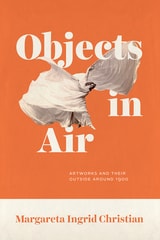
Objects in Air
Artworks and Their Outside around 1900Margareta Ingrid Christian
University of Chicago Press, 2021
Writers created an early theory of unbounded form that described what Christian calls an artwork’s ecstasis or its ability to stray outside its limits and engender its own space. Objects viewed in this perspective complicate the now-fashionable discourse of empathy aesthetics, the attention to self-projecting subjects, and the idea of the modernist self-contained artwork. For example, Christian invites us to historicize the immersive spatial installations and “environments” that have arisen since the 1960s and to consider their origins in turn-of-the-twentieth-century aesthetics. Throughout this beautifully written work, Christian offers ways for us to rethink entrenched narratives of aesthetics and modernism and to revisit alternatives.
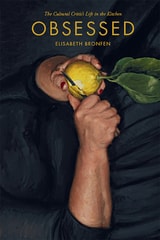
Obsessed
The Cultural Critic’s Life in the KitchenElisabeth Bronfen
Rutgers University Press, 2019
Even the most brilliant minds have to eat. And for some scholars, food preparation is more than just a chore; it’s a passion. In this unique culinary memoir and cookbook, renowned cultural critic Elisabeth Bronfen tells of her lifelong love affair with cooking and demonstrates what she has learned about creating delicious home meals. She recounts her cherished food memories, from meals eaten at the family table in postwar Germany to dinner parties with friends. Yet, in a thoughtful reflection on the pleasures of cooking for one, she also reveals that some of her favorite meals have been consumed alone.
Though it contains more than 250 mouth-watering recipes, Obsessed is anything but a conventional cookbook. As she shares a lifetime of knowledge acquired in the kitchen, Bronfen hopes to empower both novice and experienced home chefs to improvise, giving them hints on how to tweak her recipes to their own tastes. And unlike cookbooks that assume readers have access to an unlimited pantry, this book is grounded in reality, offering practical advice about food storage and reusing leftovers. As Bronfen serves up her personal stories and her culinary wisdom, reading Obsessed is like sitting down to a home-cooked meal with a clever friend.
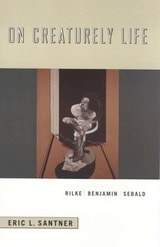
On Creaturely Life
Rilke, Benjamin, SebaldEric L. Santner
University of Chicago Press, 2006
Santner traces this theme of creaturely life from its poetic and philosophical beginnings in the first half of the twentieth century to the writings of the enigmatic German novelist W. G. Sebald. Sebald’s entire oeuvre, Santner argues, can be seen as an archive of creaturely life. For Sebald, the work on such an archive was inseparable from his understanding of what it means to engage ethically with another person’s history and pain, an engagement that transforms us from indifferent individuals into neighbors.
An indispensable book for students of Sebald, On Creaturely Life is also a significant contribution to critical theory.
On Particle Verbs and Similar Constructions in German
Anke Lüdeling
CSLI, 2001
Particle verbs have previously been analyzed as morphological objects or as phrasal constructions, but neither approach fits cleanly within its chosen framework. The resolution presented here is that particle verbs should be seen as lexicalized phrasal constructions. Emphasizing morphological and syntactic testability, over a hundred colloquial examples are shown to break the rules of previous approaches while remaining consistent with this book's proposition. To distinguish particle verbs from similar constructions, and to demonstrate how structural and morphological factors have been misidentified in the past, preverb verb constructions (PVCs) are introduced and diagrammed. This reveals the roles of listedness and non-transparency in word formation and clarifies the conclusion that particle verbs do not form a definable class of words.
One Day a Year
2001–2011Christa Wolf
Seagull Books, 2017
The book is both a personal record and a unique document of our times. With her characteristic precision and transparency, Wolf examines the interplay of the private, subjective, and major contemporary historical events. She writes about Germany after 9/11, about her work on her last great book City of Angels, and also about her exhausting confrontation with old age. One Day a Year is a compelling and personal glimpse into the life of one of the world’s greatest writers.
Ornament as Crisis
Architecture, Design, and Modernity in Hermann Broch's "The Sleepwalkers"Sarah McGaughey
Northwestern University Press, 2015
Ornament as Crisis explores the ways in which the novels of Hermann Broch’s Sleepwalkers (Schlafwandler) trilogy participate in and employ the history of architecture and architectural theory.
Beginning with the visual and architectural experiences of the figures in each novel, Sarah McGaughey analyzes the role of architecture in the trilogy as a whole, while discussing work by Broch’s contemporaries on architecture. She argues that The Sleepwalkers allows us to better understand how literature responds and contributes to social, theoretical, and spatial concepts of architecture. Ornament as Crisis guides readers through the spaces of Broch’s mdernist masterpiece and the architectural debates of his time.
Ottoman Eurasia in Early Modern German Literature
Cultural Translations (Francisci, Happel, Speer)Gerhild Scholz Williams
University of Michigan Press, 2021
Even a casual perusal of seventeenth-century European print production makes clear that the Turk was on everyone’s mind. Europe’s confrontation of and interaction with the Ottoman Empire in the face of what appeared to be a relentless Ottoman expansion spurred news delivery and literary production in multiple genres, from novels and sermons to calendars and artistic representations. The trans-European conversation stimulated by these media, most importantly the regularly delivered news reports, not only kept the public informed but provided the basis for literary conversations among many seventeenth-century writers, three of whom form the center of this inquiry: Daniel Speer (1636-1707), Eberhard Werner Happel (1647-1690), and Erasmus Francisci (1626-1694). The expansion of the Ottoman Empire during the sixteenth and seventeenth centuries offers the opportunity to view these writers' texts in the context of Europe and from a more narrowly defined Ottoman Eurasian perspective.
Ottoman Eurasia in Early Modern German Literature: Cultural Translations (Francisci, Happel, Speer) explores the variety of cultural and commercial conversations between Europe and Ottoman Eurasia as they negotiated their competing economic and hegemonic interests. Brought about by travel, trade, diplomacy, and wars, these conversations were, by definition, “cross-cultural” and diverse. They eroded the antagonism of “us and them,” the notion of the European center and the Ottoman periphery that has historically shaped the view of European-Ottoman interactions.
Out of This World
Afro-German AfrofuturismPriscilla Dionne Layne
Northwestern University Press, 2025
Examining Afro-German artists’ use of Afrofuturist tropes to critique German racial history
The term Afrofuturism was first coined in the 1990s to describe African diasporic artists’ use of science fiction, speculative fiction, and fantasy to reimagine the diaspora’s pasts and to counter not only Eurocentric prejudices but also pessimistic narratives. Out of This World: Afro-German Afrofuturism focuses on contemporary Black German Afrofuturist literature and performance that critiques Eurocentrism and, specifically, German racism and colonial history. This young generation has, Priscilla Layne argues, engaged with Afrofuturism to disrupt linear time and imagine alternative worlds, to introduce non-Western technologies into the German cultural milieu, and to consider the possibilities of posthumanism. Their experiments in futurist and speculative narratives offer new tools for breaking with the binary thinking about race, culture, and gender identity that have been enforced by repressive ideological and state apparatuses, such as educational, cultural, and police institutions. Rather than providing escapism or purely imaginary alternatives, however, they have created a space—outer and artistic—in which their lives matter.