Results by title
73 books match the query 'German literature' and 2 start with o

Ottoman Eurasia in Early Modern German Literature
Cultural Translations (Francisci, Happel, Speer)Gerhild Scholz Williams
University of Michigan Press, 2021
Even a casual perusal of seventeenth-century European print production makes clear that the Turk was on everyone’s mind. Europe’s confrontation of and interaction with the Ottoman Empire in the face of what appeared to be a relentless Ottoman expansion spurred news delivery and literary production in multiple genres, from novels and sermons to calendars and artistic representations. The trans-European conversation stimulated by these media, most importantly the regularly delivered news reports, not only kept the public informed but provided the basis for literary conversations among many seventeenth-century writers, three of whom form the center of this inquiry: Daniel Speer (1636-1707), Eberhard Werner Happel (1647-1690), and Erasmus Francisci (1626-1694). The expansion of the Ottoman Empire during the sixteenth and seventeenth centuries offers the opportunity to view these writers' texts in the context of Europe and from a more narrowly defined Ottoman Eurasian perspective.
Ottoman Eurasia in Early Modern German Literature: Cultural Translations (Francisci, Happel, Speer) explores the variety of cultural and commercial conversations between Europe and Ottoman Eurasia as they negotiated their competing economic and hegemonic interests. Brought about by travel, trade, diplomacy, and wars, these conversations were, by definition, “cross-cultural” and diverse. They eroded the antagonism of “us and them,” the notion of the European center and the Ottoman periphery that has historically shaped the view of European-Ottoman interactions.
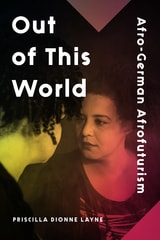
Out of This World
Afro-German AfrofuturismPriscilla Dionne Layne
Northwestern University Press, 2025
Examining Afro-German artists’ use of Afrofuturist tropes to critique German racial history
The term Afrofuturism was first coined in the 1990s to describe African diasporic artists’ use of science fiction, speculative fiction, and fantasy to reimagine the diaspora’s pasts and to counter not only Eurocentric prejudices but also pessimistic narratives. Out of This World: Afro-German Afrofuturism focuses on contemporary Black German Afrofuturist literature and performance that critiques Eurocentrism and, specifically, German racism and colonial history. This young generation has, Priscilla Layne argues, engaged with Afrofuturism to disrupt linear time and imagine alternative worlds, to introduce non-Western technologies into the German cultural milieu, and to consider the possibilities of posthumanism. Their experiments in futurist and speculative narratives offer new tools for breaking with the binary thinking about race, culture, and gender identity that have been enforced by repressive ideological and state apparatuses, such as educational, cultural, and police institutions. Rather than providing escapism or purely imaginary alternatives, however, they have created a space—outer and artistic—in which their lives matter.