Results by title
82 books match the query 'Hermeneutics' and 2 start with o
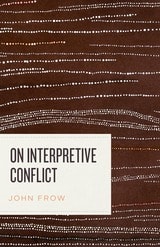
On Interpretive Conflict
John Frow
University of Chicago Press, 2019
“Interpretation” is a term that encompasses both the most esoteric and the most fundamental activities of our lives, from analyzing medical images to the million ways we perceive other people’s actions. Today, we also leave interpretation to the likes of web cookies, social media algorithms, and automated markets. But as John Frow shows in this thoughtfully argued book, there is much yet to do in clarifying how we understand the social organization of interpretation.
On Interpretive Conflict delves into four case studies where sharply different sets of values come into play—gun control, anti-Semitism, the religious force of images, and climate change. In each case, Frow lays out the way these controversies unfold within interpretive regimes that establish what counts as an interpretable object and the protocols of evidence and proof that should govern it. Whether applied to a Shakespeare play or a Supreme Court case, interpretation, he argues, is at once rule-governed and inherently conflictual. Ambitious and provocative, On Interpretive Conflict will attract readers from across the humanities and beyond.
On Interpretive Conflict delves into four case studies where sharply different sets of values come into play—gun control, anti-Semitism, the religious force of images, and climate change. In each case, Frow lays out the way these controversies unfold within interpretive regimes that establish what counts as an interpretable object and the protocols of evidence and proof that should govern it. Whether applied to a Shakespeare play or a Supreme Court case, interpretation, he argues, is at once rule-governed and inherently conflictual. Ambitious and provocative, On Interpretive Conflict will attract readers from across the humanities and beyond.
[more]
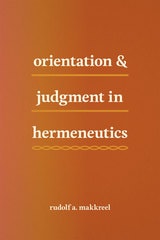
Orientation and Judgment in Hermeneutics
Rudolf A. Makkreel
University of Chicago Press, 2015
This book provides an innovative approach to meeting the challenges faced by philosophical hermeneutics in interpreting an ever-changing and multicultural world. Rudolf A. Makkreel proposes an orientational and reflective conception of interpretation in which judgment plays a central role. Moving beyond the dialogical approaches found in much of contemporary hermeneutics, he focuses instead on the diagnostic use of reflective judgment, not only to discern the differentiating features of the phenomena to be understood, but also to orient us to the various meaning contexts that can frame their interpretation.
Makkreel develops overlooked resources of Kant’s transcendental thought in order to reconceive hermeneutics as a critical inquiry into the appropriate contextual conditions of understanding and interpretation. He shows that a crucial task of hermeneutical critique is to establish priorities among the contexts that may be brought to bear on the interpretation of history and culture. The final chapter turns to the contemporary art scene and explores how orientational contexts can be reconfigured to respond to the ways in which media of communication are being transformed by digital technology. Altogether, Makkreel offers a promising way of thinking about the shifting contexts that we bring to bear on interpretations of all kinds, whether of texts, art works, or the world.
Makkreel develops overlooked resources of Kant’s transcendental thought in order to reconceive hermeneutics as a critical inquiry into the appropriate contextual conditions of understanding and interpretation. He shows that a crucial task of hermeneutical critique is to establish priorities among the contexts that may be brought to bear on the interpretation of history and culture. The final chapter turns to the contemporary art scene and explores how orientational contexts can be reconfigured to respond to the ways in which media of communication are being transformed by digital technology. Altogether, Makkreel offers a promising way of thinking about the shifting contexts that we bring to bear on interpretations of all kinds, whether of texts, art works, or the world.
[more]