Results by title
425 books match the query 'Human rights' and 4 start with o

On the Spirit of Rights
Dan Edelstein
University of Chicago Press, 2018
By the end of the eighteenth century, politicians in America and France were invoking the natural rights of man to wrest sovereignty away from kings and lay down universal basic entitlements. Exactly how and when did “rights” come to justify such measures?
In On the Spirit of Rights, Dan Edelstein answers this question by examining the complex genealogy of the rights that regimes enshrined in the American and French Revolutions. With a lively attention to detail, he surveys a sprawling series of debates among rulers, jurists, philosophers, political reformers, writers, and others who were all engaged in laying the groundwork for our contemporary systems of constitutional governance. Every seemingly new claim about rights turns out to be a variation on a theme, as late medieval notions were subtly repeated and refined to yield the talk of “rights” we recognize today. From the Wars of Religion to the French Declaration of the Rights of Man and of the Citizen to the 1948 Universal Declaration of Human Rights, On the Spirit of Rights is a sweeping tour through centuries of European intellectual history and an essential guide to our ways of thinking about human rights today.
In On the Spirit of Rights, Dan Edelstein answers this question by examining the complex genealogy of the rights that regimes enshrined in the American and French Revolutions. With a lively attention to detail, he surveys a sprawling series of debates among rulers, jurists, philosophers, political reformers, writers, and others who were all engaged in laying the groundwork for our contemporary systems of constitutional governance. Every seemingly new claim about rights turns out to be a variation on a theme, as late medieval notions were subtly repeated and refined to yield the talk of “rights” we recognize today. From the Wars of Religion to the French Declaration of the Rights of Man and of the Citizen to the 1948 Universal Declaration of Human Rights, On the Spirit of Rights is a sweeping tour through centuries of European intellectual history and an essential guide to our ways of thinking about human rights today.
[more]
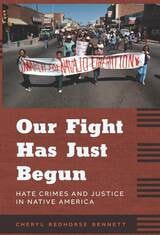
Our Fight Has Just Begun
Hate Crimes and Justice in Native AmericaCheryl Redhorse Bennett
University of Arizona Press, 2022
Our Fight Has Just Begun is a timely and urgent work. The result of more than a decade of research, it revises history, documents anti-Indianism, and gives voice to victims of racial violence. Navajo scholar Cheryl Redhorse Bennett reveals a lesser-known story of Navajo activism and the courageous organizers that confronted racial injustice and inspired generations.
Illuminating largely untold stories of hate crimes committed against Native Americans in the Four Corners region of the United States, this work places these stories within a larger history, connecting historical violence in the United States to present-day hate crimes. Bennett contends that hate crimes committed against Native Americans have persisted as an extension of an “Indian hating” ideology that has existed since colonization, exposing how the justice system has failed Native American victims and families.
While this book looks deeply at multiple generations of unnecessary and ongoing pain and violence, it also recognizes that this is a time of uncertainty and hope. The movement to abolish racial injustice and racially motivated violence has gained fierce momentum. Our Fight Has Just Begun shows that racism, hate speech, and hate crimes are ever present and offers recommendations for racial justice.
[more]
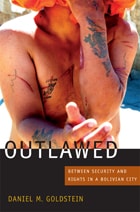
Outlawed
Between Security and Rights in a Bolivian CityDaniel M. Goldstein
Duke University Press, 2012
In Outlawed, Daniel M. Goldstein reveals how indigenous residents of marginal neighborhoods in Cochabamba, Bolivia, struggle to balance security with rights. Feeling abandoned to the crime and violence that grip their communities, they sometimes turn to vigilante practices, including lynching, to apprehend and punish suspected criminals. Goldstein describes those in this precarious position as "outlawed": not protected from crime by the law but forced to comply with legal measures in other areas of their lives, their solutions to protection criminalized while their needs for security are ignored. He chronicles the complications of the government's attempts to provide greater rights to indigenous peoples, including a new constitution that recognizes "community justice." He also examines how state definitions of indigeneity ignore the existence of marginal neighborhoods, continuing long-standing exclusionary practices. The insecurity felt by the impoverished residents of Cochabamba—and, more broadly, by the urban poor throughout Bolivia and Latin America—remains. Outlawed illuminates the complex interconnections between differing definitions of security and human rights at the local, national, and global levels.
[more]
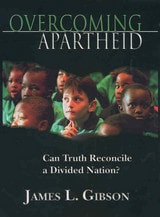
Overcoming Apartheid
Can Truth Reconcile a Divided Nation?James L. Gibson
Russell Sage Foundation, 2004
Perhaps no country in history has so directly and thoroughly confronted its past in an effort to shape its future as has South Africa. Working from the belief that understanding the past will help build a more peaceful and democratic future, South Africa has made a concerted, institutionalized effort to come to grips with its history of apartheid through its Truth and Reconciliation Commission. In Overcoming Apartheid, James L. Gibson provides the first systematic assessment of whether South Africa's truth and reconciliation process has been successful. Has the process allowed South Africa to let go of its painful past and move on? Or has it exacerbated racial tensions by revisiting painful human rights violations and granting amnesty to their perpetrators? Overcoming Apartheid reports on the largest and most comprehensive study of post-apartheid attitudes in South Africa to date, involving a representative sample of all major racial, ethnic, and linguistic groups. Grounding his analysis of truth in theories of collective memory, Gibson discovers that the process has been most successful in creating a common understanding of the nature of apartheid. His analysis then demonstrates how this common understanding is helping to foster reconciliation, as defined by the acceptance of basic principles of human rights and political tolerance, rejection of racial prejudice, and acceptance of the institutions of a new political order. Gibson identifies key elements in the process—such as acknowledging shared responsibility for atrocities of the past—that are essential if reconciliation is to move forward. He concludes that without the truth and reconciliation process, the prospects for a reconciled, democratic South Africa would diminish considerably. Gibson also speculates about whether the South African experience provides any lessons for other countries around the globe trying to overcome their repressive pasts. A groundbreaking work of social science research, Overcoming Apartheid is also a primer for utilizing innovative conceptual and methodological tools in analyzing truth processes throughout the world. It is sure to be a valuable resource for political scientists, social scientists, group relations theorists, and students of transitional justice and human rights.
[more]