Results by title
456 books match the query 'India' and 3 start with o

Of Morsels and Marvels
Maryse Condé
Seagull Books, 2019
In Of Morsels and Marvels, Condé takes us on a literary journey around places she has travelled to in India, Indonesia, and South Africa. She highlights the tastes and culinary traditions that are fascinating examples of a living museum. Such places, Condé explains, provide important insights into lesser-known aspects of contemporary life. One anecdote illustrates what becomes of the standard Antillean dishes of fish stew and goat curry by two Antilleans who own a restaurant in Sydney, Australia. Cuisine changes not only according to the individual cook but also adapts to foreign skies under which it is created. The author also recounts personal memories of her lifelong relationship with cooking, such as when Adélia, her family’s servant, wrongly blames little Maryse for mixing raisins with fish and using her imagination in the kitchen.
Blending travel with gastronomy, this enchanting volume from the winner of the 2018 Alternative Nobel Prize will delight all who marvel at the wonders of the kitchen or seek to taste the world.
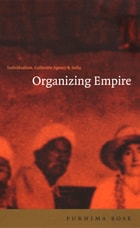
Organizing Empire
Individualism, Collective Agency, and IndiaPurnima Bose
Duke University Press, 2003
From a historically grounded, feminist perspective, Bose offers four case studies, each of which illuminates a distinct individualizing rhetorical strategy. She looks at the parliamentary debates on the Amritsar Massacre of 1919, in which several hundred unarmed Indian protesters were killed; Margaret Cousins’s firsthand account of feminist organizing in Ireland and India; Kalpana Dutt’s memoir of the Bengali terrorist movement of the 1930s, which was modeled in part on Irish anticolonial activity; and the popular histories generated by ex-colonial officials and their wives. Bringing to the fore the constraints that colonial domination placed upon agency and activism, Organizing Empire highlights the complexity of the multiple narratives that constitute British colonial history.
Our History, Their History, Whose History?
Romila Thapar
Seagull Books, 2023
In this timely book, historian Romila Thapar delves into the complex world of nationalism and its impact on the interpretations of the past and on the discipline of history itself. History, she expounds, is no mere collection of information and chronology, and its purpose extends well beyond storytelling.
Recognizing nationalism as a powerful force that gives rise to various narratives that provide ancestry to communities and shape the direction of societies, Thapar explores how, in India, two conflicting notions of nationalism have evolved and shaped the idea of the nation. Today, one such nationalistic theory claims the victimization of one religious community by another through centuries of “misrule.” Such a claim willfully ignores ample evidence to the contrary to suit a particular political and ideological purpose. Thapar counters such attempts at misrepresentation by citing several historical instances of the nuanced interface and intermingling of cultures, as well as by showing how today’s conflicts have their roots in the British colonial construction of India’s history. She also addresses the recent controversy surrounding the deletions of sections of Indian history textbooks published by NCERT, the Indian educational council, and suggests that the intention is more likely to be the promotion of a particular reading of history that conforms to the ideology of those in power.
Engaging and thought-provoking, Our History, Their History, Whose History? invites readers to question the authenticity of historical narratives touted by one group of nationalists, and it explores the clash between professional historians who study the past to understand our inherited present and fabricators who wield history for political gain.