Results by title
468 books match the query 'Industries' and 8 start with o
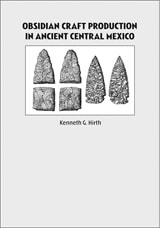
Obsidian Craft Production in Ancient Central Mexico
Kenneth Hirth
University of Utah Press, 2006
The appearance of such craft specialists—who produced large quantities of goods for other households—represented a significant and fundamental change in the structure of prehistoric economies. In central Mexico one particularly important craft specialty was the making of obsidian prismatic blades, the cutting tools of choice.
Unlike most other craft activities, obsidian craft production can be studied using archaeological techniques. Obsidian Craft Production in Ancient Central Mexico examines the obsidian craft industry found at the site of Xochicalco, Morelos, between A.D. 650 and 900, the Gobernador or Epiclassic period when independent city-states appeared throughout central Mexico to fill the political vacuum left by the decline of Teotihuacan. Because the demand for obsidian tools remained constant, author Kenneth Hirth contends that obsidian can serve as a general model for discussing craft production and economic organization on a broader theoretical level.

Ohio On The Move
Transportation in the Buckeye StateH. Roger Grant
Ohio University Press, 1999
Few American states can match the rich and diverse transportation heritage of Ohio. Every major form of public conveyance eventually served the Buckeye state. From the “Canal Age” to the “Interurban Era,” Ohio emerged as a national leader. The state’s central location, abundant natural resources, impressive wealth, shrewd business leadership, and episodes of good fortune explain the dynamic nature of its transport past.
Ohio on the Move is the first systematic scholarly account of the transportation history of Ohio. To date, little has appeared on several subjects discussed here, including intercity bus and truck operations and commercial aviation. The more familiar topics of river and lake transport, canals, steam railroads, electric interurbans, and mass transit are extensively explored in the Ohio context.
In this inaugural volume of Ohio University Press’s Ohio Bicentennial Series, Professor Grant demonstrates the truth of the slogan that Ohio is “the heart of it all” - not solely by location but also in the impressive network of transportation arteries that have linked the state, whether natural waterways and air space or various artificial land-travel routes.

Oil Wars
Yahia Said
Pluto Press, 2007
Oil and Urbanization on the Pacific Coast
Ralph Bramel Lloyd and the Shaping of the Urban WestMichael R. Adamson
West Virginia University Press, 2018
Oil and Urbanization on the Pacific Coast tells the story of oilman Ralph Bramel Lloyd, a small business owner who drove the development of one of America’s largest oil fields. Lloyd invested his petroleum earnings in commercial real estate—much of it centered around automobiles and the fuel they require—in several western cities, notably Portland, Oregon. Putting the history of extractive industry in dialogue with the history of urban development, Michael R. Adamson shows how energy is woven into the fabric of modern life, and how the “energy capital” of Los Angeles exerted far-flung influence in the US West.
A contribution to the relatively understudied history of small businesses in the United States, Oil and Urbanization on the Pacific Coast explores issues of interest to multiple audiences, such as the competition for influence over urban development waged among local growth machines and outside corporate interests; the urban rivalries of a region; the importance of public capital in mobilizing the commercial real estate sector during the Great Depression and World War II; and the relationships among owners, architects, and contractors in the execution of commercial building projects.
Oil, Banks, and Politics
The United States and Postrevolutionary Mexico, 1917–1924By Linda B. Hall
University of Texas Press, 1995
Mexico was second only to the United States as the world's largest oil producer in the years following the Mexican Revolution. As the revolutionary government became institutionalized, it sought to assure its control of Mexico's oil resources through the Constitution of 1917, which returned subsoil rights to the nation. This comprehensive study explores the resulting struggle between oil producers, many of which were U.S. companies, and the Mexican government.
Linda Hall goes beyond the diplomacy to look at the direct impact of a powerful, highly profitable foreign-controlled industry on a government and a nation trying to recover from a major civil war. She draws on extensive research in Mexican archives, including both government sources and the private papers of Presidents Alvaro Obregón and Plutarco Elías Calles, as well as U.S. government and private sources.
Since the North American Free Trade Agreement has expanded United States business ties to Mexico, this study of a crucial moment in U.S.-Mexican business relations will be of interest to a wide audience in business, diplomatic, and political history.
On My Own
Korean Businesses and Race Relations in AmericaIn-Jin Yoon
University of Chicago Press, 1997
In On My Own, In-Jin Yoon combines an intimate fieldwork account of Korean-black relations in Chicago and Los Angeles with extensive quantitative analysis at the national level. Yoon argues that a complete understanding of the contemporary Korean-American community requires systematic analyses of patterns of Korean immigration, entrepreneurship, and race relations with other minority groups. He explains how small business has become the major economic activity of Korean immigrants and how Korean businesses in minority neighborhoods have intensified racial tensions between Koreans and minorities like blacks and Latinos.
“A groundbreaking study of Korean-black relations. Yoon’s insights on immigration, entrepreneurship, and race relations significantly enhance our understanding of urban racial tensions.”—William Julius Wilson, Harvard University

One Small Farm
Photographs of a Wisconsin Way of LifeCraig Schreiner
Wisconsin Historical Society Press, 2013
“People’s lives are written on the fields of old farms. The rows of the fields are like lines on a page, blank and white in winter, filled in with each year’s story of happiness, disappointment, drought, rain, sun, scarcity, plenty. The chapters accumulate, and people enter and leave the narrative. Only the farm goes on.”—From the Introduction
In One Small Farm, Craig Schreiner’s evocative color photographs capture one family as they maintain the rhythms and routines of small farm life near Pine Bluff, Wisconsin. “Milk in the morning and milk at night. Feed the cows and calves. Plant crops. Grind feed. Chop and bale hay. Cut wood. Clean the barn. Spread manure on the fields. Plow snow and split wood in winter. In spring, pick rocks from the fields. Cultivate corn. Pick corn. Harvest oats and barley. Help calves be born. Milk in the morning and milk at night.”
There’s much more to life on the farm than just chores, of course, and Schreiner captures the rhythms and richness of everyday life on the farm in all seasons, evoking both the challenges and the joys and providing viewers a window into a world that is quickly fading. In documenting the Lamberty family’s daily work and life, these thoughtful photos explore larger questions concerning the future of small farm agriculture, Wisconsin cultural traditions, and the rural way of life.

Outbreak
Foodborne Illness and the Struggle for Food SafetyTimothy D. Lytton
University of Chicago Press, 2019
With Outbreak, Timothy D. Lytton provides an up-to-date history and analysis of the US food safety system. He pays particular attention to important but frequently overlooked elements of the system, including private audits and liability insurance.
Lytton chronicles efforts dating back to the 1800s to combat widespread contamination by pathogens such as E. coli and salmonella that have become frighteningly familiar to consumers. Over time, deadly foodborne illness outbreaks caused by infected milk, poison hamburgers, and tainted spinach have spurred steady scientific and technological advances in food safety. Nevertheless, problems persist. Inadequate agency budgets restrict the reach of government regulation. Pressure from consumers to keep prices down constrains industry investments in safety. The limits of scientific knowledge leave experts unable to assess policies’ effectiveness and whether measures designed to reduce contamination have actually improved public health. Outbreak offers practical reforms that will strengthen the food safety system’s capacity to learn from its mistakes and identify cost-effective food safety efforts capable of producing measurable public health benefits.