Results by title
1031 books match the query 'Intellectual life' and 11 start with o
Object Lessons and the Formation of Knowledge
The University of Michigan Museums, Libraries, and Collections 1817–2017Kerstin Barndt and Carla M. Sinopoli, editors
University of Michigan Press, 2017
Octavio Paz
A MeditationIlan Stavans
University of Arizona Press, 2001

On Cultural Freedom
An Exploration of Public Life in Poland and AmericaJeffrey C. Goldfarb
University of Chicago Press, 1983
Goldfarb—who examines conditions in the Soviet Union, the United States, and their respective European allies—focuses most closely upon Poland and the United States. He investigates a wide range of concrete cases, including the Polish opposition movement and Solidarity, the migration of artists, the American television and magazine industries, American philanthropy, and communist cultural conveyor belts.
From these cases, Goldfarb derives a definitive set of sociological conditions for cultural freedom: critical creativity which resists systematic constraints, continuity of cultural tradition, and a relatively autonomous public realm for the reception of culture. Cultural freedom, Goldfarb shows, is not a static state but a process of achievement. Its parameters and content are determined by social practice in cultural institutions and by their relations with other components and the totality of social structure.
So defined, cultural freedom is transformed from an ideological concept into one with real critical and analytical power. Through it we can appreciate the invisible nature of constraint in the West and the unapparent but acting supports of cultural freedom existing in socialist countries. Most importantly, Goldfarb's conclusions provide a framework for understanding more clearly than before the circumstance of cultural freedom in both East and West so that citizens may utilize their full creative abilities as they address the problems of the present day.
Once Were Pacific
Maori Connections to OceaniaAlice Te Punga Somerville
University of Minnesota Press, 2012
Native identity is usually associated with a particular place. But what if that place is the ocean? Once Were Pacific explores this question as it considers how Māori and other Pacific peoples frame their connection to the ocean, to New Zealand, and to each other through various creative works. Māori scholar Alice Te Punga Somerville shows how and when Māori and other Pacific peoples articulate their ancestral history as migratory seafarers, drawing their identity not only from land but also from water.
Although Māori are ethnically Polynesian, and Aotearoa New Zealand is clearly a part of the Pacific region, in New Zealand the terms “Māori” and “Pacific” are colloquially applied to two distinct communities: Māori are Indigenous, and “Pacific” refers to migrant communities from elsewhere in the region. Asking how this distinction might blur historical and contemporary connections, Te Punga Somerville interrogates the relationship between indigeneity, migration, and diaspora, focusing on texts: poetry, fiction, theater, film, and music, viewed alongside historical instances of performance, journalism, and scholarship.
In this sustained treatment of the Māori diaspora, Te Punga Somerville provides the first critical analysis of relationships between Indigenous and migrant communities in New Zealand.
One Island, Many Voices
Conversations with Cuban-American WritersEduardo R. del Rio
University of Arizona Press, 2008
From playwright Dolores Prida to author and literary critic Gustavo Pérez Firmat, these voices run the gamut of both genre and personality. In addition to the essential facts of literary accomplishment, the interviews include a wealth of insight into each writer’s history, motivations, concerns, and relationship to language. These personal details serve to humanize and illuminate the unique circumstances and realities that have shaped both the authors and their work.
What del Rio has ultimately brought together is a series of intimate sketches that will not only serve as an important reference for any discussion of the literature but will also help readers to develop for themselves a sense of what Cuban-American writing is, and what it is not.
CONTENTS
Preface
Acknowledgments
Introduction
Nilo Cruz
Roberto Fernández
Cristina García
Carolina Hospital
Eduardo Machado
Dionisio Martínez
Pablo Medina
Achy Obejas
Ricardo Pau-Llosa
Gustavo Pérez Firmat
Dolores Prida
Virgil Suárez
Epilogue
Notes
Bibliography
Index
Oppenheimer
The Tragic IntellectCharles Thorpe
University of Chicago Press, 2007
Oracles of Empire
Poetry, Politics, and Commerce in British America, 1690-1750David S. Shields
University of Chicago Press, 1990
British America's poetry of empire was dominated by three issues: mercantilism's promise that civilization and wealth would be transmitted from London to the provinces; the debate over the extent of metropolitan prerogatives in law and commerce when they obtruded upon provincial rights and interests; and the argument that Britain's imperium pelagi was an ethical empire, because it depended upon the morality of trade, while the empires of Spain and France were immoral empires because they were grounded upon conquest. In discussing these issues, Shields provides a virtual anthology of poems long lost to students of American literature.

Other Sisterhoods
LITERARY THEORY AND U.S. WOMEN OF COLOREdited by Sandra Kumamoto Stanley
University of Illinois Press, 1998
The fifteen contributors to Other Sisterhoods: Literary Theory and
U.S. Women of Color examine the ways that women writers of color have
contributed to the discourse of literary and cultural theory. They focus
on the impact of key issues, such as social construction and identity
politics, on the works of women writers of color, as well as on the ways
these women deal with differences relating to gender, class, race/ethnicity,
and sexuality. The book also explores the ways women writers of color
have created their own ethnopoetics within the arena of literary and cultural
theory, helping to redefine the nature of theory itself.
"A sophisticated resource that will do much to carry us through
to the next century. Great work!" -- Alvina E. Quintana, author of
Home Girls: Chicana Literary Voices
CONTRIBUTORS:Sandra Kumamoto Stanley, AnaLouise Keating, Dionne
Espinoza, Kimberly N. Brown, Marilyn Edelstein, Tomo Hattori, Robin Riley
Fast, King-Kok Cheung, Timothy Libretti, Renae Moore Bredin, Jennifer
Browdy de Hernandez, Kimberly M. Blaeser, Kathryn Bond Stockton, Eun Kyung
Min, Cecilia Rodriguez Milanes
Otto Weininger
Sex, Science, and Self in Imperial ViennaChandak Sengoopta
University of Chicago Press, 2000
This provocative, enlightening study explores the milieu in which the philosopher Otto Weininger (1880-1903) wrote his controversial book Sex and Character. Shortly after its publication, Weininger committed suicide at the age of twenty-three. His book, which argued that women and Jews were mere sexual beings who lacked individuality, became a bestseller.
Hailed as a genius by intellectuals such as Ludwig Wittgenstein and Karl Kraus, Weininger was admired, not for his prejudices, but for his engagement with the central issues of the time—the nature and meanings of identity. Sengoopta pays particular attention to how Weininger appropriated scientific language and data to defend his views and examines the scientific theories themselves.
Out of Brownsville
Encounters with Nobel Laureates and Other Jewish Writers: A Cultural MemoirJules Chametzky
University of Massachusetts Press, 2012
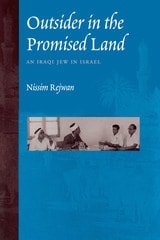
Outsider in the Promised Land
An Iraqi Jew in IsraelBy Nissim Rejwan
University of Texas Press, 2006
In 1951, Israel was a young nation surrounded by hostile neighbors. Its tenuous grip on nationhood was made slipperier still by internal tensions among the various communities that had immigrated to the new Jewish state, particularly those between the politically and socially dominant Jewish leadership hailing from Eastern Europe and the more numerous Oriental Jews from the Middle East and North Africa. Into this volatile mix came Nissim Rejwan, a young Iraqi Jewish intellectual who was to become one of the country's leading public intellectuals and authors.
Beginning with Rejwan's arrival in 1951 and climaxing with the tensions preceding Israel's victory in the Six-Day War of 1967, this book colorfully chronicles Israel's internal and external struggles to become a nation, as well as the author's integration into a complex culture. Rejwan documents how the powerful East European leadership, acting as advocates of Western norms and ideals, failed to integrate Israel into the region and let the country take its place as a part of the Middle East. Rejwan's essays and occasional articles are an illuminating example of how minority groups use journalism to gain influence in a society. Finally, the letters and diary entries reproduced in Outsider in the Promised Land are full of lively, witty meditations on history, literature, philosophy, education, and art, as well as one man's personal struggle to find his place in a new nation.