366 books match the query 'International' and 4 start with o
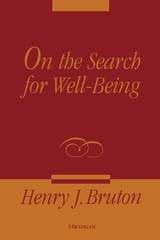
cover of On the Search for Well-Being

On the Search for Well-Being

Henry J. Bruton

University of Michigan Press, 2001
This book takes on one of the great questions of the day: Why are some countries enormously rich and others so heartbreakingly poor?
Henry J. Bruton organizes the discussion around three basic ideas. The first is that well-being reflects not only the availability and distribution of goods and services, but also employment, values, institutions, and quality of preferences. The second is that ignorance is ubiquitous; hence growth of well-being depends primarily on commitments to searching and learning. The extent of such commitments is embedded in deep-seated characteristics of the society, its history, and the degree to which it can look ahead. The third is that economic policy-making is largely a matter of muddling through; furthermore, the idea that an economy can be assumed to be in a general equilibrium and can therefore be left to itself must be rejected. The author explores these ideas and their implications for the processes of growth and for policies to facilitate that growth.
The book breaks new ground in its emphasis on ignorance and learning and its generalized definition of well-being. Drawing from contemporary work in evolutionary economics, the economics of technological change, analytical economic history, and the new political economy, this work should be of interest to historians, sociologists, and students of technology, as well as economists. While directly concerned with development, it has implications for labor, trade, economic history, and industrial organization.
Henry J. Bruton is Professor of Economics, Williams College.
[more]
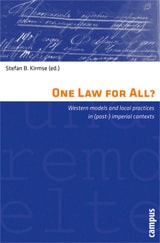
cover of One Law for All?: Western Models and Local Practices in (Post-) Imperial Contexts

One Law for All?

Western Models and Local Practices in (Post-) Imperial Contexts

Edited by Stefan B. Kirmse

Campus Verlag, 2012

Examining new archival material from the nineteenth and early twentieth centuries, One Law for All? discusses legal transfer and practice in imperial and post-imperial societies, including Russia, Latin America, Africa, and East Asia. The essays collected here analyze the legal sphere as a site of struggle, both in debate and in everyday life, from the level of universal aspirations to particular local practices. The contributors explore the ways in which both lawmakers and ordinary people talk about and actively use the law, thereby telling a story of contested European hegemony, local assertions, and multiple legal borrowings.
[more]
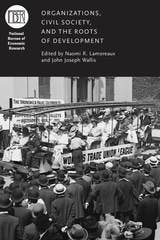
cover of Organizations, Civil Society, and the Roots of Development

Organizations, Civil Society, and the Roots of Development

Edited by Naomi R. Lamoreaux and John Joseph Wallis

University of Chicago Press, 2017

Modern developed nations are rich and politically stable in part because their citizens are free to form organizations and have access to the relevant legal resources. Yet in spite of the advantages of open access to civil organizations, it is estimated that eighty percent of people live in countries that do not allow unfettered access. Why have some countries disallow the formation of organizations as part of their economic and political system?
           
The contributions to Organizations, Civil Society, and the Roots of Development seek to answer this question through an exploration of how developing nations throughout the eighteenth and nineteenth centuries, including the United States, United Kingdom, France, and Germany, made the transition to allowing their citizens the right to form organizations. The transition, contributors show, was not an easy one. Neither political changes brought about by revolution nor subsequent economic growth led directly to open access. In fact, initial patterns of change were in the opposite direction, as political coalitions restricted access to specific organizations for the purpose of maintaining political control. Ultimately, however, it became clear that these restrictions threatened the foundation of social and political order. Tracing the path of these modern civil societies, Organizations, Civil Society, and the Roots of Development is an invaluable contribution to all interested in today’s developing countries and the challenges they face in developing this organizational capacity.
 
[more]
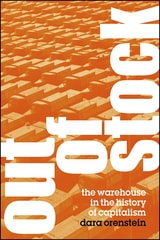
cover of Out of Stock: The Warehouse in the History of Capitalism

Out of Stock

The Warehouse in the History of Capitalism

Dara Orenstein

University of Chicago Press, 2019

In Out of Stock, Dara Orenstein delivers an ambitious and engrossing account of that most generic and underappreciated site in American commerce and industry: the warehouse. She traces the progression from the nineteenth century’s bonded warehouses to today’s foreign-trade zones, enclaves where goods can be simultaneously on US soil and off US customs territory. Orenstein contends that these zones—nearly 800 of which are scattered across the country—are emblematic of why warehouses have begun to supplant factories in the age of Amazon and Walmart. Circulation is so crucial to the logistics of how and where goods are made that it is increasingly inseparable from production, to the point that warehouses are now some of the most pivotal spaces of global capitalism. Drawing from cultural geography, cultural history, and political economy, Out of Stock nimbly demonstrates the centrality of warehouses for corporations, workers, cities, and empires.
 
[more]