412 books match the query 'Japan' and 7 start with o
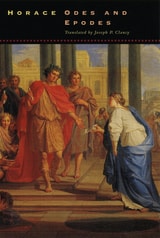
cover of Odes and Epodes

Odes and Epodes

Horace

University of Chicago Press, 1960

The writings of Horace have exerted strong and continuing influence on writers from his day to our own. Sophisticated and intellectual, witty and frank, he speaks to the cultivated and civilized world of today with the same astringent candor and sprightliness that appeared so fresh at the height of Rome's wealthy and glory.

In 23 B.C., when he published the first three books of his lyrics, Horace was 42 years old, secure in the favor of the emperor Augustus, and living in ease and comfort as a country gentleman on his Sabine farm. Serenity is reflected in these lyrics, certainly, but so are other experiences, for Horace had lived through three major political crises in a society that was the center of the world, that was sophisticated, refined—and beginning to decay. A worldly, high-spirited, cultivated man, Horace responds in his poetry to the myriad elements of Roman life he knew so well.

The Odes and Epodes of Horace collects the entirety of his lyric poetry, comprising all 103 odes, the Carmen Saeculare ("Festival Hymn"), and the earlier epodes. Joseph P. Clancy has achieved a mirroring of the originals that is worthy in its own right as English verse, and his introductions to each book of lyrics are both lively and informed.
[more]
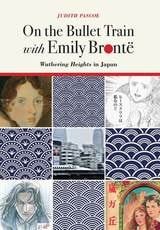
cover of On the Bullet Train with Emily Brontë: Wuthering Heights in Japan

On the Bullet Train with Emily Brontë

Wuthering Heights in Japan

Judith Pascoe

University of Michigan Press, 2017

While teaching in Japan, Judith Pascoe was fascinated to discover the popularity that Emily Brontë’s novel Wuthering Heights has enjoyed there. Nearly 100 years after its first formal introduction to the country, the novel continues to engage the imaginations of Japanese novelists, filmmakers, manga artists and others, resulting in numerous translations, adaptations, and dramatizations. On the Bullet Train with Emily Brontë is Pascoe’s lively account of her quest to discover the reasons for the continuous Japanese embrace of Wuthering Heights, including quite varied and surprising adaptations of the novel. At the same time, the book chronicles Pascoe’s experience as an adult student of Japanese. She contemplates the multiple Japanese translations of Brontë, as contrasted to the single (or non-existent) English translations of major Japanese writers. Carrying out a close reading of a distant country’s Wuthering Heights, Pascoe begins to see American literary culture as a small island on which readers are isolated from foreign literature.
 
In this and in her previous book, The Sarah Siddons Audio Files, Pascoe’s engaging narrative innovates a new scholarly form involving immersive research practice to attempt a cross-cultural version of reader-response criticism. On the Bullet Train with Emily Brontë will appeal to scholars in the fields of 19th-century British literature, adaptation studies, and Japanese literary history.
[more]
cover of One Sunny Day: A Child's Memories of Hiroshima

One Sunny Day

A Child's Memories of Hiroshima

Hideko Tamura Snider

Oregon State University Press, 2023

Hideko was ten years old when the atomic bomb devastated her home in Hiroshima. In this eloquent and moving narrative, Hideko recalls her life before the bomb, the explosion itself, and the influence of that trauma upon her subsequent life in Japan and the United States. Her years in America have given her unusual insights into the relationship between Japanese and American cultures and the impact of Hiroshima on our lives.  

This new edition includes two expanded chapters and revisions throughout. A new epilogue brings the story up to date. This poignant story of courage and resilience remains deeply relevant today, offering a profoundly personal testament against the ongoing threat of nuclear warfare.
[more]
cover of Ontology of Production: Three Essays

Ontology of Production

Three Essays

Nishida KitarM

Duke University Press, 2012

Ontology of Production presents three essays by the influential Japanese philosopher Nishida Kitarō (1870–1945), translated for the first time into English by William Haver. While previous translations of his writings have framed Nishida within Asian or Oriental philosophical traditions, Haver's introduction and approach to the texts rightly situate the work within Nishida's own commitment to Western philosophy. In particular, Haver focuses on Nishida's sustained and rigorous engagement with Marx's conception of production.

Agreeing with Marx that ontology is production and production is ontology, Nishida in these three essays—"Expressive Activity" (1925), "The Standpoint of Active Intuition" (1935), and "Human Being" (1938)—addresses sense and reason, language and thought, intuition and appropriation, ultimately arguing that in this concept of production, ideality and materiality are neither mutually exclusive nor oppositional but, rather, coimmanent. Nishida's forceful articulation of the radical nature of Marx's theory of production is, Haver contends, particularly timely in today's speculation-driven global economy. Nishida's reading of Marx, which points to the inseparability of immaterial intellectual labor and material manual labor, provokes a reconsideration of Marxism's utility for making sense of—and resisting—the logic of contemporary capitalism.
[more]
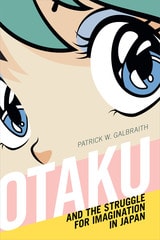
cover of Otaku and the Struggle for Imagination in Japan

Otaku and the Struggle for Imagination in Japan

Patrick Galbraith

Duke University Press, 2019

From computer games to figurines and maid cafes, men called “otaku” develop intense fan relationships with “cute girl” characters from manga, anime, and related media and material in contemporary Japan. While much of the Japanese public considers the forms of character love associated with “otaku” to be weird and perverse, the Japanese government has endeavored to incorporate “otaku” culture into its branding of “Cool Japan.” In Otaku and the Struggle for Imagination in Japan, Patrick W. Galbraith explores the conflicting meanings of “otaku” culture and its significance to Japanese popular culture, masculinity, and the nation. Tracing the history of “otaku” and “cute girl” characters from their origins in the 1970s to his recent fieldwork in Akihabara, Tokyo (“the Holy Land of Otaku”), Galbraith contends that the discourse surrounding “otaku” reveals tensions around contested notions of gender, sexuality, and ways of imagining the nation that extend far beyond Japan. At the same time, in their relationships with characters and one another, “otaku” are imagining and creating alternative social worlds.
[more]
cover of Otaku: Japan's Database Animals

Otaku

Japan's Database Animals

Hiroki Azuma

University of Minnesota Press, 2009

 In Japan, obsessive adult fans and collectors of manga and anime are known as otaku. When the underground otaku subculture first emerged in the 1970s, participants were looked down on within mainstream Japanese society as strange, antisocial loners. Today otaku have had a huge impact on popular culture not only in Japan but also throughout Asia, Europe, and the United States.

Hiroki Azuma’s Otaku offers a critical, philosophical, and historical inquiry into the characteristics and consequences of this consumer subculture. For Azuma, one of Japan’s leading public intellectuals, otaku culture mirrors the transformations of postwar Japanese society and the nature of human behavior in the postmodern era. He traces otaku’s ascendancy to the distorted conditions created in Japan by the country’s phenomenal postwar modernization, its inability to come to terms with its defeat in the Second World War, and America’s subsequent cultural invasion. More broadly, Azuma argues that the consumption behavior of otaku is representative of the postmodern consumption of culture in general, which sacrifices the search for greater significance to almost animalistic instant gratification. In this context, culture becomes simply a database of plots and characters and its consumers mere “database animals.” 

A vital non-Western intervention in postmodern culture and theory, Otaku is also an appealing and perceptive account of Japanese popular culture.
[more]
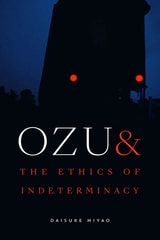
cover of Ozu and the Ethics of Indeterminacy

Ozu and the Ethics of Indeterminacy

Daisuke Miyao

Duke University Press, 2026

Ozu and the Ethics of Indeterminacy re-examines cinema studies through the work of Japanese filmmaker Yasujirō Ozu, employing the multiple methodologies and indeterminacy of Ozu’s films as a model for discussions of cinema’s relationship to the world and the formation of film studies as a discipline. Centering a selection of Ozu films in each chapter, Daisuke Miyao builds a method based on the way films directed by Ozu avoid unitary perspective and allow multiple possibilities of standpoint and spectatorial position, which Miyao calls the ethics of indeterminacy. Analyzing Ozu’s use of cinematography, narrative, and color, Miyao theorizes the indeterminate in film—the seen and unseen, human and nonhuman, domestic and international—to initiate a multi-directional dialogue on the study of cinema that reaches beyond auteurism and culturalism to establish a new basis for disciplinary conversations.
[more]