Results by title
496 books match the query 'Jewish' and 13 start with o
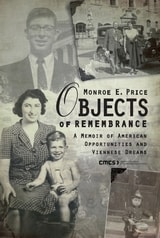
Objects of Remembrance
A Memoir of American Opportunities and Viennese DreamsMonroe E. Price
Central European University Press, 2009
This is a memoir about the power of American assimilation and opportunity in the face of persisting refugee realities. Like Isaac Bashevis Singer, Monroe Price recounts the continuing impact of European identities as families, cast from their homes by the rise of Hitler and the Third Reich, struggle to find their way in a new and challenging environment.
In a series of reflections, Price, who was born to a Jewish family in Vienna in 1938 and left when he was seven months old, seeks to create the Vienna of his infancy, including Jewish life, anti-Semitism, the Anschluss, and Kristallnacht (during which his father was arrested). He shifts to scenes of American socialization in the places he moved with his parents:: Macon, Georgia, Cincinnati, Ohio, and the experience of New York City. Through these reflections, Price illuminates ideas about family, religion, friends and schooling as well as deeply personal issues such as home, food and intimacy.
Price’s memoir weaves complicated strands—his Viennese origins, campaigns to distribute Jewish refugees away from New York City, the special qualities of Midwestern Ohio life in the 1950s—and the contrasting patterns of adjustment by different generations in his family in the American landscape. As he traces the particular path of his own life, Price reveals a more universal story of adjustment, and the relationship between a marginal community and the drama of American citizenship.
On Robert Antelme's The Human Race
Essays and CommentaryRobert Antelme
Northwestern University Press, 2003
In this volume, the extraordinary nature and extent of Robert Antelme's accomplishment, and of the reverberations he set in motion in French life and literature, finds eloquent expression. The pieces Antelme wrote for journals—including essays on "principles put to the test," man as the "basis of right," and the question of revenge—appear here alongside appreciations of The Human Race by authors from Perec to Maurice Blanchot to Sarah Kofman. Also included are Antelme's personal recollections and interviews with, among others, Dionys Mascolo (who brought Antelme back from Dachau), Marguerite Duras (Antelme's wife, who tells of his return from Germany), and Mitterand.
Also available: Antelme's The Human Race

On the Arab-Jew, Palestine, and Other Displacements
Selected Writings of Ella ShohatElla Shohat
Pluto Press, 2017
Spanning several decades, Ella Shohat's work has introduced conceptual frameworks that fundamentally challenged conventional understandings of Palestine, Zionism and the Middle East, focusing on the pivotal figure of the Arab-Jew. This book gathers together her most influential political essays, interviews, speeches, testimonies and memoirs, as well as previously unpublished material.
Defying the binarist and Eurocentric Arab-versus-Jew rendering of the Israeli/Palestinian conflict, Shohat's work has dared to engage with the deeper historical and cultural questions swirling around colonialism, Orientalism and nationalism. Shohat's paradigm-shifting work unpacks such fraught issues as the anomalies of the national/colonial in Zionist discourse; the narrating of Jewish pasts in Muslim spaces; the links and distinctions between the dispossession of the Nakba and the dislocation of Arab-Jews; the traumatic memories triggered by partition and border-crossing; the echoes within Islamophobia of the anti-Semitic figure of 'the Jew'; and the efforts to imagine a possible future inter-communal 'convivencia'.
Shohat's transdisciplinary perspective illuminates the cultural politics in and around the Middle East. Juxtaposing texts of various genres written in divergent contexts, the book offers a vivid sense of the author's intellectual journey.
On the Doorposts of Your House, Revised Edition
Al Mezuzot Beitecha: Prayers and Ceremonies for the Jewish HomeRabbi Chaim Stern
Central Conference of American Rabbis, 2010
On the Margins
Essays on the History of Jews in EstoniaAnton Weiss-Wendt
Central European University Press, 2017
Estonia is perhaps the only country in Europe that lacks a comprehensive history of its Jewish minority. Spanning over 150 years of Estonian Jewish history, On the Margins is a truly unique book. Rebuilding a life beyond so-called Pale of Jewish Settlement in the Russian Empire, the Jewish cultural autonomy in interwar Estonia, and the trauma of Soviet occupation of 1940–41 are among the issues addressed in the book but most profoundly, the book wrestles with the subject of the Holocaust and its legacy in Estonia.
Specifically, it examines the quasi-legal system of murder instituted in Nazi-occupied Estonia, confiscation of Jewish property, and Jewish forced labor camps and develops an analysis of the causes of collaboration during the Holocaust. The book also explores the dynamics of war crimes trials in the Soviet Union since the 1960s and so-called denaturalization trials in the United States in the 1980s. The haunting memory of Soviet and Nazi rule, the book concludes, prevents a larger segment of today’s Estonian population from facing up to the Holocaust and the universal message that it carries.E
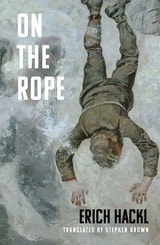
On the Rope
A Hero's StoryErich Hackl
Haus Publishing, 2020
Based on a true story, On the Rope is an account of extreme courage in the face of danger, violence, and hatred. Exploring themes of displacement and survival, friendship and family, it ends with the women’s efforts to bring recognition the selfless heroism of those who faced tremendous personal risk in order to protect them. A novella by one of Europe’s most prominent literary novelists, On the Rope layers deeply personal stories in a grounded historical account of life before, during, and after the Second World War. It paints a vivid picture of the hardships forced upon people by conflict and separation, depicting the forming and unravelling of relationships as a fact of life.
One Hundred Hungers
Lauren Camp
Tupelo Press, 2016
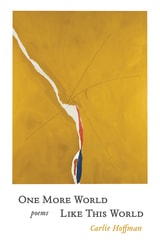
One More World Like This World
Carlie Hoffman
Four Way Books, 2025
Approaching adaptation as a coping mechanism against perpetual exile, Hoffman recasts female archetypes as contemporary women, drawing a throughline between the narrative past and present circumstances. Persephone follows her captor “deeper inside the replica of girlhood,” and Eurydice in New Jersey “knew where she was going” as she made her way to death across “the parking lot and graveyard’s / fertile grass.” Rather than simply retelling a familiar tale, Hoffman’s poems illuminate mythology as a discourse with time and recognize solidarity between women as a conversation that continues beyond the grave.
The timeless wisdom of this collection is how it unveils the constant and concurrent tragedies taking place everywhere around us while salvaging the irreducible pleasure of living from the wrecks of perception. Despite it all, we want to live. Perhaps, Hoffman seems to say, we were expelled from the garden not once but again and again, and, each time we exit, we go out searching for one more world like this world. “The apple’s a for-sale sign swaying from the tree,” she writes in the collection’s final poem “Borges Sells Me the Apple, Sells Me the World.” Or, to revisit the stage set in “Teaching the Persona Poem at Ramapo College of New Jersey,” “Outside the classroom window, snow falls, unencumbered / by a wind from nowhere the night Eurydice chooses to stay.”
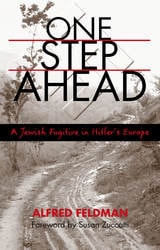
One Step Ahead
A Jewish Fugitive in Hitler's EuropeAlfred Feldman. Foreword by Susan Zuccotti
Southern Illinois University Press, 2001
Through compelling personal accounts and family correspondence, One Step Ahead documents Alfred Feldman’s harrowing flight into exile as he and his family fled the pogroms that flooded across Nazi-occupied Europe. It is a memoir of horror and hope recounted by a man who survived the organized terror of Hitler’s "Final Solution" as it destroyed entire generations of European Jewish life within ten catastrophic years in the mid-twentieth century. Feldman’s memoir conveys the searing pain that has never left him, while demonstrating the triumphant humanity of a survivor.
Feldman vividly describes the impact of the escalating anti-Semitic hatred and violence in Germany during the 1930s, the impact of the notorious Nuremberg Laws in 1935, and the terrifying Kristallnacht pogrom in 1938. By age sixteen, Feldman was living with his parents and three younger sisters in Antwerp, Belgium, during the 1939 German invasions of Poland, marking the start of World War II. In the face of increasing persecution, Feldman’s extended family scattered over the globe in a desperate attempt to remain one step ahead of their Nazi pursuers.
Recalling his life on the run, Feldman describes what few survivors have chosen to write about: the Vichy raids of August 26, 1942; the French labor brigades; the Comité Dubouchage; and life in super-vised residence in France under the Italians. While in the south of France, Feldman endured food shortages and Nazi anti-Semitic measures, beginning with work camps and culminating in the deportation and ultimate death of his mother and sisters at Auschwitz.
To evade the Germans, Feldman and his father fled into the Italian Alps in September of 1943, hiding between the Allies and the Germans. Aided by local villagers, the Feldmans survived precariously for over a year and a half, along with other Jewish refugees, until that region was liberated. Only then, and only gradually, did Feldman manage to piece together the fate of his surviving family and learn at last of the death of his mother and sisters.
Now, as an adult, Alfred Feldman has retraced his escape and exile, taking his wife and children to his hometown in Germany, the mountains in Italy, and Montagnac, where a plaque commemorates his mother and sisters.
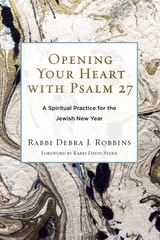
Opening Your Heart with Psalm 27
A Spiritual Practice for the Jewish New YearRabbi Debra J. Robbins
Central Conference of American Rabbis, 2019
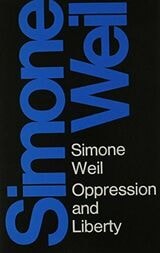
Oppression and Liberty
Simone Weil
University of Massachusetts Press, 1973
Simone Weil was an extraordinary woman whose brief life was intensely devoted to searching for answers to some of the gravest questions inherent in the human condition: the nature of justice, the reasons for human exploitation, the problem of faith. Although debate still lingers about the interpretation of her life and her writings, many contemporary scholars consider her one of the most brilliant, original minds of the twentieth century. This collection of essays by Simone Weil deals with the controversial sociopolitical issues which have confronted us since the time of the French Revolution. The first essay was written in 1932 or 1933 when she was still in her twenties. The last remained unfinished when she died in England at the age of 34, a French-Jewish refugee from Nazi-occupied France.
The essays take a long, close look at Marx and Marxism, and at socialism versus capitalism vis-à-vis labor and the working class. Weil evaluates individuals, ideologies, and institutions with reference to two kinds and uses of power: oppression, which leads ultimately to enslavement or death; and liberty, which leads to humaneness, justice, and charity.
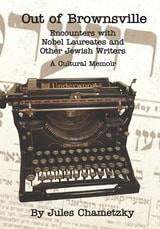
Out of Brownsville
Encounters with Nobel Laureates and Other Jewish Writers: A Cultural MemoirJules Chametzky
University of Massachusetts Press, 2012
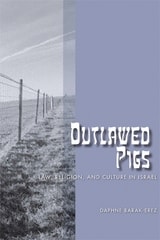
Outlawed Pigs
Law, Religion, and Culture in IsraelDaphne Barak-Erez
University of Wisconsin Press, 2007
Daphne Barak-Erez specifically traces the course of two laws, one that authorized municipalities to ban the possession and trading in pork within their jurisdiction and another law that forbids pig breeding throughout Israel, except for areas populated mainly by Christians. Her analysis offers a comprehensive, decade-by-decade discussion of the overall relationship between law and culture since the inception of the Israeli nation-state.
By examining ever-fluctuating Israeli popular opinion on Israel's two laws outlawing the trade and possession of pigs, Barak-Erez finds an interesting and accessible way to explore the complex interplay of law, religion, and culture in modern Israel, and more specifically a microcosm for the larger question of which lies more at the foundation of Israeli state law: religion or cultural tradition.