Results by title
72 books match the query 'Korea (South)' and 2 start with o
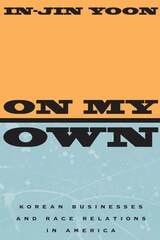
On My Own
Korean Businesses and Race Relations in AmericaIn-Jin Yoon
University of Chicago Press, 1997
The Los Angeles riots shattered Korean immigrants’ naive belief in the American dream. As many as 2,300 Korean shopkeepers lost their lifetime investments in one day. Korean immigrants had struggled for years to become economically independent through small businesses of their own. However, the riots made them realize how fragile their economic base is because their businesses are dependent on the impoverished, oppressed, and rebellious classes.
In On My Own, In-Jin Yoon combines an intimate fieldwork account of Korean-black relations in Chicago and Los Angeles with extensive quantitative analysis at the national level. Yoon argues that a complete understanding of the contemporary Korean-American community requires systematic analyses of patterns of Korean immigration, entrepreneurship, and race relations with other minority groups. He explains how small business has become the major economic activity of Korean immigrants and how Korean businesses in minority neighborhoods have intensified racial tensions between Koreans and minorities like blacks and Latinos.
“A groundbreaking study of Korean-black relations. Yoon’s insights on immigration, entrepreneurship, and race relations significantly enhance our understanding of urban racial tensions.”—William Julius Wilson, Harvard University
[more]
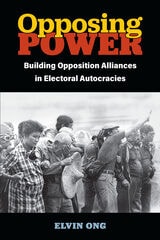
Opposing Power
Building Opposition Alliances in Electoral AutocraciesElvin Ong
University of Michigan Press, 2022
Opposing Power argues that perceptions of regime vulnerability and mutual dependency by opposition elites shape the building of opposition alliances. When electoral autocracies are consistently dominant, opposition parties eschew fully fledged alliances. At best, they allocate only one candidate to contest against the incumbent in each subnational electoral district to avoid splitting the opposition vote. However, when multiple regime-debilitating events strike within a short period of time, thus pushing an incumbent to the precipice of power, opposition elites expect victory, accepting costly compromises to build alliances and seize power. Opposing Power shows how oppositions build these alliances through case study comparisons in East and Southeast Asia—between the Philippines and South Korea in the late 1980s, and between Malaysia and Singapore from 1965 to 2020.
[more]