Results by title
527 books match the query 'Labor' and 12 start with o

Of Forests and Fields
Mexican Labor in the Pacific NorthwestMario Jimenez Sifuentez
Rutgers University Press, 2016
Just looking at the Pacific Northwest’s many verdant forests and fields, it may be hard to imagine the intense work it took to transform the region into the agricultural powerhouse it is today. Much of this labor was provided by Mexican guest workers, Tejano migrants, and undocumented immigrants, who converged on the region beginning in the mid-1940s. Of Forests and Fields tells the story of these workers, who toiled in the fields, canneries, packing sheds, and forests, turning the Pacific Northwest into one of the most productive agricultural regions in the country.

Office Politics
Computers, Labor, and the Fight for Safety and HealthMogensen, Vernon L
Rutgers University Press, 1996
The desktop computer has transformed office work. Business and social forecasters claimed that the use of video display terminals (VDTs) in the “Office of the Future” would free workers from routine tasks, giving them more time for creative work and chances for career advancement. Office Politics argues that, for many VDT workers––most of whom are nonunionized women in low-paying, dead-end jobs––exactly the opposite has been true. VDTs have been used to routinize office tasks; export work via satellite to low-wage, nonunion offshore offices; to de-skill workers and monitor their productivity. And the nature of the work has led to widespread health and safety problems, including vision, musculoskeletal (repetitive motion), and stress-related illnesses. Many have also charged that the electromagnetic fields (EMFs) emitted by computer terminals are responsible for miscarriages, for birth defects, and for promoting cancer.
As office workers sought to protect themselves against these new occupational health and safety problems, they found little help from organized labor, business, or the government. Office Politics is the first book to explain why. It shows how corporate interests successfully redefined the VDT health and safety crisis as a “comfort” problem, how the government refused to collect data on the true scope of VDT-related illnesses or to regulate Information Age industries, and how labor unions ignored women workers.
Office Politics is key reading for everyone who works at a computer. It will be of special interest to students, academics, and professionals in political science, sociology, occupational and environmental health, business, labor and management issues, women’s studies, computing, and public policy.
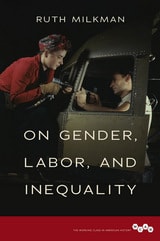
On Gender, Labor, and Inequality
Ruth Milkman
University of Illinois Press, 2016
Milkman's introduction frames a career-spanning scholarly project: her interrogation of historical and contemporary intersections of class and gender inequalities in the workplace, and the efforts to challenge those inequalities. Early chapters focus on her pioneering work on women's labor during the Great Depression and the World War II years. In the book's second half, Milkman turns to the past fifty years, a period that saw a dramatic decline in gender inequality even as growing class imbalances created greater-than-ever class disparity among women. She concludes with a previously unpublished essay comparing the impact of the Great Depression and the Great Recession on women workers.
A first-of-its-kind collection, On Gender, Labor, and Inequality is an indispensable text by one of the world's top scholars of gender, equality, and work.

On Strike for Respect
The Clerical and Technical Workers' Strike at Yale University, 1984-85Toni Gilpin, Gary Isaac, Dan Letwin, and Jack McKivigan
University of Illinois Press, 1995
It is we who type the letters, mind the office without fail.
And until we get a contract, it is we who'll shut down Yale, For the union
makes us strong.
(To the tune of "John Brown's Body")
"Must reading for anyone who wants to learn what a revitalized labor
movement would look like." -- Labor Notes
"A textbook on solidarity unionism." -- Staughton Lynd
"One of the very best books on labor in the 1970s and 80s."
-- Dana Frank, University of California at Santa Cruz
"There are very few case studies in recent labor history as readable
and provocative as this one." -- Karen Sawislak, Stanford University
On Strike for Respect is a lively account of the 1984-85 strike
by clerical and technical workers at Yale University. Members of Local
34, with a strong female majority, mobilized themselves and the public,
breathing new life into the labor movement as they fought for and won
substantial gains. A short update on current conditions concludes this
volume.
On the Edge of the Law
Culture, Labor, and Deviance on the South Texas BorderBy Chad Richardson and Rosalva Resendiz
University of Texas Press, 2006
The Valley of South Texas is a region of puzzling contradictions. Despite a booming economy fueled by free trade and rapid population growth, the Valley typically experiences high unemployment and low per capita income. The region has the highest rate of drug seizures in the United States, yet its violent crime rate is well below national and state averages. The Valley's colonias are home to the poorest residents in the nation, but their rates of home ownership and intact two-parent families are among the highest in the country for low-income residential areas. What explains these apparently irreconcilable facts?
Since 1982, faculty and students associated with the Borderlife Research Project at the University of Texas-Pan American have interviewed thousands of Valley residents to investigate and describe the cultural and social life along the South Texas-Northern Mexico border. In this book, Borderlife researchers clarify why Valley culture presents so many apparent contradictions as they delve into issues that are "on the edge of the law"—traditional health care and other cultural beliefs and practices, displaced and undocumented workers, immigration enforcement, drug smuggling, property crime, criminal justice, and school dropout rates. The researchers' findings make it plain that while these issues present major challenges for the governments of the United States and Mexico, their effects and contradictions are especially acute on the border, where residents must daily negotiate between two very different economies; health care, school, and criminal justice systems; and worldviews.
On the Job
Is Long-Term Employment a Thing of the Past?David, editor Neumark
Russell Sage Foundation, 2000

One-Eyed Science
Occupational Health and Women WorkersKaren Messing
Temple University Press, 1998
Messing investigates different types of occupational health issues for women, notably the controversial topics of male/female differences in jobs, health, and basic biology. The pain and suffering of women workers is illustrated in vivid case studies of research into health risks for women in the workplace, including musculoskeletal disease, the hazards of office work, emotional stress, and reproductive hazards.
No longer can employers, administrators, and health professionals ignore the very real problems women encounter in their jobs. Throughout the book, Messing captures the everyday reality of workplace tasks and stress -- from lifting boxes to juggling mental tasks under pressure to the emotional labor of caring for upset or abusive people -- by combining on-site observing with listening to the workers' descriptions of their work lives.
Responding to the tough question, why are scientists so unresponsive to the needs of women workers, Messing describes long-standing difficulties in gaining attention for the occupational health of women, ranging from the structure of the grant process and the conferences crucial to the professional life of researchers to the basic assumptions of scientific practice. Messing laments the separation of even most feminist health researchers from workplace concerns and asserts that it is time to develop a science that can prevent women workers' pain and suffering.

Organized Labour and Politics in Mexico
Changes, Continuities and ContradictionsGraciela Bensusan and Kevin J. Middlebrook
University of London Press, 2012
This state of affairs - especially the failure to enact progressive labor law reform since democratic regime change in 2000 - limits democracy and imposes heavy costs on society as a whole.
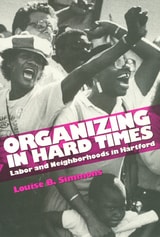
Organizing In Hard Times
Labor and Neighborhoods In HartfordLouise B. Simmons
Temple University Press, 1994
In 1990, Hartford, Connecticut, ranked as the eight poorest city in the country by the census; the real estate market was severely depressed; downtown insurance companies were laying off and the retail department stores were closing; public services were strained; and demolition sites abandoned for lack of funds pockmarked the streets. Hartford's problems are typical of those experienced in numerous U.S. cities affected by a lingering recession.
The harsh economic times felt throughout the city's workplaces and neighborhoods precipitated the formation of grassroots alliances between labor and community organizations. Coming together to create new techniques, their work has national implications for the development of alternative strategies for stimulating economic recovery.
Louise B. Simmons, a former Hartford City Councilperson, offers an insider's view of these coalitions, focusing on three activist unions—rhe New England Health Care Employees Union, the Hotel and Restaurant Employees, and the United Auto Workers—and three community groups—Hartford Areas Rally Together, Organized North Easterners-Clay Hill and North End, and Asylum Hill Organizing Project. Her in-depth analysis illustrates these groups' successes and difficulties in working together toward a new vision of urban politics.
In the series Labor and Social Change, edited by Paula Rayman and Carmen Sirianni.
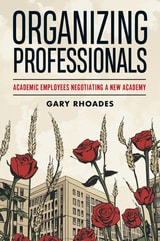
Organizing Professionals
Academic Employees Negotiating a New AcademyGary Rhoades
Rutgers University Press, 2025

Out Front
Lesbians, Gays, and the Struggle for Workplace Rights, Volume 17Patrick McCreery and Kitty Krupat, eds.
Duke University Press, 0
In their examinations of worker and gay rights, the scholars, artists, and activists who speak in this volume argue that neither the labor movement nor the gay rights movement will make substantial progress without a deeper understanding of the connections between identity politics and class. Included is a major policy statement by AFL-CIO president John J. Sweeney. Four other labor leaders—Bill Fletcher Jr., Yvette Hererra, Gloria Johnson, and Van Allen Sheets—discuss homophobia as “labor’s new frontier.” Nikhil Pal Singh’s conversation with lesbian activist Amber Hollibaugh and a virtuoso piece by filmmaker Tami Gold offer incisive personal histories and commentaries, which Cathy J. Cohen takes the mainstream gay and lesbian movement to task for not adequately or consistently focusing on issues of class.
Contributors. Cathy J. Cohen, Bill Fletcher Jr., Tami Gold, Yvette Herrera, Amber Hollibaugh, Gloria Johnson, Kitty Krupat, Patrick McCreery, Van Allen Sheets, Nikhal Pal Singh, John J. Sweeney

Out of Sync & Out of Work
History and the Obsolescence of Labor in Contemporary CultureBurges, Joel
Rutgers University Press, 2018