Results by title
128 books match the query 'Language and languages' and 7 start with o
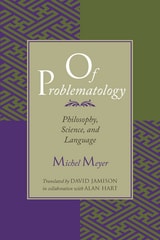
Of Problematology
Philosophy, Science, and LanguageMichel Meyer
University of Chicago Press, 1995
For Meyer, philosophy does not solve problems or give answers but instead shows how propositions are related to a whole field of questions that give them meaning. Reason is identified not with answers but with the question-answer process. Meyer pursues this new theory of reason and meaning in a critique of Western philosophy from Socrates, Plato, and Aristotle through Heidegger, Wittgenstein, and Foucault. He provides a detailed analysis of Descartes' notion of radical doubt and demonstrates its implications for the subsequent philosophical tradition that ignored the questioning process while pursuing an unshakable foundation for knowledge. Meyer argues that recent work in rhetoric points toward a theory of radical questioning and claims that the methods of rhetoric and argumentation must be turned back on philosophy itself in order to recover the original significance of metaphysics as the science of ultimate questions.
On Heidegger and Language
Edited and Translated by Joseph J. Kockelmans
Northwestern University Press, 1980

On What We Know We Don't Know
Explanation, Theory, Linguistics, and How Questions Shape ThemSylvain Bromberger
University of Chicago Press, 1992
On the Origin of Language
Jean-Jacques Rousseau and Johann Gottfried Herder
University of Chicago Press, 1986
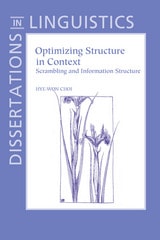
Optimizing Structure in Context
Scrambling and Information StructureHye-Won Choi
CSLI, 1999
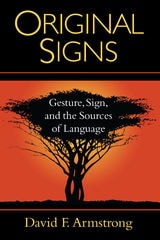
Original Signs
Gesture, Sign, and the Sources of LanguageDavid F. Armstrong
Gallaudet University Press, 2002
In the ongoing debate about evolution, scholars frequently argue either the perspective that humans stand as the end product of a deliberate process or that they derive from a series of random acts of natural selection. David F. Armstrong’s new book Original Signs embraces the Darwinian concept of natural selection and extends it to apply to the formation of language. While most current linguistic theory envisions language as a system for translating the contents of the mind into linear strings of arbitrary symbols, Armstrong asserts that this model does not characterize signed languages. He shows that language is inherently a multichannel activity, of which the two primary channels are auditory and visual.
Original Signs employs a more expansive notion of language that takes into account the full range of human communicative behavior. By making no strict separation between language and gesture, this thought-provoking work reveals that the use by deaf people of signs to create a fully formed language is also a natural facet of communication development for hearing people.
Armstrong explores the influences of Plato and Descartes on modern linguistics, and delineates the theories of earlier anthropological linguists Edward Sapir and Benjamin Lee Whorf, who thought of language as natural experiments connected to individual cultures. This exceptional work of scholarship methodically demonstrates that the intricacies of how languages develop, whether they depend upon words or signs, and that the complexity among languages that contact one another cannot be accounted for by the sequential hierarchical processes previously put forth by linguists and logicians. Original Signs will prove to be a fascinating, watershed work invaluable to linguists, anthropologists, and all other scholars and students engaged in the search for the origin of language.
Out of Style
Reanimating Stylistic Study in Composition and RhetoricPaul G. Butler
Utah State University Press, 2008
Scholars in composition know that the ideas about writing most common in the discourse of public intellectuals are egregiously backward. Without a vital approach to stylistics, Butler argues, writing studies will never dislodge the controlling fantasies of self-authorized pundits in the nation’s intellectual press. Rhetoric and composition must answer with a public discourse that is responsive to readers’ ongoing interest in style but is also grounded in composition theory.