Results by title
124 books match the query 'Learning' and 4 start with o
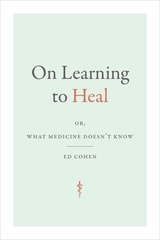
On Learning to Heal
or, What Medicine Doesn't KnowEd Cohen
Duke University Press, 2023
At thirteen, Ed Cohen was diagnosed with Crohn’s disease—a chronic, incurable condition that nearly killed him in his early twenties. At his diagnosis, his doctors told him that the best he could hope for would be periods of remission. Unfortunately, doctors never mentioned healing as a possibility. In On Learning to Heal, Cohen draws on fifty years of living with Crohn’s to consider how Western medicine’s turn from an “art of healing” toward a “science of medicine” deeply affects both medical practitioners and their patients. He demonstrates that although medicine can now offer many seemingly miraculous therapies, medicine is not and has never been the only way to enhance healing. Exploring his own path to healing, he argues that learning to heal requires us to desire and value healing as a vital possibility. With this book, Cohen advocates reviving healing’s role for all those whose lives are touched by illness.
[more]
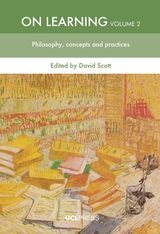
On Learning, Volume 2
Philosophies, Concepts and PracticesEdited by David Scott
University College London, 2024
An original and provocative interpretation of learning as a concept and as a practice.
The contributors to this volume focus on two meta-concepts: knowledge and learning, on the relationship between the two, and the way these can be framed in epistemic, social, political, and economic terms. Knowledge and learning, as meta-concepts, are positioned in various networks or constellations of meaning, principally: their antecedents, their relations to other relevant concepts, and the way the concepts are used in the lifeworld.
The various authors in this book explore several important concepts that are relevant to the idea of learning: Meta-concepts such as epistemology, inferential role semantics, phenomenology, rationality, thinking, hermeneutics, critical realism, and pragmatism. Meso-concepts such as probability, woman, training, assessment, education, system, race, friendship, Bildung, curriculum, ecology and pedagogy. Like David Scott’s first volume of On Learning, this collection also focuses on philosophy, concepts, and practices as a response to empiricist and positivist conceptions of knowledge. It challenges reductionist ideas of learning that have filtered through to the management of our schools, colleges, and universities; confronts over-simplified messages about learning, knowledge, curriculum, and assessment; and fosters the denial that values are central to understanding how we live and how we should live, the normative dimension to social policy and social theory.
[more]
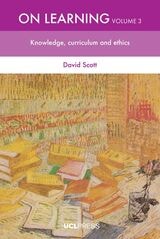
On Learning, Volume 3
Knowledge, Curriculum and EthicsDavid Scott
University College London, 2025
Moving beyond test scores and outcomes, this volume redefines what it means to learn by intertwining ideas from philosophy, mathematics, and social theory.
What does it mean to learn? In On Learning, Volume 3: Knowledge, Curriculum and Ethics, David Scott probes the intricate relationship between knowledge and learning, questioning reductionist and empiricist perspectives that dominate contemporary education. This volume, like the first two in the series, critically analyzes the philosophical and ethical dimensions of learning, pushing beyond simplified notions of curriculum and assessment. Scott ties in a range of key concepts, including epistemology and critical realism, to offer a profound rethinking of what it means to know and engage with the world.
At the heart of this book is a call to recognize that learning is not merely a mechanical process or a set of measurable outcomes but a deeply human and ethical endeavor. On Learning, Volume 3 urges readers to reconsider the structures that shape education today and invites us to rethink how we understand knowledge and learning, and the values that underpin them.
[more]
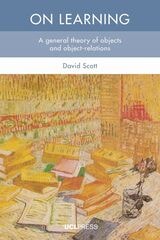
On Learning
A General Theory of Objects and Object-RelationsDavid Scott
University College London, 2021
A philosophical work that tackles the question, “What is learning?”.
What is learning? This book is a philosophical work that develops a general theory of ontological objects and object-relations, examining concepts as acquired dispositions. David Scott answers a series of questions about concepts in general and the concept of learning in particular. This volume offers a counterargument to empiricist conceptions of learning, rejecting the propagation of simple messages about learning, knowledge, curriculum, and assessment. Instead, Scott argues that values are central to understanding how we live, permeating our descriptions of the world, the attempts we make at creating better futures, and our relations with other people.
What is learning? This book is a philosophical work that develops a general theory of ontological objects and object-relations, examining concepts as acquired dispositions. David Scott answers a series of questions about concepts in general and the concept of learning in particular. This volume offers a counterargument to empiricist conceptions of learning, rejecting the propagation of simple messages about learning, knowledge, curriculum, and assessment. Instead, Scott argues that values are central to understanding how we live, permeating our descriptions of the world, the attempts we make at creating better futures, and our relations with other people.
[more]